Max Planck Institute for Biophysical Chemistry, Department of Molecular Biology, Göttingen, Germany.
Max Planck Institute for Biophysical Chemistry, Bioanalytical Mass Spectrometry, Göttingen, Germany.
Nature. 2020 Mar;579(7799):448-451. doi: 10.1038/s41586-020-2088-0. Epub 2020 Mar 11.
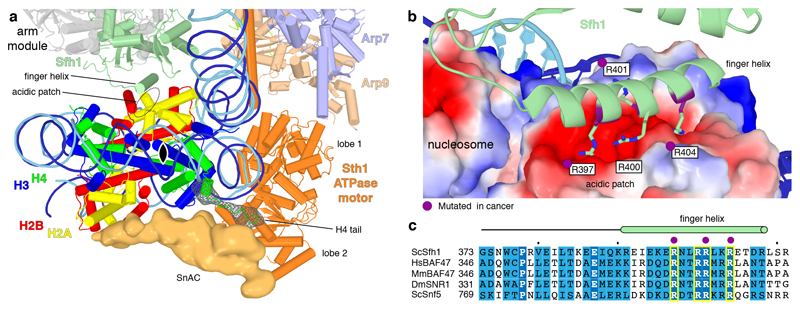
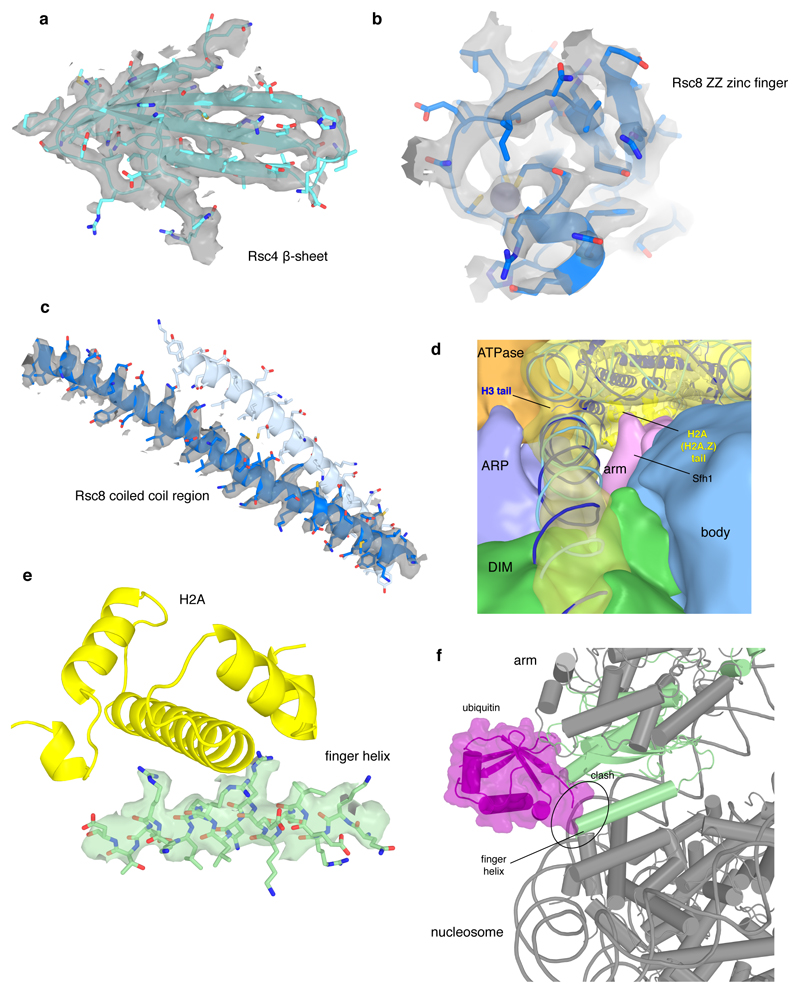
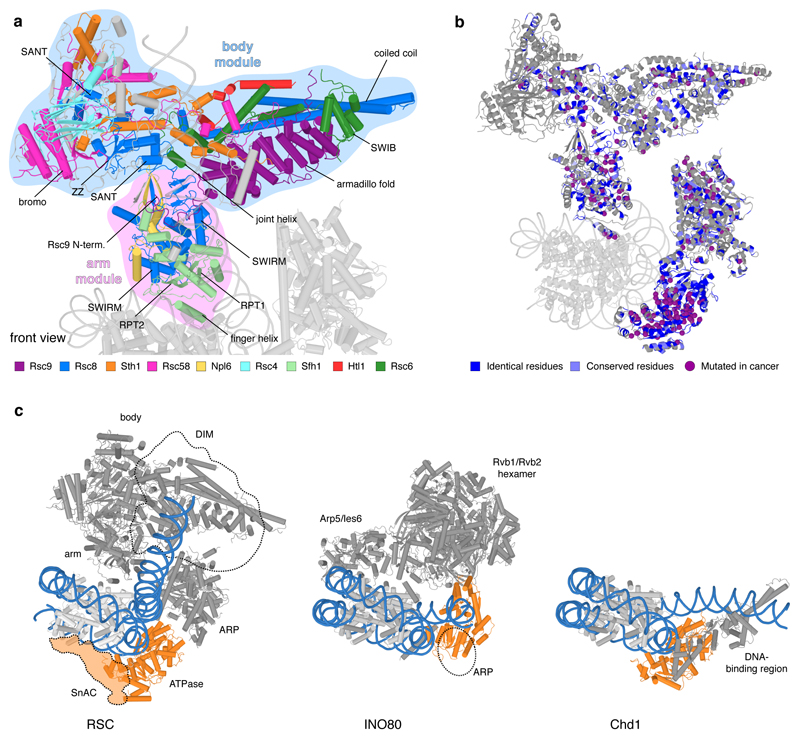
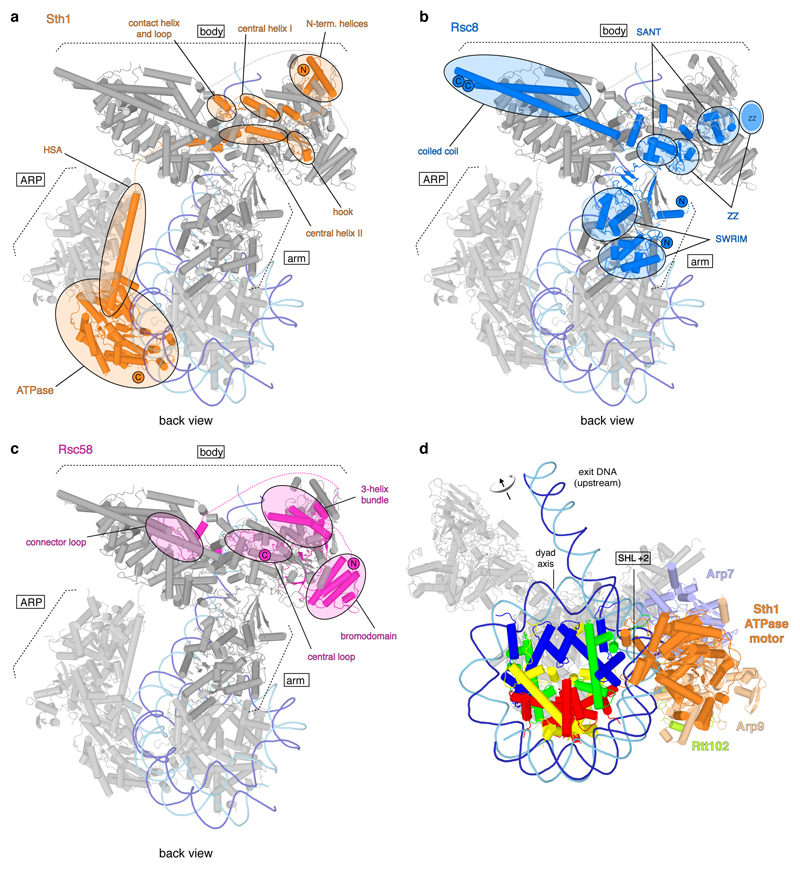
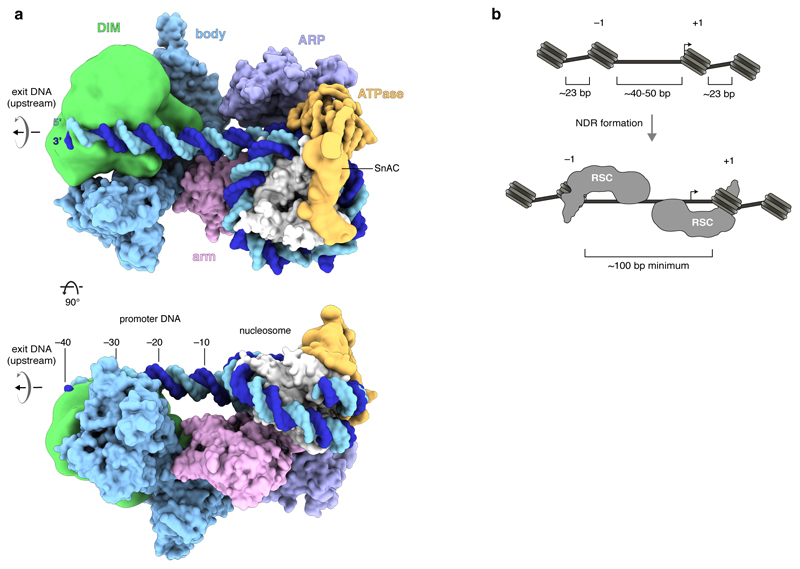
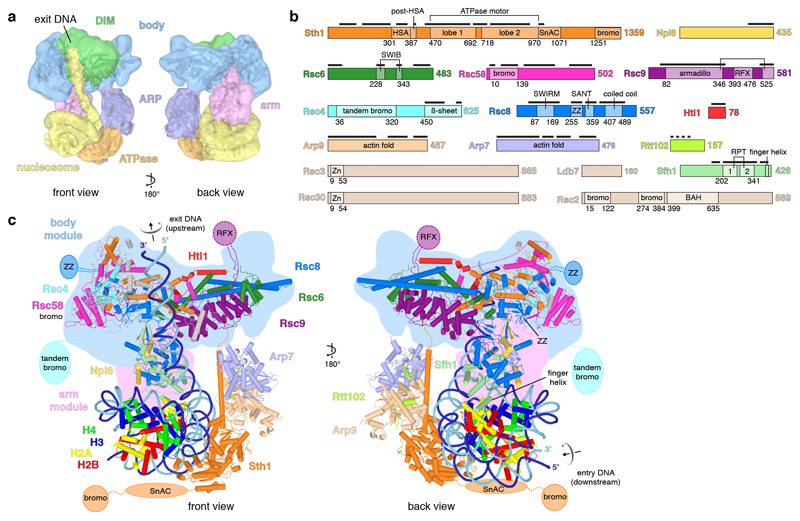
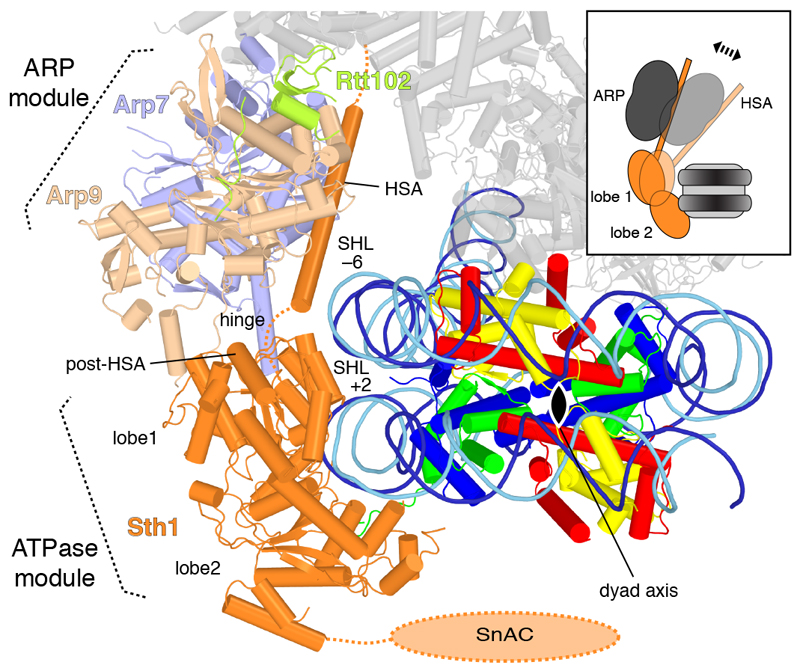
Chromatin-remodelling complexes of the SWI/SNF family function in the formation of nucleosome-depleted, transcriptionally active promoter regions (NDRs). In the yeast Saccharomyces cerevisiae, the essential SWI/SNF complex RSC contains 16 subunits, including the ATP-dependent DNA translocase Sth1. RSC removes nucleosomes from promoter regions and positions the specialized +1 and -1 nucleosomes that flank NDRs. Here we present the cryo-electron microscopy structure of RSC in complex with a nucleosome substrate. The structure reveals that RSC forms five protein modules and suggests key features of the remodelling mechanism. The body module serves as a scaffold for the four flexible modules that we call DNA-interacting, ATPase, arm and actin-related protein (ARP) modules. The DNA-interacting module binds extra-nucleosomal DNA and is involved in the recognition of promoter DNA elements that influence RSC functionality. The ATPase and arm modules sandwich the nucleosome disc with the Snf2 ATP-coupling (SnAC) domain and the finger helix, respectively. The translocase motor of the ATPase module engages with the edge of the nucleosome at superhelical location +2. The mobile ARP module may modulate translocase-nucleosome interactions to regulate RSC activity. The RSC-nucleosome structure provides a basis for understanding NDR formation and the structure and function of human SWI/SNF complexes that are frequently mutated in cancer.
染色质重塑复合物 SWI/SNF 家族在形成核小体缺失、转录活跃的启动子区域 (NDR) 中发挥作用。在酵母酿酒酵母中,必需的 SWI/SNF 复合物 RSC 包含 16 个亚基,包括 ATP 依赖性 DNA 转位酶 Sth1。RSC 从启动子区域去除核小体,并定位侧翼 NDR 的特殊 +1 和 -1 核小体。在这里,我们展示了 RSC 与核小体底物复合物的低温电子显微镜结构。该结构揭示了 RSC 形成五个蛋白质模块,并提出了重塑机制的关键特征。主体模块作为我们称为 DNA 相互作用、ATP 酶、臂和肌动蛋白相关蛋白 (ARP) 模块的四个柔性模块的支架。DNA 相互作用模块结合额外核小体 DNA,并参与识别影响 RSC 功能的启动子 DNA 元件。ATP 酶和臂模块分别用 Snf2 ATP 偶联 (SnAC) 结构域和指螺旋夹在核小体盘上。ATP 酶模块的转位酶马达与核小体的超螺旋位置 +2 边缘接合。可移动的 ARP 模块可能调节转位酶-核小体相互作用以调节 RSC 活性。RSC-核小体结构为理解 NDR 形成以及在癌症中经常发生突变的人类 SWI/SNF 复合物的结构和功能提供了基础。