Zhang Daiyan, Zhang Yun, Gao Yan, Chai Xingyun, Pi Rongbiao, Chan Ging, Hu Yuanjia
1State Key Laboratory of Quality Research in Chinese Medicine, Institute of Chinese Medical Sciences, University of Macau, Macau, China.
2Modern Research Center for Traditional Chinese Medicine, School of Chinese Materia Medica, Beijing University of Chinese Medicine, Beijing, 100029 China.
Chin Med. 2020 Mar 16;15:25. doi: 10.1186/s13020-020-00302-4. eCollection 2020.
Traditional Chinese medicine (TCM) encompasses numerous herbal formulas which play critical therapeutic roles through "multi-components, multi-targets and multi-pathways" mechanisms. Exploring the interaction among these mechanisms can certainly help to depict the core therapeutic function of herbal formulas. Xiaoyao decoction (XYD) is one of the most well-known traditional Chinese medicine formulas which has been widely applied to treat various diseases. In this study, taking XYD as an example, we proposed a network pharmacology-based method to identify the main therapeutic targets of this herbal concoctions.
Chemical data of XYD were retrieved from the Traditional Chinese Medicine Systems Pharmacology Database (TCMSP), Traditional Chinese Medicines Integrated Database (TCMID) and Compound Reference Database (CRD) and screened oral bioavailability attributes from SwissADME using Veber's filter. Targets of sample chemicals were identified using the online tool similarity ensemble approach (SEA), and pathways were enriched using STRING database. On the basis of targets-pathways interactions from the enrichment, a "targets-pathways-targets" (TPT) network was constructed. In the TPT network, the importance of each target was calculated by the declining value of network efficiency, which represents the influential strength of a specific set-off target on the whole network. Network-based predictive results were statistically validated with existing experimental evidence.
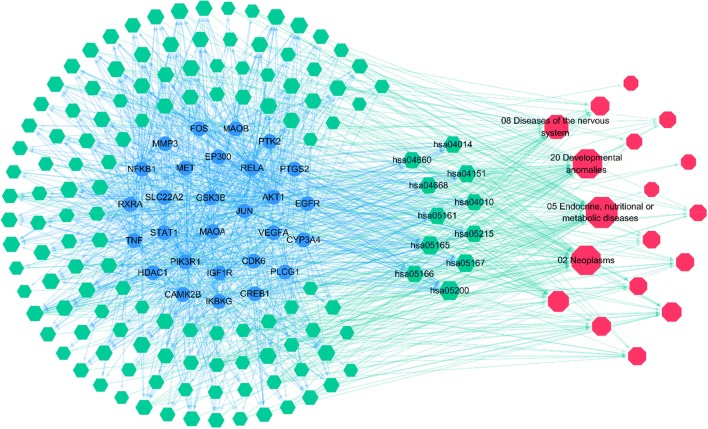
The TPT network was comprised of 279 nodes and 6549 edges. The declining value of network efficiency of the sample targets was significantly correlated with their involvement frequency in existing studies of XYD using Spearman's test ( < 0.001). The top 10% of candidate targets, such as AKT1, PIK3R1, NFKB1 and RELA, etc., were chosen as XYD's main therapeutic targets, which further show pharmacological functions synergistically through 11 main pathways. These pathways are responsible for endocrine, nutritional or metabolic diseases, neoplasms and diseases of the nervous system, etc.
The network pharmacology-based approach in the present study shows promising potential for identifying the main therapeutic targets from TCM formulas. This study provides valuable information for TCM researchers and clinicians for better understanding the main therapeutic targets and therapeutic roles of herbal decoctions in clinical settings.
中药包含众多草药配方,通过“多成分、多靶点和多途径”机制发挥关键治疗作用。探索这些机制之间的相互作用无疑有助于描绘草药配方的核心治疗功能。逍遥散(XYD)是最著名的中药配方之一,已被广泛应用于治疗各种疾病。在本研究中,以逍遥散为例,我们提出了一种基于网络药理学的方法来确定这种草药制剂的主要治疗靶点。
从中药系统药理学数据库(TCMSP)、中药综合数据库(TCMID)和化合物参考数据库(CRD)中检索逍遥散的化学数据,并使用Veber过滤器从SwissADME中筛选口服生物利用度属性。使用在线工具相似性集成方法(SEA)确定样本化学物质的靶点,并使用STRING数据库对途径进行富集。基于富集后的靶点-途径相互作用,构建了一个“靶点-途径-靶点”(TPT)网络。在TPT网络中,每个靶点的重要性通过网络效率的下降值来计算,该值代表特定起始靶点对整个网络的影响强度。基于网络的预测结果用现有的实验证据进行统计学验证。
TPT网络由279个节点和6549条边组成。使用Spearman检验(<0.001),样本靶点的网络效率下降值与其在逍遥散现有研究中的参与频率显著相关。前10%的候选靶点,如AKT1、PIK3R1、NFKB1和RELA等,被选为逍遥散的主要治疗靶点,它们通过11条主要途径进一步协同发挥药理作用。这些途径与内分泌、营养或代谢疾病、肿瘤和神经系统疾病等有关。
本研究中基于网络药理学的方法在从中药配方中识别主要治疗靶点方面显示出有前景的潜力。本研究为中药研究人员和临床医生更好地理解草药汤剂在临床环境中的主要治疗靶点和治疗作用提供了有价值的信息。