Tian Na, Sun Weize, Feng Yang, Guo Xusheng, Lu Jian, Li Chao, Hou Yuanjun, Wang Xuesong, Zhou Qianxiong
Key Laboratory of Photochemical Conversion and Optoelectronic Materials , Technical Institute of Physics and Chemistry , Chinese Academy of Sciences , Beijing 100190 , P. R. China . Email:
University of Chinese Academy of Sciences , Beijing 100049 , P. R. China.
Chem Sci. 2019 Oct 24;10(43):9949-9953. doi: 10.1039/c9sc03957k. eCollection 2019 Nov 21.
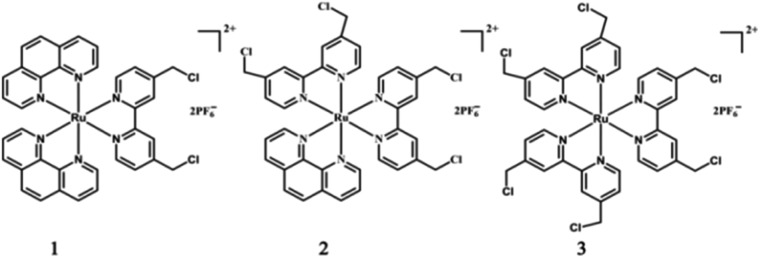
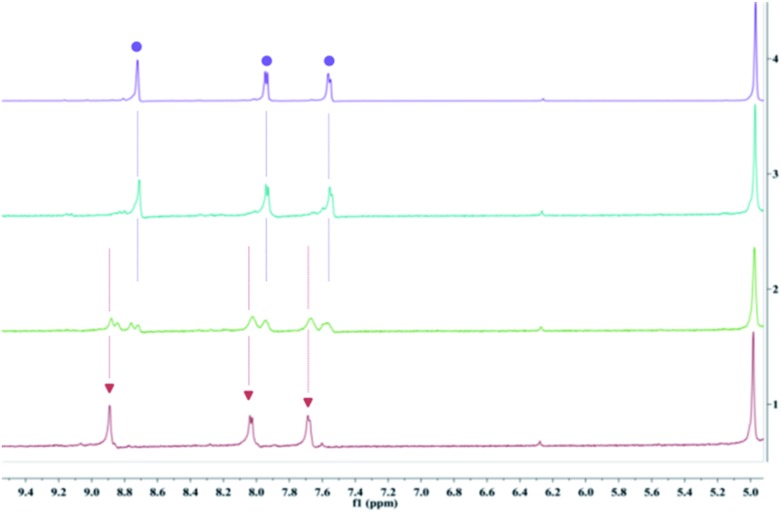
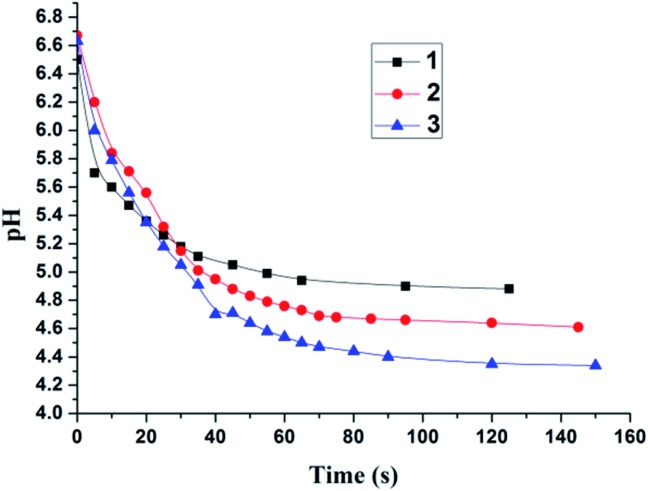
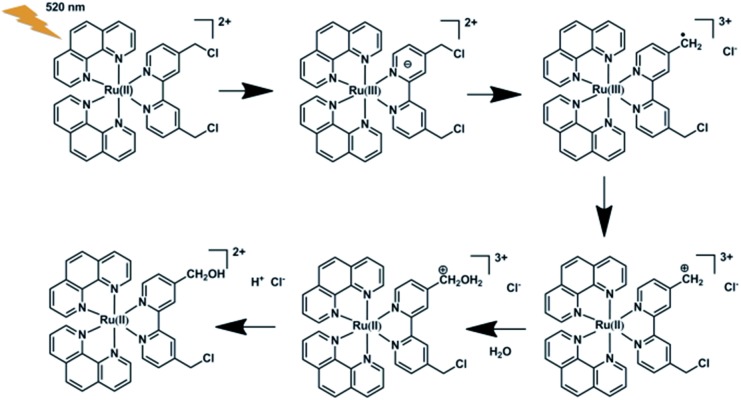
Photoacid generators (PAGs) are finding increasing applications in spatial and temporal modulation of biological events and . In these applications, large pH jumps at low PAG concentrations are of great importance to achieve maximal expected manipulation but minimal unwanted interference. To this end, both high photoacid quantum yield and capacity are essential, where the capacity refers to the proton number that a PAG molecule can release. Up to now, most PAGs only produce one proton for each molecule. In this work, the hydrolysis reaction of benzyl chlorides was successfully leveraged to develop a novel type of PAG. Upon visible light irradiation, Ru(ii) polypyridyl complexes modified with chloromethyl groups can undergo full hydrolysis with photoacid quantum yield as high as 0.6. Depending on the number of the chloromethyl groups, the examined Ru(ii) complexes can release multiple protons per molecule, leading to large pH jumps at very low PAG concentrations, a feature particularly favorable for bio-related applications.
光产酸剂(PAGs)在生物事件的空间和时间调制中得到越来越多的应用。在这些应用中,低PAG浓度下的大幅pH跃变对于实现最大预期操作但最小化不必要的干扰非常重要。为此,高光产酸量子产率和容量都至关重要,其中容量是指一个PAG分子可以释放的质子数。到目前为止,大多数PAGs每个分子仅产生一个质子。在这项工作中,成功利用苄基氯的水解反应开发了一种新型的PAG。在可见光照射下,用氯甲基修饰的钌(II)多吡啶配合物可以发生完全水解,光产酸量子产率高达0.6。根据氯甲基的数量,所研究的钌(II)配合物每个分子可以释放多个质子,从而在非常低的PAG浓度下导致大幅pH跃变,这一特性特别有利于生物相关应用。