Department of Economics, Stockholm School of Economics, Stockholm, Sweden.
Research Institute for Industrial Economics, Stockholm, Sweden.
JAMA Netw Open. 2020 Mar 2;3(3):e1919713. doi: 10.1001/jamanetworkopen.2019.19713.
Poor health and unhealthy lifestyles are substantially more prevalent among individuals with low income than among individuals with high income, but the underlying mechanisms are not well understood.
To evaluate whether changes to unearned wealth from lotteries are associated with long-term health behaviors and overall health.
DESIGN, SETTING, AND PARTICIPANTS: In this quasi-experimental cohort study, 4820 participants (aged 18-70 years at the time of winning) in 3 Swedish lotteries were surveyed from September 1, 2016, to November 11, 2016, between 5 and 22 years after a lottery event. Outcomes of participants in the same lottery who were randomly assigned prizes of different magnitudes by the lotteries but were ex ante identical in terms of their probability of winning different prizes were compared. Data were analyzed from December 22, 2016, to November 21, 2019.
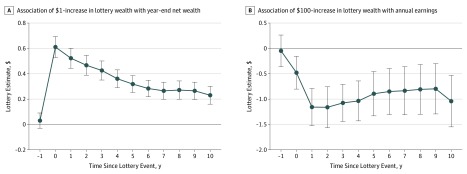
Lottery prizes ranged from $0 for nonwinning players to $1.6 million.
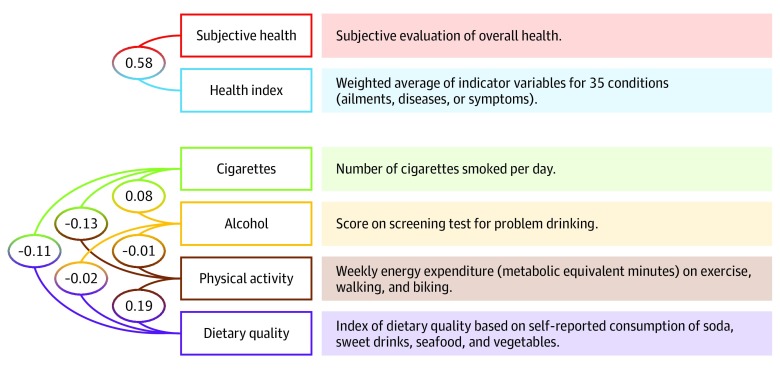
Four lifestyle factors (smoking, alcohol consumption, physical activity, and a healthy diet index) and 2 measures of overall health (subjective health and an index of total health derived from responses to questions about 35 health conditions).
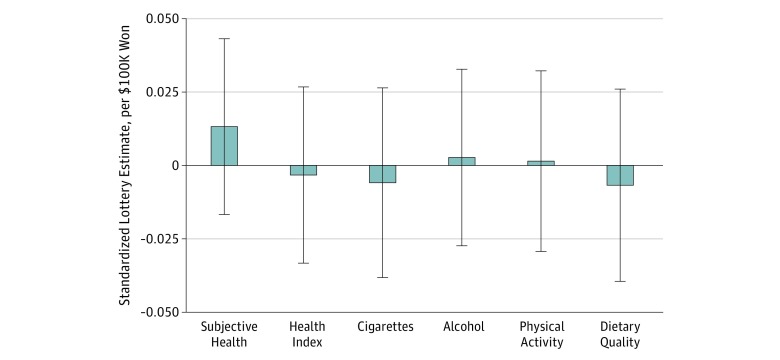
The survey was returned by 3344 of 4820 individuals (69%; 1722 [51.5%] male), which corresponded to 3362 observations. The mean (SD) age was 48 (11.8) years in the year of the lottery win and 60 (11.0) years at the time of the survey. There were no statistically significant associations between prize amount won and any of the 6 long-term health outcomes. Estimated associations expressed in SD units per $100 000 won were as follows: smoking (-0.006, 95% CI, -0.038 to 0.026); alcohol consumption (0.003, 95% CI, -0.027 to 0.033); physical activity (0.001, 95% CI, -0.029 to 0.032); dietary quality (-0.007, 95% CI, -0.040 to 0.026); subjective health (0.013, 95% CI, -0.017 to 0.043); and index of total health (-0.003, 95% CI, -0.033 to 0.027).
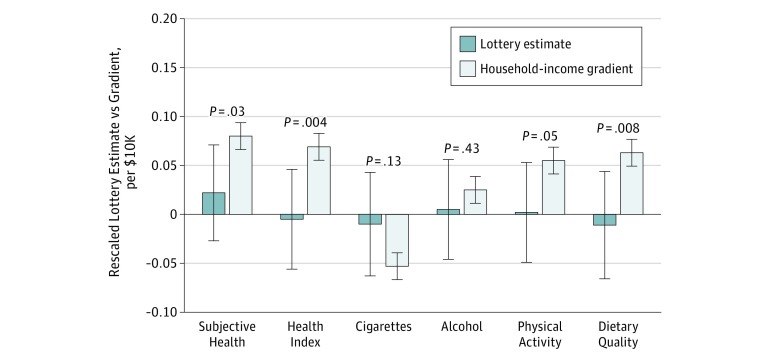
In this study of Swedish lottery players, unearned wealth from random lottery prize winnings was not associated with subsequent healthy lifestyle factors or overall health. The findings suggest that large, random transfers of unearned wealth are unlikely to be associated with large, long-term changes in health habits or overall health.
与高收入人群相比,低收入人群的健康状况和不健康的生活方式更为普遍,但其中的潜在机制尚不清楚。
评估彩票带来的非劳动财富的变化是否与长期健康行为和整体健康有关。
设计、地点和参与者:在这项准实验性队列研究中,共有 4820 名参与者(在赢得彩票时年龄在 18-70 岁之间)参与,他们来自瑞典的 3 场彩票活动,在赢得彩票后的 5 到 22 年内,于 2016 年 9 月 1 日至 11 月 11 日期间接受调查。彩票将参与者随机分配不同金额的奖品,但在赢得不同奖品的概率方面,参与者在赢得彩票之前是完全相同的。从 2016 年 12 月 22 日至 2019 年 11 月 21 日对数据进行分析。
彩票奖金从非中奖者的 0 美元到 160 万美元不等。
4 个生活方式因素(吸烟、饮酒、身体活动和健康饮食指数)和 2 个整体健康指标(主观健康和由 35 种健康状况问题的回答得出的总健康指数)。
共有 4820 名参与者中的 3344 名(69%;1722 名[51.5%]为男性)完成了调查,相当于 3362 次观察。中奖时的平均(SD)年龄为 48(11.8)岁,调查时的平均年龄为 60(11.0)岁。赢得的奖金数额与任何 6 项长期健康结果之间均无统计学显著关联。以每 10 万美元赢得的 SD 单位表示的估计关联如下:吸烟(-0.006,95%CI,-0.038 至 0.026);饮酒(0.003,95%CI,-0.027 至 0.033);身体活动(0.001,95%CI,-0.029 至 0.032);饮食质量(-0.007,95%CI,-0.040 至 0.026);主观健康(0.013,95%CI,-0.017 至 0.043);以及总健康指数(-0.003,95%CI,-0.033 至 0.027)。
在这项对瑞典彩票玩家的研究中,彩票随机奖金带来的非劳动财富与随后的健康生活方式因素或整体健康状况无关。研究结果表明,大量随机的非劳动财富转移不太可能与健康习惯或整体健康的长期显著变化相关。