Department of Biomedical Sciences, BK21 PLUS program, College of Medicine, Korea University Guro Hospital, Seoul 08308, Korea.
Medical Science Research Center, College of Medicine, Korea University Guro Hospital, Seoul 08308, Korea.
Viruses. 2020 Mar 17;12(3):325. doi: 10.3390/v12030325.
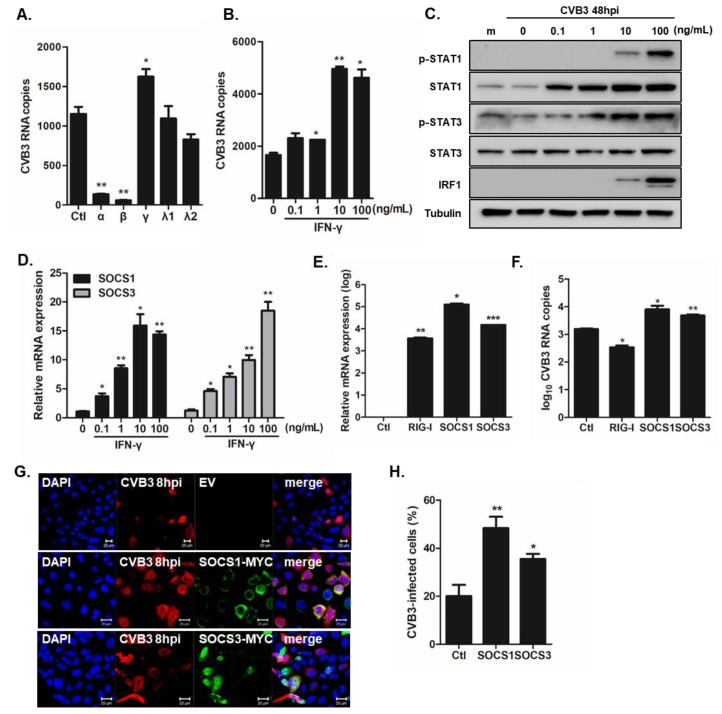
Coxsackievirus B3 (CVB3), a member of family, is an important human pathogen that causes a wide range of diseases, including myocarditis, pancreatitis, and meningitis. Although CVB3 has been well demonstrated to target murine neural progenitor cells (NPCs), gene expression profiles of CVB3-infected human NPCs (hNPCs) has not been fully explored. To characterize the molecular signatures and complexity of CVB3-mediated host cellular responses in hNPCs, we performed QuantSeq 3' mRNA sequencing. Increased expression levels of viral RNA sensors (, ) and interferon-stimulated genes, such as , , , , , , were detected in response to CVB3 infection, while expression level was significantly downregulated in hNPCs. Consistent with the gene expression profile, CVB3 infection led to enhanced secretion of inflammatory cytokines and chemokines, such as interleukin-6 (IL-6), interleukin-8 (IL-8), and monocyte chemoattractant protein-1 (MCP-1). Furthermore, we show that type I interferon (IFN) treatment in hNPCs leads to significant attenuation of CVB3 RNA copy numbers, whereas, type II IFN (IFN-γ) treatment enhances CVB3 replication and upregulates suppressor of cytokine signaling 1/3 (SOCS) expression levels. Taken together, our results demonstrate the distinct molecular patterns of cellular responses to CVB3 infection in hNPCs and the pro-viral function of IFN-γ via the modulation of SOCS expression.
柯萨奇病毒 B3(CVB3)属于小核糖核酸病毒科,是一种重要的人类病原体,可引起多种疾病,包括心肌炎、胰腺炎和脑膜炎。尽管 CVB3 已被证实可靶向鼠神经祖细胞(NPC),但 CVB3 感染人 NPC(hNPC)的基因表达谱尚未得到充分探索。为了描绘 CVB3 在 hNPC 中介导的宿主细胞反应的分子特征和复杂性,我们进行了 QuantSeq 3' mRNA 测序。CVB3 感染后,检测到病毒 RNA 传感器(、)和干扰素刺激基因(如、、、、、、)的表达水平增加,而 hNPC 中的 表达水平显著下调。与基因表达谱一致,CVB3 感染导致炎症细胞因子和趋化因子(如白细胞介素 6(IL-6)、白细胞介素 8(IL-8)和单核细胞趋化蛋白 1(MCP-1))的分泌增强。此外,我们表明,hNPC 中的 I 型干扰素(IFN)处理可显著降低 CVB3 RNA 拷贝数,而 II 型 IFN(IFN-γ)处理可增强 CVB3 复制并上调细胞因子信号转导抑制因子 1/3(SOCS)的表达水平。总之,我们的结果表明 hNPC 对 CVB3 感染的细胞反应具有独特的分子模式,以及 IFN-γ 通过调节 SOCS 表达的促病毒功能。