Li Qiuli, Chen Weichao, Luo Rongzhen, Zhang Zhiyi, Song Ming, Chen Wenkuan, Yang Zhongyuan, Yang Yuanzhong, Guo Zhuming, Yang Ankui
Department of Head and Neck Surgery, Sun Yat-sen University Cancer Center, State Key Laboratory of Oncology in South China, Collaborative Innovation Center for Cancer Medicine, Guangzhou 510060, China.
Department of Pathology, Sun Yat-sen University Cancer Center, State Key Laboratory of Oncology in South China, Collaborative Innovation Center for Cancer Medicine, Guangzhou 510060, China.
Mol Ther Nucleic Acids. 2020 Jun 5;20:279-291. doi: 10.1016/j.omtn.2019.11.036. Epub 2020 Jan 11.
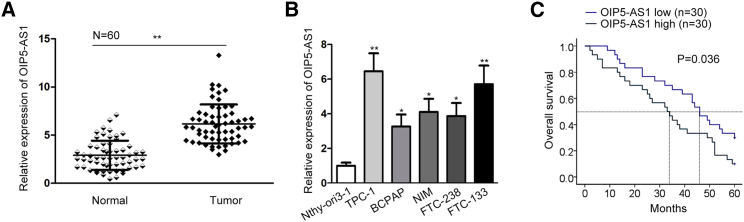
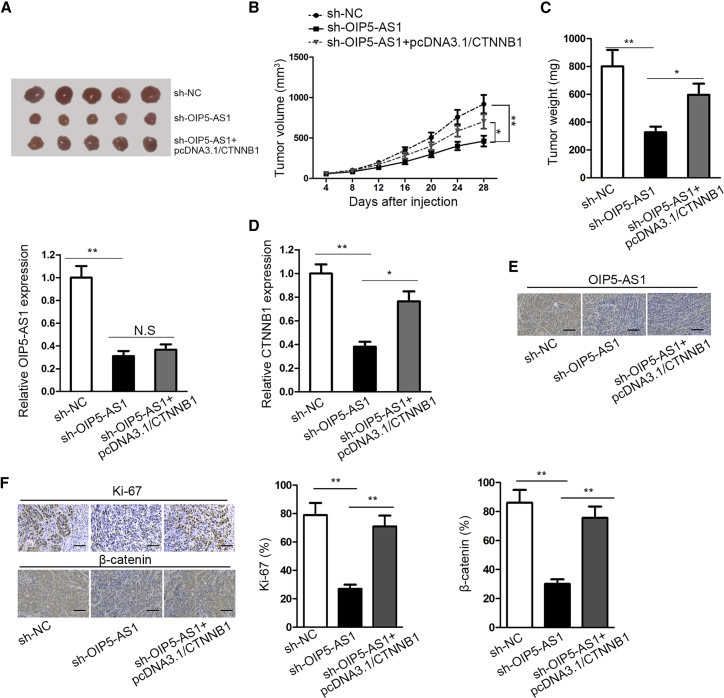
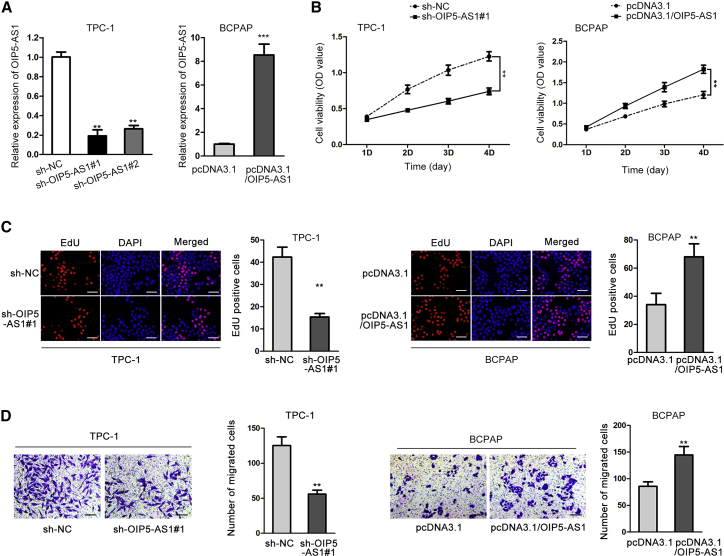
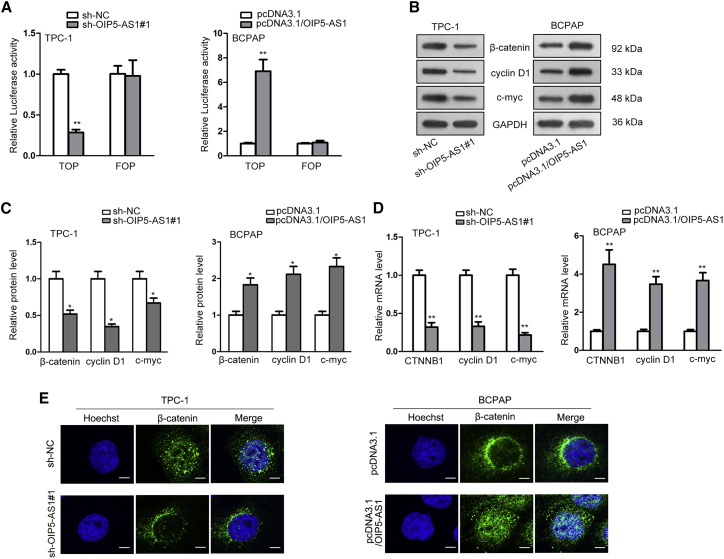
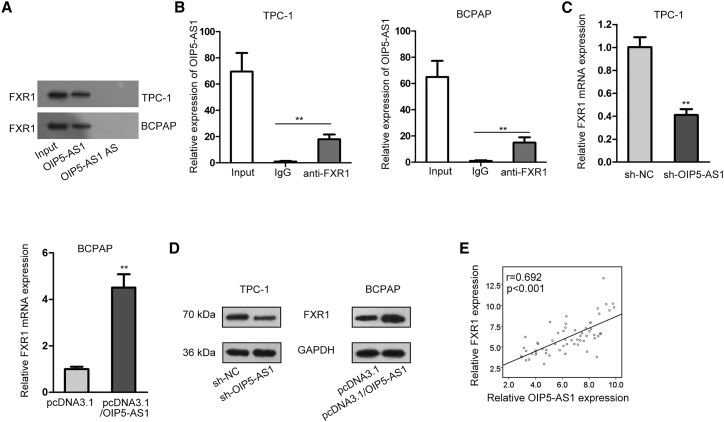
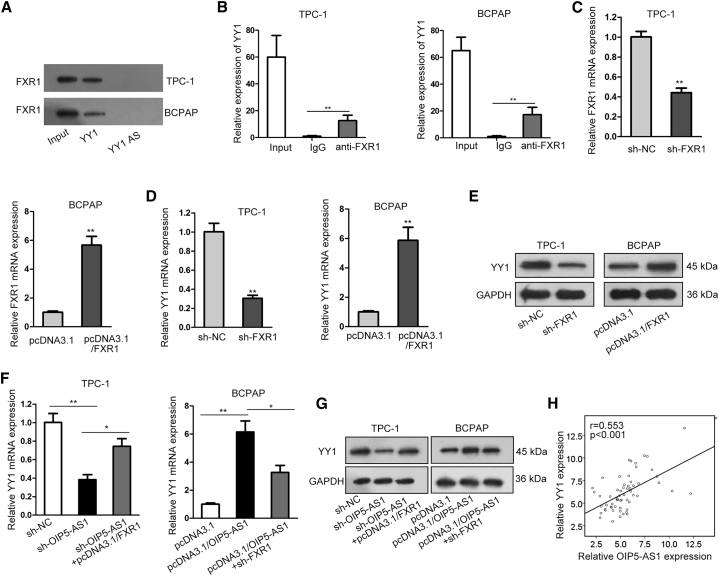
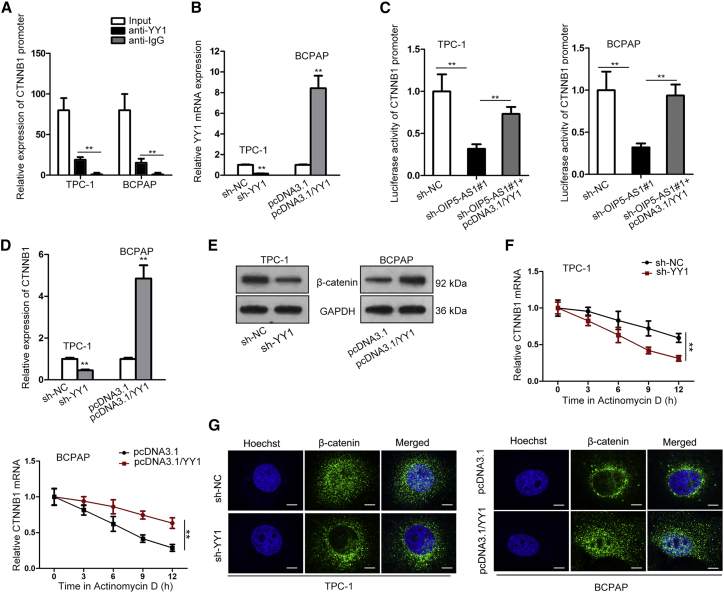
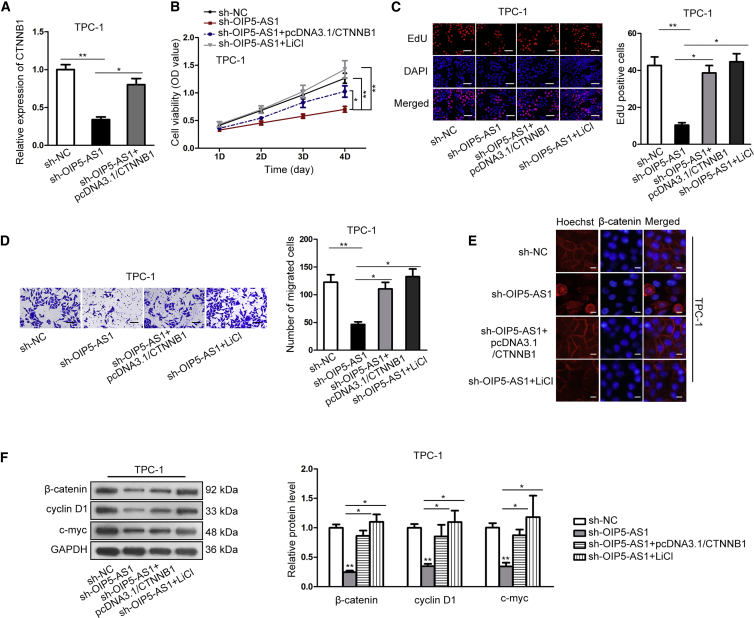
As a common malignancy, thyroid cancer mainly occurs in the endocrine system. There have been accumulating studies on therapeutic methods of thyroid cancer, but its internal molecular mechanism is still not fully understood. Long noncoding RNA (lncRNA) OIP5-AS1 was confirmed as an oncogene and related to poor prognosis in various cancers. Nevertheless, its role and underlying mechanism remain unclear in thyroid cancer. Here, we observed a significant upregulation of OIP5-AS1 in thyroid cancer tissues and cells, and upregulated OIP5-AS1 was correlated with poor prognosis in thyroid cancer. Moreover, OIP5-AS1 knockdown resulted in the inhibited cell proliferation and migration, while overexpressed OIP5-AS1 exhibited the reverse function in thyroid cancer. Besides, OIP5-AS1 was found to positively regulate Wnt/β-catenin signaling pathway. Through mechanism exploration, OIP5-AS1 was discovered to activate Wnt/β-catenin signaling pathway via FXR1/YY1/CTNNB1 axis. Finally, rescue assays indicated that the inhibitive role of silenced OIP5-AS1 in thyroid cancer cell growth and Wnt/β-catenin signaling pathway could be rescued by overexpression of CTNNB1 or addition of lithium chloride (LiCl). In conclusion, upregulation of OIP5-AS1 predicted unfavorable prognosis and enhanced thyroid cancer cell growth by activating Wnt/β-catenin signaling pathway.
甲状腺癌作为一种常见的恶性肿瘤,主要发生在内分泌系统。关于甲状腺癌的治疗方法已有越来越多的研究,但对其内在分子机制仍未完全了解。长链非编码RNA(lncRNA)OIP5-AS1已被证实为一种癌基因,与多种癌症的不良预后相关。然而,其在甲状腺癌中的作用及潜在机制仍不清楚。在此,我们观察到甲状腺癌组织和细胞中OIP5-AS1显著上调,且OIP5-AS1上调与甲状腺癌的不良预后相关。此外,敲低OIP5-AS1导致细胞增殖和迁移受到抑制,而在甲状腺癌中过表达OIP5-AS1则表现出相反的作用。此外,发现OIP5-AS1正向调节Wnt/β-连环蛋白信号通路。通过机制探索,发现OIP5-AS1通过FXR1/YY1/CTNNB1轴激活Wnt/β-连环蛋白信号通路。最后,挽救实验表明,过表达CTNNB1或添加氯化锂(LiCl)可挽救沉默OIP5-AS1对甲状腺癌细胞生长和Wnt/β-连环蛋白信号通路的抑制作用。总之,OIP上调5-AS1通过激活Wnt/β-连环蛋白信号通路预示不良预后并促进甲状腺癌细胞生长。