Health Outcomes Real-World Evidence, Kantar Health, San Mateo, California, USA
Global Health Economics & Outcomes Research, Teva Branded Pharmaceutical Products R&D, Inc, West Chester, Pennsylvania, USA.
BMJ Open Respir Res. 2020 Mar;7(1). doi: 10.1136/bmjresp-2019-000534.
The objective of this analysis was to examine the association between asthma control (based on Asthma Control Test (ACT) responses) and healthcare resource utilisation (HRU), work productivity and health-related quality of life (HRQoL) among a nationwide sample of US adults with a self-reported diagnosis of asthma and without comorbid chronic obstructive pulmonary disease.
Data were obtained from the 2015 and 2016 self-administered, internet-based National Health and Wellness Surveys. Patients were grouped by ACT score (≤15: poorly controlled; 16-19: partly controlled; 20-25: well-controlled asthma). Study outcomes included HRU (patient-reported healthcare provider visits, emergency department visits and hospitalisations during the previous 6 months); work productivity, measured using the Work Productivity and Activity Impairment-General Health Scale; HRU-associated costs and work productivity loss and HRQoL, measured using EuroQoL-5 Dimensions-5 Levels (EQ-5D-5L) and the Short Form Health Survey-36V.2 (SF-36V.2). Incremental differences in outcomes between groups were assessed using generalised linear models adjusted for covariates.
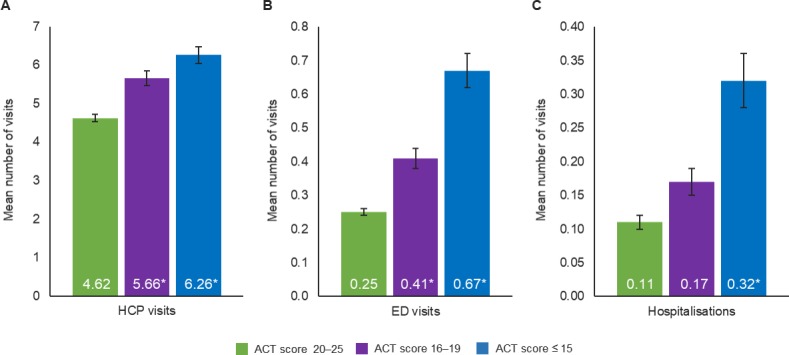
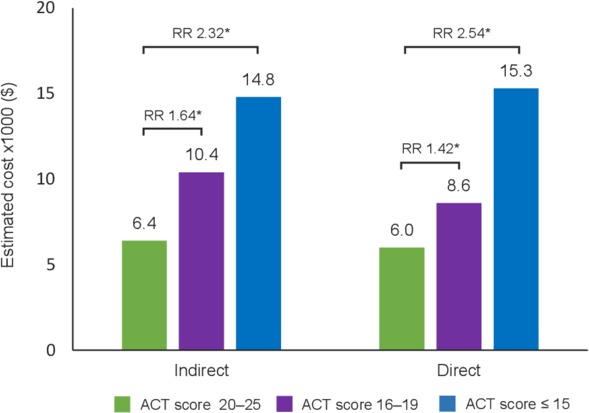
Of 7820 eligible adults, 17.4% had poorly controlled, 20.1% partly controlled and 62.5% well-controlled asthma. Well-controlled asthma was associated with significantly lower HRU (p<0.001) and lower mean direct costs ($6012 vs $8554 and $15 262, respectively; p<0.001); well-controlled asthma was also associated with significantly lower mean scores for work absenteeism, work presenteeism, overall work impairment and activity impairment (all p<0.001), and lower mean indirect costs ($6353 vs $10 448 and $14 764, respectively; p<0.001). Clinically meaningful differences favouring well-controlled asthma were seen for all HRQoL measures, with statistically significantly higher adjusted mean EQ-5D-5L index and SF-6D Health Utilities Index scores (derived from SF-36V.2) for patients with well-controlled asthma compared with partly controlled or poorly controlled asthma (p<0.001).
The study demonstrates a clear relationship between asthma control and its impact on HRU, costs, work productivity and HRQoL. This will allow for better identification and management of patients with poorly controlled asthma.
本分析旨在考察美国成年人中报告的哮喘诊断,无合并慢性阻塞性肺疾病的患者中,哮喘控制(基于哮喘控制测试(ACT)应答)与医疗资源利用(HRU)、工作生产力和健康相关生活质量(HRQoL)之间的关系。
数据来自 2015 年和 2016 年的自我管理、基于互联网的全国健康和健康调查。患者根据 ACT 评分(≤15:控制不佳;16-19:部分控制;20-25:控制良好的哮喘)进行分组。研究结果包括 HRU(患者报告的过去 6 个月内的医疗保健提供者就诊、急诊就诊和住院);工作生产力,使用工作生产力和活动障碍-一般健康量表进行测量;HRU 相关成本和工作生产力损失以及 HRQoL,使用 EuroQoL-5 维度-5 级(EQ-5D-5L)和简短健康调查-36V.2(SF-36V.2)进行测量。使用广义线性模型调整协变量评估组间结果的增量差异。
在 7820 名合格的成年人中,17.4%的患者哮喘控制不佳,20.1%的患者部分控制,62.5%的患者控制良好。控制良好的哮喘与 HRU 显著降低(p<0.001)和平均直接成本降低(分别为$6012 与$8554 和$15262;p<0.001)有关;控制良好的哮喘还与工作缺勤、工作在职、整体工作障碍和活动障碍的平均得分显著降低(均为 p<0.001)以及平均间接成本降低(分别为$6353 与$10448 和$14764;p<0.001)有关。对于所有 HRQoL 测量指标,控制良好的哮喘均具有明显的临床意义,与部分控制或控制不佳的哮喘相比,控制良好的哮喘患者的平均调整 EQ-5D-5L 指数和 SF-6D 健康效用指数评分更高(由 SF-36V.2 推导)(p<0.001)。
该研究表明哮喘控制与 HRU、成本、工作生产力和 HRQoL 之间存在明确关系。这将有助于更好地识别和管理控制不佳的哮喘患者。