Division of Viral Hepatitis, National Center for HIV/AIDS, Viral Hepatitis, STD, and TB Prevention, Centers for Disease Control and Prevention, Atlanta, Georgia, USA.
Clin Infect Dis. 2020 Dec 17;71(10):e571-e579. doi: 10.1093/cid/ciaa298.
Despite national immunization efforts, including universal childhood hepatitis A (HepA) vaccination recommendations in 2006, hepatitis A virus (HAV)-associated outbreaks have increased in the United States. Unvaccinated or previously uninfected persons are susceptible to HAV infection, yet the susceptibility in the US population is not well known.
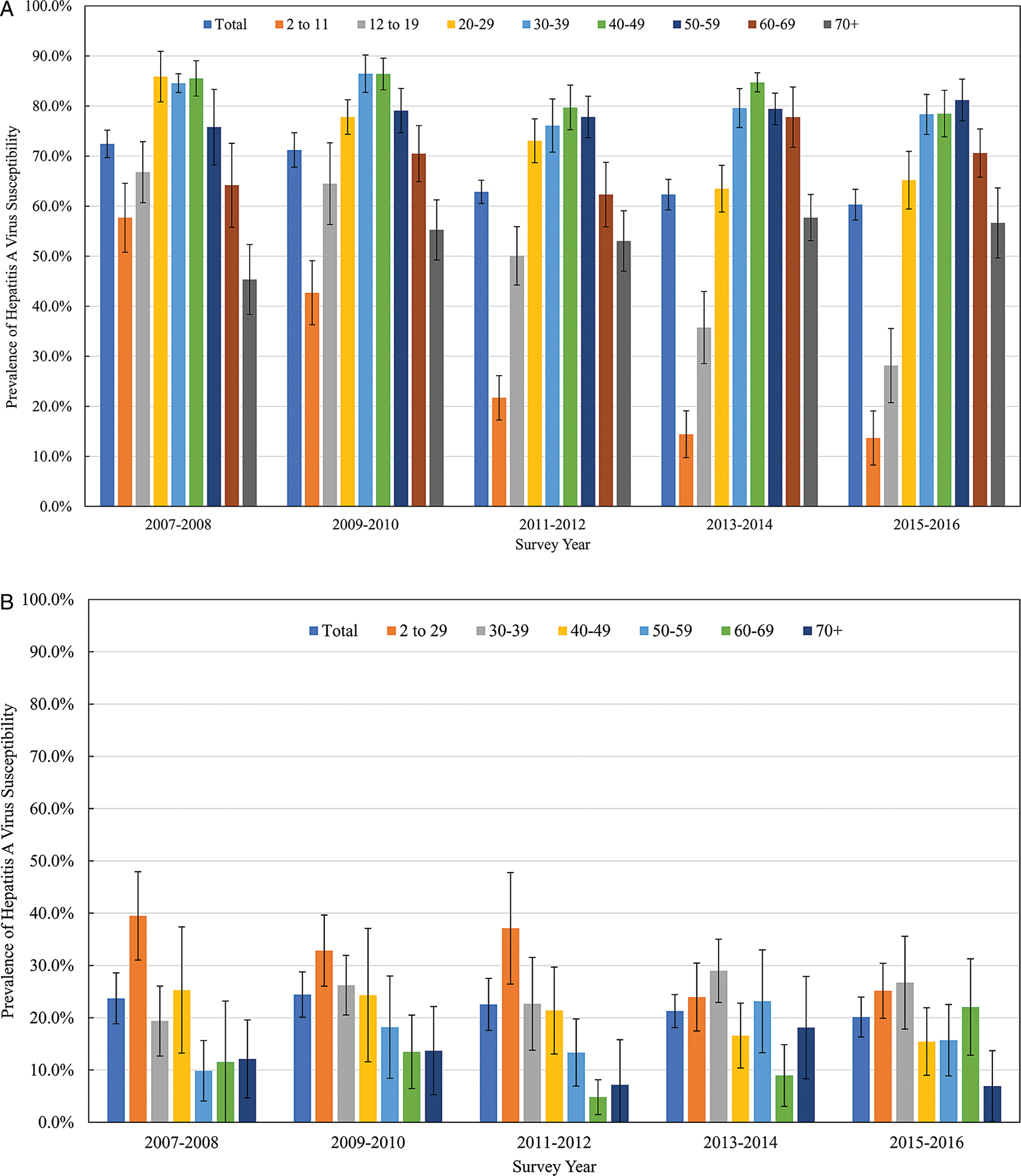
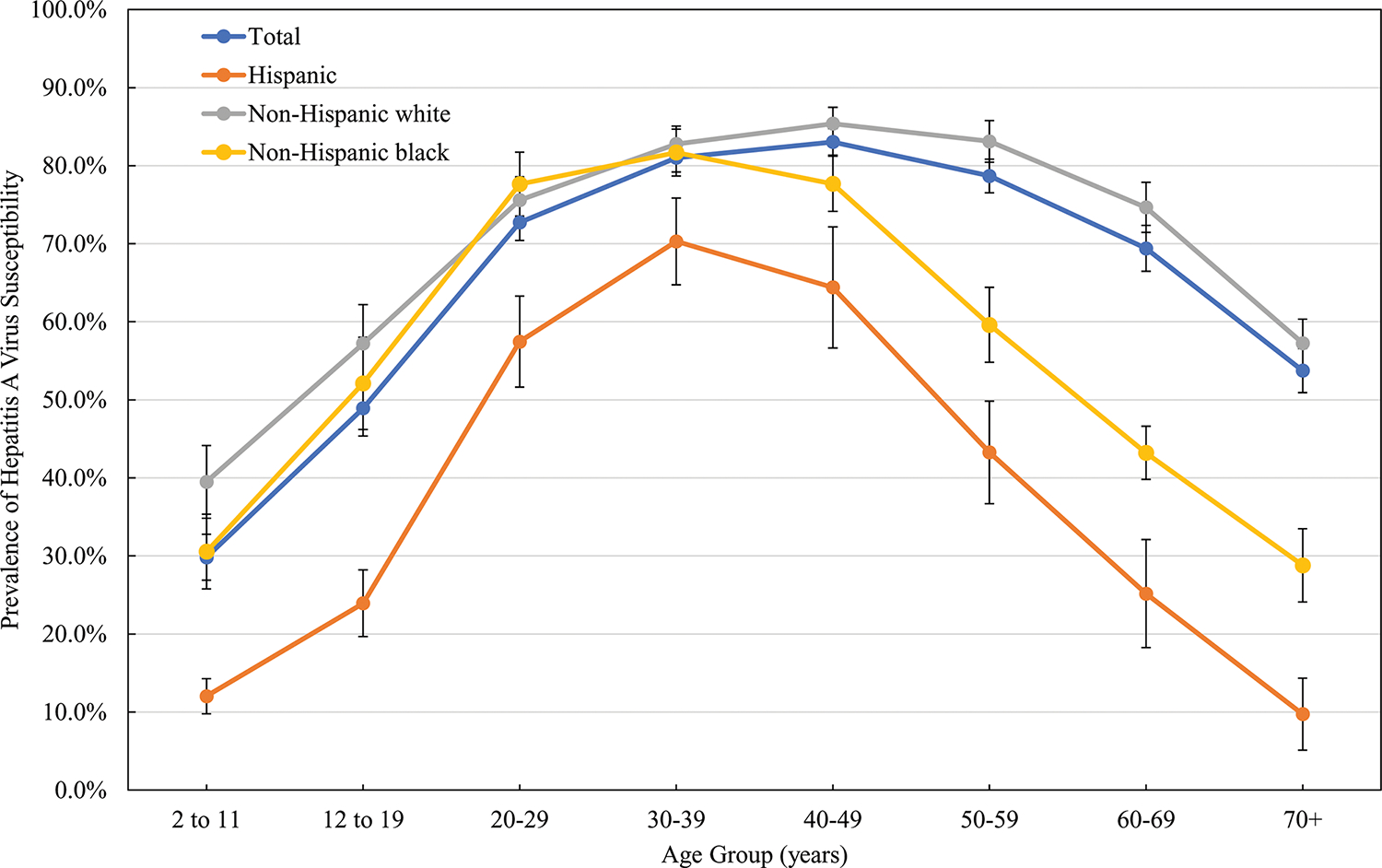
Using National Health and Nutrition Examination Survey 2007-2016 data, we estimated HAV susceptibility prevalence (total HAV antibody negative) among persons aged ≥2 years. Among US-born adults aged ≥20 years, we examined prevalence, predictors, and age-adjusted trends of HAV susceptibility by sociodemographic characteristics. We assessed HAV susceptibility and self-reported nonvaccination to HepA among risk groups and the "immunization cohort" (those born in or after 2004).
Among US-born adults aged ≥20 years, HAV susceptibility prevalence was 74.1% (95% confidence interval, 72.9-75.3%) during 2007-2016. Predictors of HAV susceptibility were age group 30-49 years, non-Hispanic white/black, 130% above the poverty level, and no health insurance. Prevalences of HAV susceptibility and nonvaccination to HepA, respectively, were 72.9% and 73.1% among persons who reported injection drug use, 67.5% and 65.2% among men who had sex with men, 55.2% and 75.1% among persons with hepatitis B or hepatitis C, and 22.6% and 25.9% among the immunization cohort. Susceptibility and nonvaccination decreased over time among the immunization cohort but remained stable among risk groups.
During 2007-2016, approximately three-fourths of US-born adults remained HAV susceptible. Enhanced vaccination efforts are critically needed, particularly targeting adults at highest risk for HAV infection, to mitigate the current outbreaks.
尽管美国开展了全国性免疫接种工作,包括 2006 年提出的儿童普遍接种甲型肝炎(HepA)疫苗建议,但甲型肝炎病毒(HAV)相关疫情仍有所增加。未接种或既往未感染过的人群易感染 HAV,但美国人群的易感性尚不清楚。
利用 2007-2016 年全国健康和营养调查数据,我们估计了≥2 岁人群中 HAV 易感性的流行率(总 HAV 抗体阴性)。对于≥20 岁的美国出生成年人,我们根据社会人口统计学特征检查了 HAV 易感性的流行率、预测因素和年龄调整趋势。我们评估了风险人群和“免疫接种队列”(出生于或之后 2004 年的人群)中 HAV 易感性和自我报告的 HepA 未接种情况。
在≥20 岁的美国出生成年人中,2007-2016 年期间 HAV 易感性的流行率为 74.1%(95%置信区间,72.9%-75.3%)。HAV 易感性的预测因素为年龄组 30-49 岁、非西班牙裔白人/黑人、收入高于贫困线 130%和没有医疗保险。分别有 72.9%和 73.1%的报告有注射吸毒史的人、67.5%和 65.2%的男男性接触者、55.2%和 75.1%的乙型肝炎或丙型肝炎患者存在 HAV 易感性和 HepA 未接种情况,免疫接种队列中分别有 22.6%和 25.9%存在 HAV 易感性和 HepA 未接种情况。在免疫接种队列中,易感性和未接种率随时间推移而下降,但在风险人群中保持稳定。
在 2007-2016 年期间,约有四分之三的美国出生成年人仍易感染 HAV。需要加强疫苗接种工作,特别是针对感染 HAV 风险最高的成年人,以减轻当前疫情。