Kattner Florian, Meinhardt Hanna
Institute of Psychology, Technische Universität Darmstadt, Darmstadt, Germany.
Institute of Psychology, University of Hamburg, Hamburg, Germany.
Front Psychol. 2020 Mar 5;11:346. doi: 10.3389/fpsyg.2020.00346. eCollection 2020.
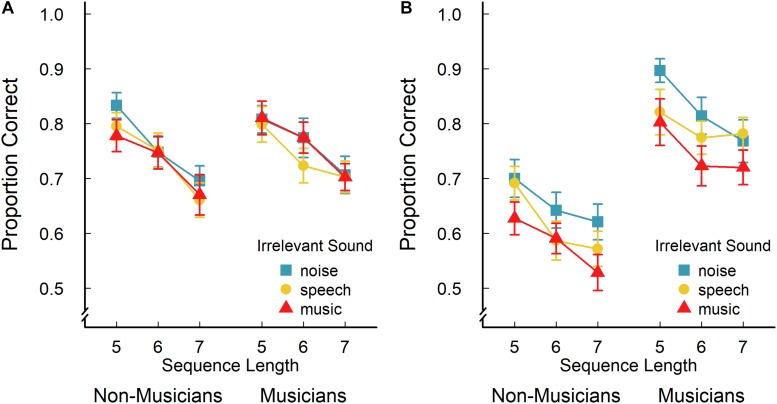
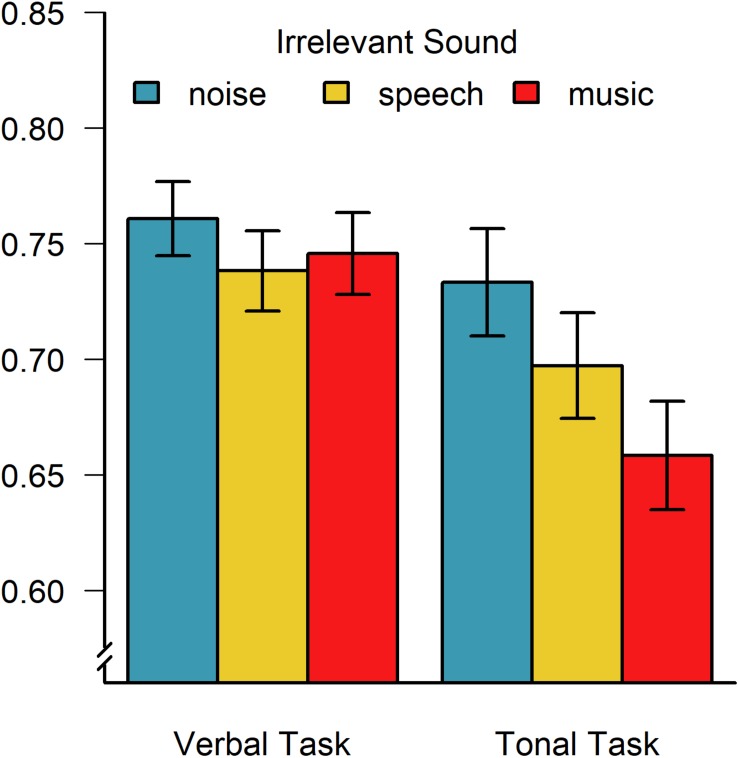
Task-irrelevant speech or music sounds are known to disrupt verbal short-term memory even when participants are instructed to ignore the sound, suggesting that automatically processed acoustical changes interfere with the rehearsal of phonological items. However, much less is known about auditory distraction in tasks that require the memorization and recall of non-phonological auditory items. In the present study, both musically trained and untrained participants were asked to memorize random tone sequences (consisting of low, medium, and high pitch tones) while task-irrelevant sound was presented. Irrelevant instrumental music was found to produce more disruption of tonal recall than white noise, whereas irrelevant speech produced intermediate levels of disruption. In contrast, only speech produced significant interference in an analogous verbal recall task. Crucially, although musically trained participants were able to recall more tones in general, the degree of auditory distraction that was produced by irrelevant music in the tonal recall task was found to be independent of musical expertise. The findings are in line with the assumption of two separate mechanisms for the maintenance of tonal and phonological information. Specifically, short-term memory for tone sequences may rely on a pitch-based rehearsal system which is disrupted by the perception of irrelevant pitch changes as contained in instrumental music (and to a lesser extent in speech), whereas serial recall of verbal items is most sensitive to phonological sounds.
已知与任务无关的语音或音乐声音会干扰言语短期记忆,即使参与者被指示忽略这些声音,这表明自动处理的声学变化会干扰语音项目的复述。然而,对于需要记忆和回忆非语音听觉项目的任务中的听觉干扰,我们了解得要少得多。在本研究中,受过音乐训练和未受过音乐训练的参与者都被要求在呈现与任务无关的声音时记忆随机音调序列(由低音、中音和高音组成)。结果发现,无关的器乐音乐比白噪声对音调回忆的干扰更大,而无关的语音产生的干扰程度居中。相比之下,只有语音在类似的言语回忆任务中产生了显著干扰。至关重要的是,尽管受过音乐训练的参与者总体上能够回忆起更多的音调,但在音调回忆任务中,无关音乐产生的听觉干扰程度与音乐专业知识无关。这些发现与维持音调信息和语音信息的两种独立机制的假设一致。具体而言,音调序列的短期记忆可能依赖于基于音高的复述系统,该系统会被器乐音乐(以及在较小程度上语音)中包含的无关音高变化的感知所干扰,而言语项目的序列回忆对语音声音最为敏感。