Faculty of Medicine Carl Gustav Carus, Institute of Immunology, TU Dresden, Dresden, Germany.
National Center for Tumor Diseases (NCT), Partner Site Dresden, Dresden, Germany.
Front Immunol. 2020 Mar 4;11:364. doi: 10.3389/fimmu.2020.00364. eCollection 2020.
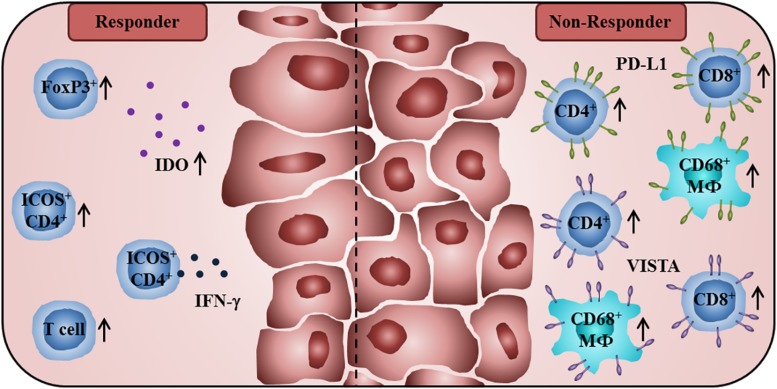
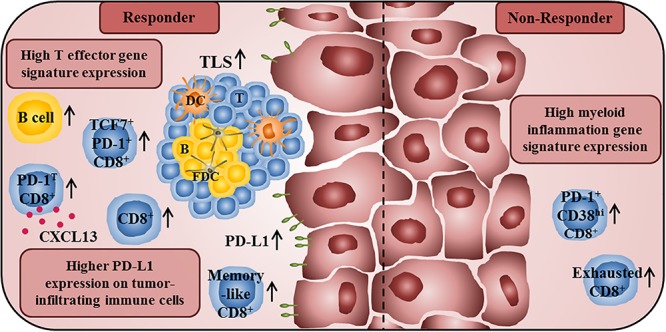
The tumor immune contexture plays a major role for the clinical outcome of patients. High densities of CD45RO T helper 1 cells and CD8 T cells are associated with improved survival of patients with various cancer entities. In contrast, a higher frequency of tumor-infiltrating M2 macrophages is correlated with poor prognosis. Recent studies provide evidence that the tumor immune architecture also essentially contributes to the clinical efficacy of immune checkpoint inhibitor (CPI) therapy in patients. Pretreatment melanoma samples from patients who experienced a clinical response to anti-programmed cell death protein 1 (PD-1) treatment show higher densities of infiltrating CD8 T cells compared to samples from patients that progressed during therapy. Anti-PD-1 therapy results in an increased density of tumor-infiltrating T lymphocytes in treatment responders. In addition, elevated frequencies of melanoma-infiltrating TCF7CD8 T cells are correlated with beneficial clinical outcome of anti-PD-1-treated patients. In contrast, a high density of tumor-infiltrating, dysfunctional PD-1CD38 CD8 cells in melanoma patients is associated with anti-PD-1 resistance. Such findings indicate that comprehensive tumor immune contexture profiling prior to and during CPI therapy may lead to the identification of underlying mechanisms for treatment response or resistance, and the design of improved immunotherapeutic strategies. Here, we focus on studies exploring the impact of intratumoral T and B cells at baseline on the clinical outcome of CPI-treated cancer patients. In addition, recent findings demonstrating the influence of CPIs on tumor-infiltrating lymphocytes are summarized.
肿瘤免疫微环境对患者的临床结局起着重要作用。高密度的 CD45RO T 辅助 1 细胞和 CD8 T 细胞与各种癌症实体患者的生存改善相关。相比之下,肿瘤浸润性 M2 巨噬细胞的频率较高与预后不良相关。最近的研究提供了证据,表明肿瘤免疫结构也对免疫检查点抑制剂(CPI)治疗患者的临床疗效有重要贡献。接受抗程序性细胞死亡蛋白 1(PD-1)治疗有临床反应的患者的预处理黑色素瘤样本显示,与治疗进展的患者相比,浸润性 CD8 T 细胞的密度更高。抗 PD-1 治疗导致治疗反应者肿瘤浸润性 T 淋巴细胞的密度增加。此外,黑色素瘤浸润性 TCF7CD8 T 细胞的频率升高与抗 PD-1 治疗患者的有益临床结局相关。相反,黑色素瘤患者肿瘤浸润性、功能失调的 PD-1CD38 CD8 细胞密度高与抗 PD-1 耐药相关。这些发现表明,在 CPI 治疗之前和期间进行全面的肿瘤免疫结构分析可能有助于确定治疗反应或耐药的潜在机制,并设计改进的免疫治疗策略。在这里,我们重点关注研究探讨基线时肿瘤内 T 和 B 细胞对 CPI 治疗癌症患者临床结局的影响。此外,还总结了最近发现的 CPIs 对肿瘤浸润性淋巴细胞的影响。