Hoseinzadeh Parastoo, Ruge-Wehling Brigitte, Schweizer Patrick, Stein Nils, Pidon Hélène
Genomics of Genetic Resources, Department of Genebank, Leibniz Institute of Plant Genetics and Crop Plant Research (IPK), Gatersleben, Germany.
Institute for Breeding Research on Agricultural Crops, Julius Kühn Institute (JKI), Sanitz, Germany.
Front Plant Sci. 2020 Mar 3;11:225. doi: 10.3389/fpls.2020.00225. eCollection 2020.
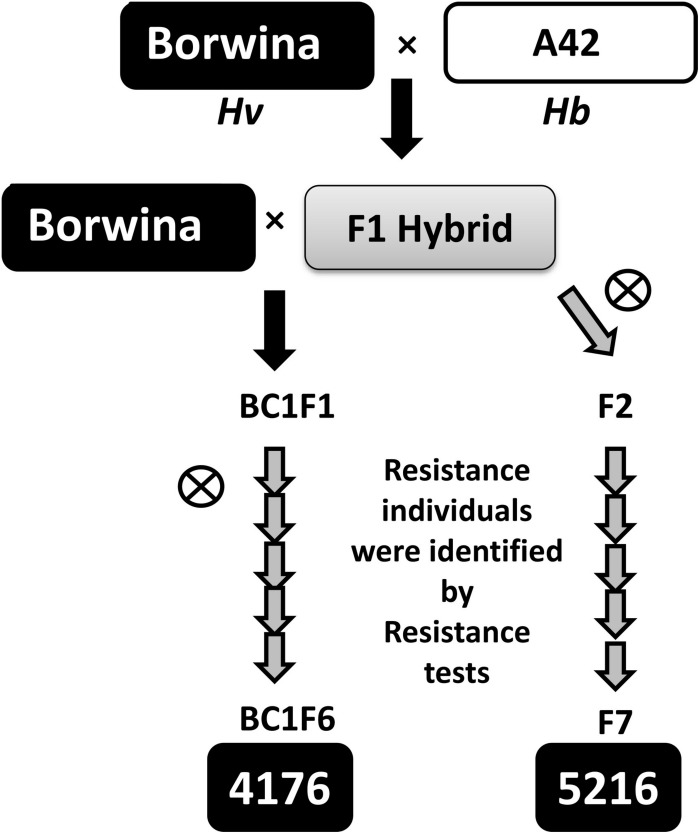
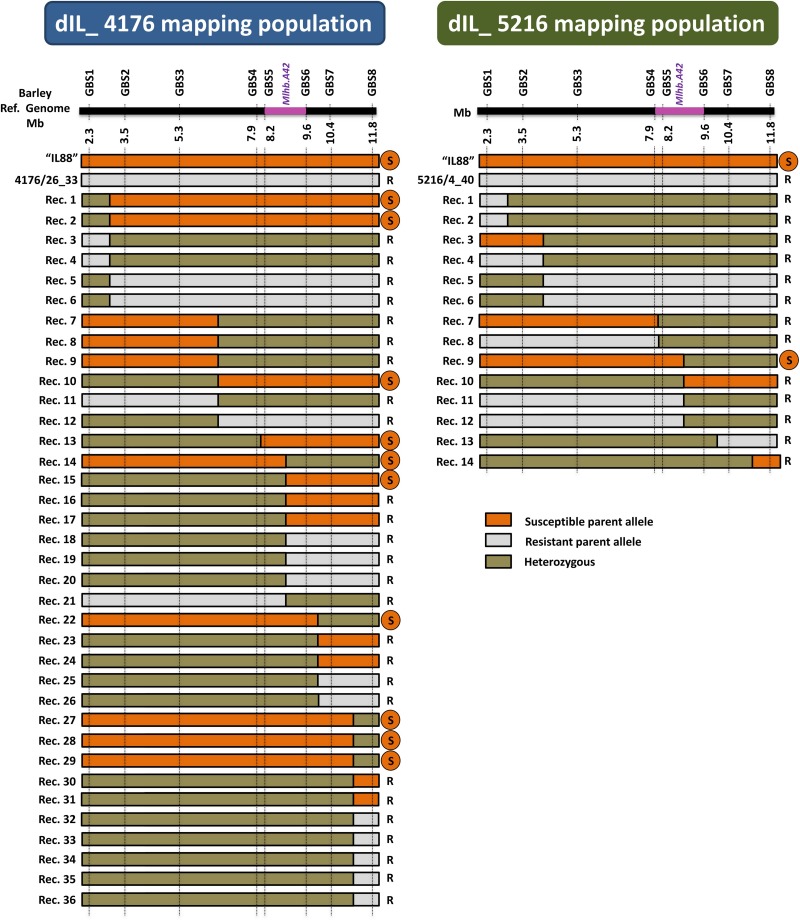
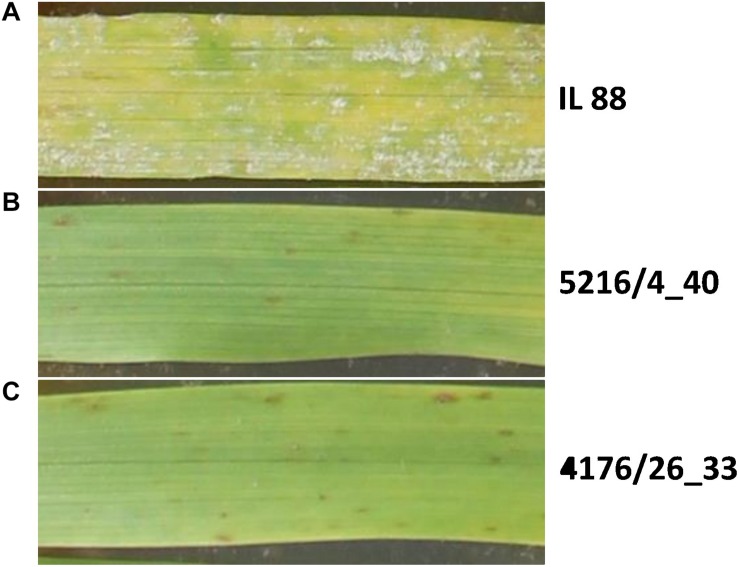
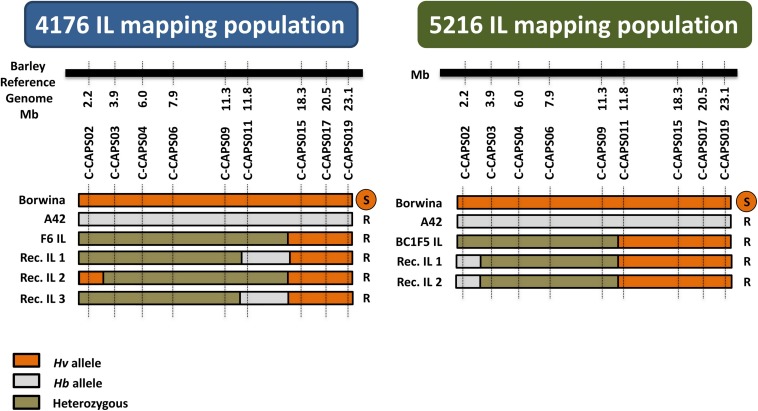
Powdery mildew caused by f. sp. is one of the main foliar diseases in barley ( L.; ). Naturally occurring resistance genes used in barley breeding are a cost effective and environmentally sustainable strategy to minimize the impact of pathogens, however, the primary gene pool of contains limited diversity owing to recent domestication bottlenecks. To ensure durable resistance against this pathogen, more genes are required that could be unraveled by investigation of secondary barley gene-pool. A large set of () introgression lines (ILs) harboring a diverse set of desirable resistance traits have been developed and are being routinely used as source of novel diversity in gene mapping studies. Nevertheless, this strategy is often compromised by a lack of recombination between the introgressed fragment and the orthologous chromosome of the barley genome. In this study, we fine-mapped a gene conferring resistance to barley powdery mildew. The initial genotyping of two ILs mapping populations with differently sized 2HS introgressions revealed severely reduced interspecific recombination in the region of the introgressed segment, preventing precise localization of the gene. To overcome this difficulty, we developed an alternative strategy, exploiting intraspecific recombination by crossing two ILs with collinear introgressions, one of which carries a powdery mildew resistance gene, while the other doesn't. The intraspecific recombination rate in the -introgressed fragment of 2HS was approximately 20 times higher than it was in the initial simple ILs mapping populations. Using high-throughput genotyping-by-sequencing (GBS), we allocated the resistance gene to a 1.4 Mb interval, based on an estimate using the genome as reference, in populations of only 103 and 146 individuals, respectively, similar to what is expected at this locus in barley. The most likely candidate resistance gene within this interval is part of the coiled-coil nucleotide-binding-site leucine-rich-repeat (CC-NBS-LLR) gene family, which is over-represented among genes conferring strong dominant resistance to pathogens. The reported strategy can be applied as a general strategic approach for identifying genes underlying traits of interest in crop wild relatives.
由大麦白粉菌(Blumeria graminis f. sp. hordei)引起的白粉病是大麦(Hordeum vulgare L.)的主要叶部病害之一。在大麦育种中使用天然存在的抗性基因是一种具有成本效益且环境可持续的策略,可将病原体的影响降至最低,然而,由于近期驯化瓶颈,大麦的初级基因库多样性有限。为确保对这种病原体的持久抗性,需要更多基因,可通过对大麦二级基因库的研究来揭示这些基因。已经开发出了一大批携带各种理想抗性性状的大麦(Hordeum vulgare)渗入系(ILs),并在基因定位研究中常规用作新多样性的来源。然而,这种策略常常因渗入片段与大麦基因组的同源染色体之间缺乏重组而受到影响。在本研究中,我们对一个赋予大麦对白粉病抗性的基因进行了精细定位。对两个具有不同大小2HS渗入片段的大麦渗入系定位群体进行的初始基因分型显示,渗入片段区域的种间重组严重减少,从而妨碍了该基因的精确定位。为克服这一困难,我们开发了一种替代策略,通过将两个具有共线渗入片段的大麦渗入系杂交来利用种内重组,其中一个携带白粉病抗性基因,另一个则不携带。2HS的渗入片段中的种内重组率比最初的简单渗入系定位群体高出约20倍。使用高通量测序基因分型(GBS),我们分别在仅103和146个个体的群体中,基于以大麦基因组为参考的估计,将抗性基因定位到了一个1.4 Mb的区间内,这与大麦该位点的预期情况相似。该区间内最有可能的候选抗性基因是卷曲螺旋核苷酸结合位点富含亮氨酸重复序列(CC-NBS-LRR)基因家族的一部分,该家族在赋予对病原体强显性抗性的基因中占比过高。所报道的策略可作为一种通用的战略方法,用于鉴定作物野生近缘种中感兴趣性状的潜在基因