Ciążyńska Magdalena, Bednarski Igor A, Wódz Karolina, Narbutt Joanna, Lesiak Aleksandra
Department of Proliferative Diseases, Nicolaus Copernicus Multidisciplinary Centre for Oncology and Traumatology, Lodz 93-513, Poland.
Department of Dermatology, Pediatric Dermatology and Dermatological Oncology, Medical University of Lodz, Lodz 91-347, Poland.
Oncol Lett. 2020 Mar;19(3):1649-1656. doi: 10.3892/ol.2020.11284. Epub 2020 Jan 9.
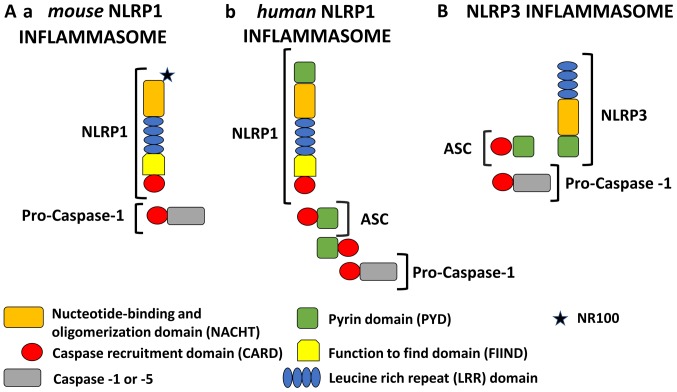
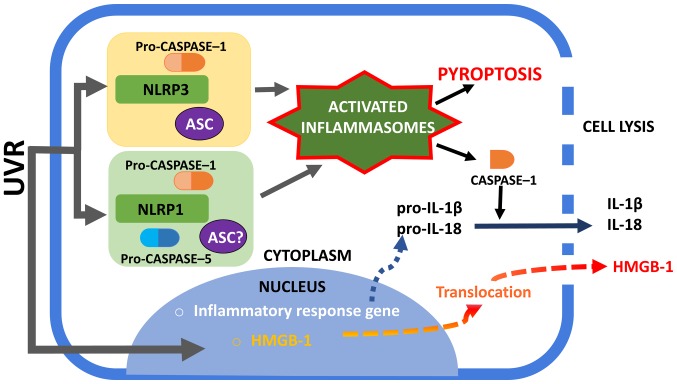
Inflammasomes are key innate immune system receptors that detect pathogenic endo- and exogenous stressors like microorganisms or ultraviolet radiation (UVR) which activate the highly proinflammatory cytokines interleukin-1β and interleukin-18. Inflammasomes are not only involved in inflammation, but also in carcinogenesis and tumor progression. Due to the dynamic increase in non-melanoma skin cancers (NMSC), it has become necessary to determine how UVR, which plays a key role in NMSC development, can regulate the structure and function of inflammasomes. In the present study, the regulatory mechanisms of NOD-Like Receptor Family Pyrin Domain Containing 1 and 3 inflammasome activation as well as an effective inflammasome-mediated immune response after UVR exposition are discussed. The differences and similarities between these molecular complexes that monitor cellular health, inflammation, and skin carcinogenesis are also highlighted. Despite numerous scientific data, more studies are still required to better understand the biology of inflammasomes in skin cancer development and to explore their therapeutic potential.
炎性小体是先天性免疫系统的关键受体,可检测致病性内源性和外源性应激源,如微生物或紫外线辐射(UVR),这些应激源会激活高度促炎细胞因子白细胞介素-1β和白细胞介素-18。炎性小体不仅参与炎症反应,还与致癌作用和肿瘤进展有关。由于非黑色素瘤皮肤癌(NMSC)的发病率不断动态上升,有必要确定在NMSC发生中起关键作用的UVR如何调节炎性小体的结构和功能。在本研究中,我们讨论了含NOD样受体家族吡咯结构域蛋白1和3炎性小体激活的调节机制,以及紫外线照射后有效的炎性小体介导的免疫反应。还强调了这些监测细胞健康、炎症和皮肤致癌作用的分子复合物之间的异同。尽管有大量科学数据,但仍需要更多研究来更好地了解炎性小体在皮肤癌发生中的生物学特性,并探索其治疗潜力。