Wang Qinghua, Xue Jie, Ren Qingfang, Li Xiaona, Qiu Xiaoli
Department of Breast Surgery, Linyi Cancer Hospital, Linyi, Shandong 276000, P.R. China.
Department of Medical Oncology, Linyi Cancer Hospital, Linyi, Shandong 276000, P.R. China.
Oncol Lett. 2020 Mar;19(3):2547-2553. doi: 10.3892/ol.2020.11260. Epub 2020 Jan 24.
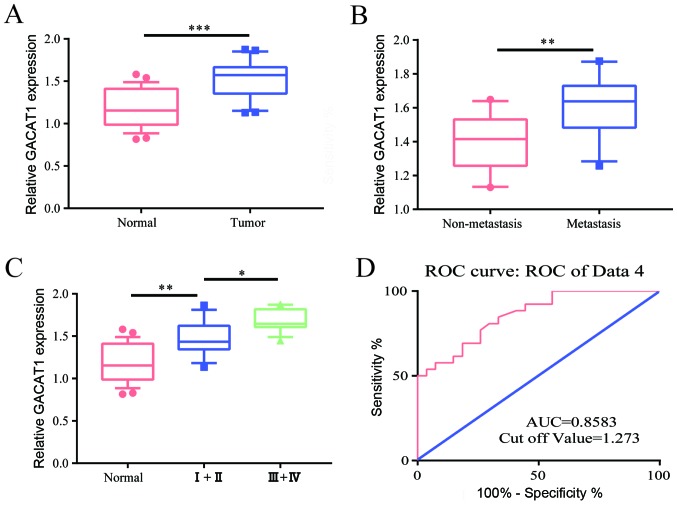
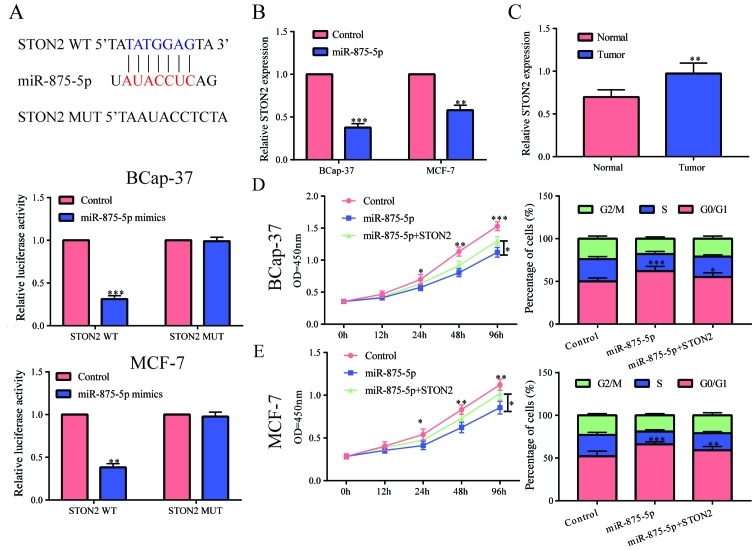
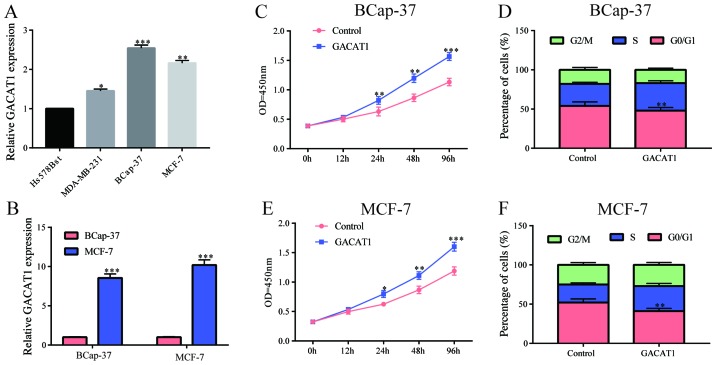
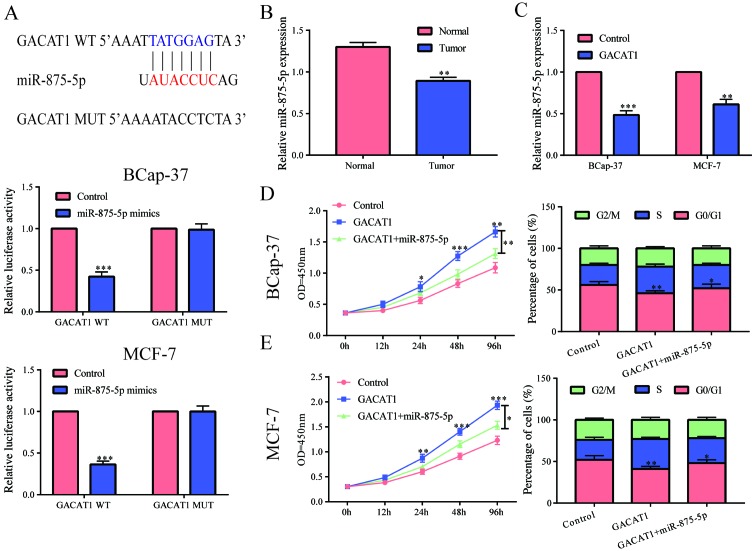
Role of long-chain non-coding ribonucleic acid (lncRNA) GACAT1 in the development of breast cancer and its possible mechanism were investigated. The levels of GACAT1, microRNA-875-3p and Stonin2 (STON2) in breast cancer tissues and adjacent normal tissues were detected by quantitative real-time polymerase chain reaction (qRT-PCR). The level of GACAT1 in breast cancer cell lines was further explored. The effects of GACAT1 and microRNA-875-3p on cell proliferation and cycle were detected by cell counting kit-8 (CCK-8) and flow cytometry. The binding relationship between microRNA-875-3p and STON2, microRNA-875-3p and GACAT1 was examined by a dual luciferase reporting assay. It was confirmed by rescue experiments whether GACAT1 canregulate the level of STON2 by binding to microRNA-875-3p. GACAT1 level was clearly enhanced in breast cancer tissues compared to that of the adjacent tissues. Similar result was observed in breast cancer cell lines. Upregulation of GACAT1 promoted the proliferation and cycle of breast cancer cells including MCF-7 and BCap-37. The dual luciferase reporting assay results indicated that GACAT1 had a binding relationship with microRNA-875-3p. Further experiments confirmed that microRNA-875-3p was conspicuously downregulated in breast cancer tissues, and upregulation of microRNA-875-3p could inhibit the proliferation ability of MCF-7 and BCap-37 cells, and partially reversed the promoting effect of GACAT1 on cell cycle. Through bioinformatics prediction and dual luciferase reporter gene experiments, we found that STON2 might be a target gene of microRNA-875-3p. Overexpression of STON2 could partially abolish the effect of microRNA-875-3p on cell proliferation and cycle of MCF-7 and BCap-37 cells. GACAT1 can participate in the progression of breast cancer by promoting the proliferation and cycle of breast cancer cells. The mechanism may be through the regulation of the level of STON2 by adsorbing microRNA-875-3p.
研究了长链非编码核糖核酸(lncRNA)GACAT1在乳腺癌发生发展中的作用及其可能机制。采用定量实时聚合酶链反应(qRT-PCR)检测乳腺癌组织及癌旁正常组织中GACAT1、微小RNA-875-3p和Stonin2(STON2)的水平。进一步探究乳腺癌细胞系中GACAT1的水平。采用细胞计数试剂盒-8(CCK-8)和流式细胞术检测GACAT1和微小RNA-875-3p对细胞增殖和周期的影响。通过双荧光素酶报告基因实验检测微小RNA-875-3p与STON2、微小RNA-875-3p与GACAT1之间的结合关系。通过挽救实验证实GACAT1是否能通过与微小RNA-875-3p结合来调节STON2的水平。与癌旁组织相比,乳腺癌组织中GACAT1水平明显升高。在乳腺癌细胞系中也观察到类似结果。GACAT1的上调促进了包括MCF-7和BCap-37在内的乳腺癌细胞的增殖和周期进程。双荧光素酶报告基因实验结果表明GACAT1与微小RNA-875-3p存在结合关系。进一步实验证实,微小RNA-875-3p在乳腺癌组织中明显下调,上调微小RNA-875-3p可抑制MCF-7和BCap-37细胞的增殖能力,并部分逆转GACAT1对细胞周期的促进作用。通过生物信息学预测和双荧光素酶报告基因实验,我们发现STON2可能是微小RNA-875-3p的靶基因。STON2的过表达可部分消除微小RNA-875-3p对MCF-7和BCap-37细胞增殖和周期的影响。GACAT1可通过促进乳腺癌细胞的增殖和周期进程参与乳腺癌的进展。其机制可能是通过吸附微小RNA-875-3p来调节STON2的水平。