Departamento de Bioquímica y Biología Molecular, Facultad de Óptica y Optometría, Universidad Complutense de Madrid, 28037 Madrid, Spain.
UFIEC, Chronic Disease Programme, Instituto de Salud Carlos III, Majadahonda 28220, Madrid, Spain.
Theranostics. 2020 Feb 10;10(7):3022-3034. doi: 10.7150/thno.42507. eCollection 2020.
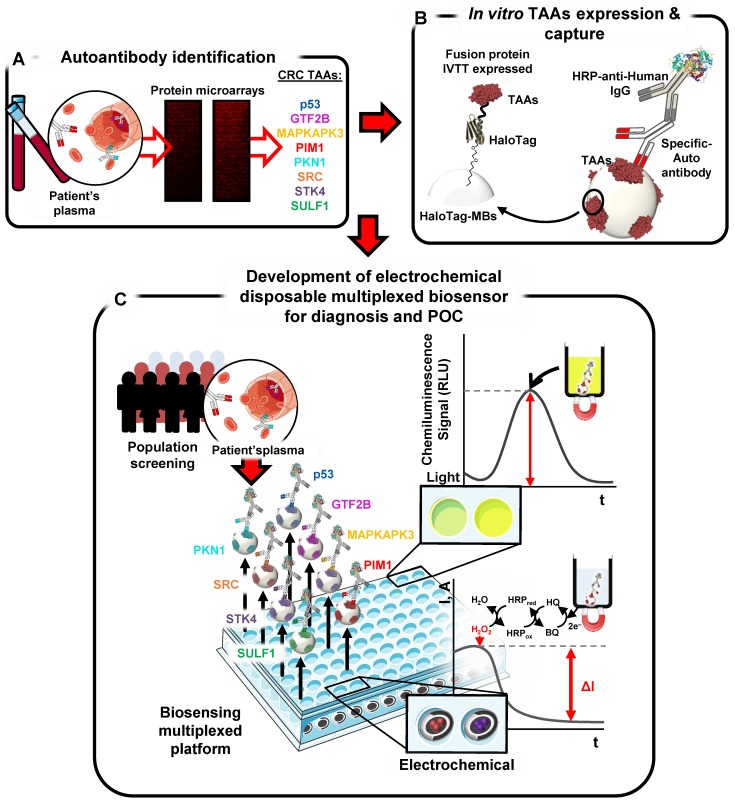
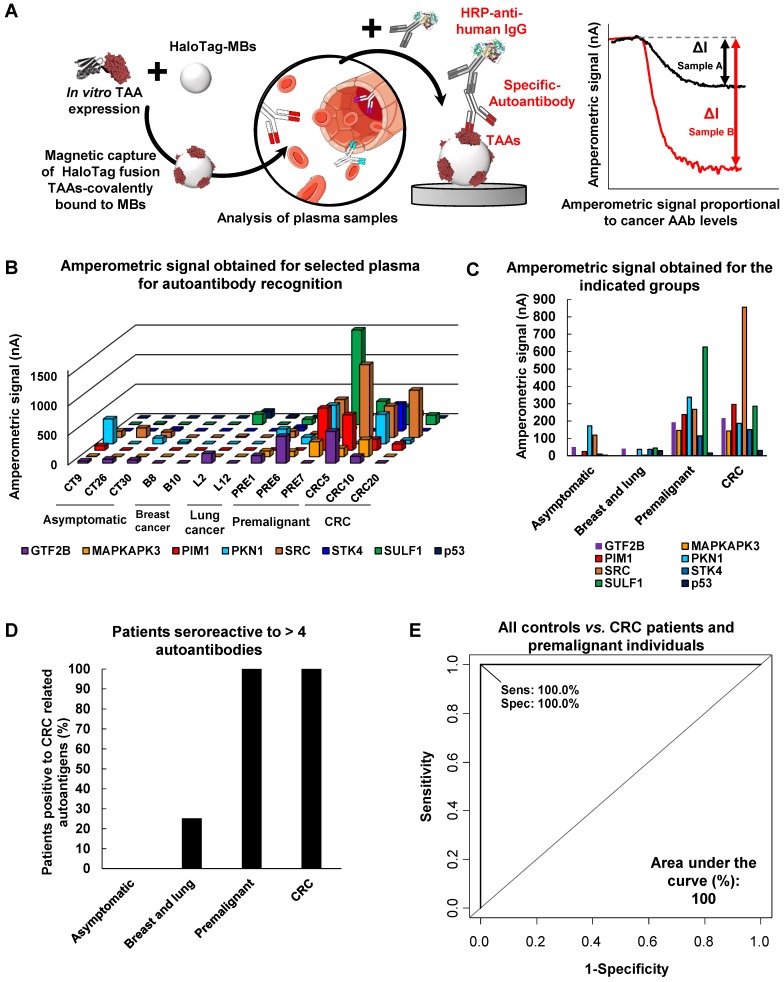
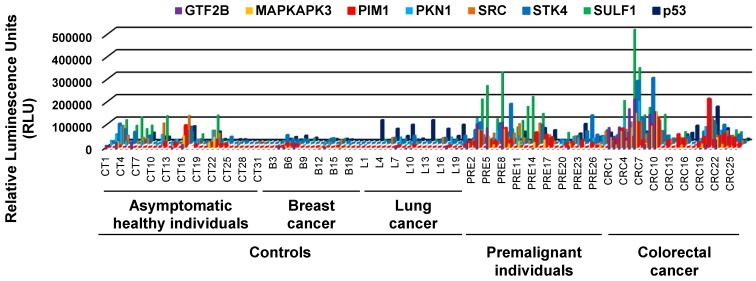
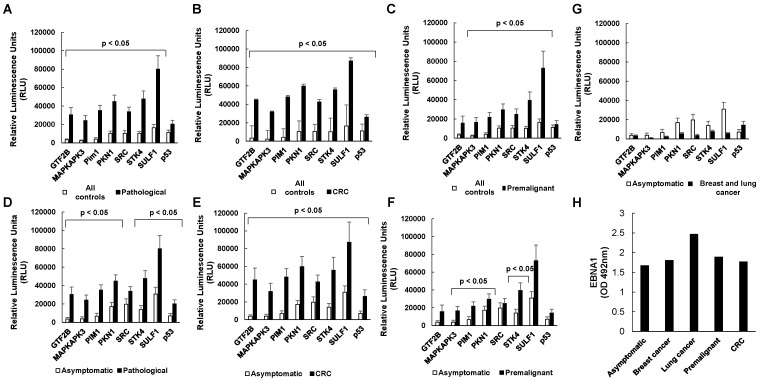
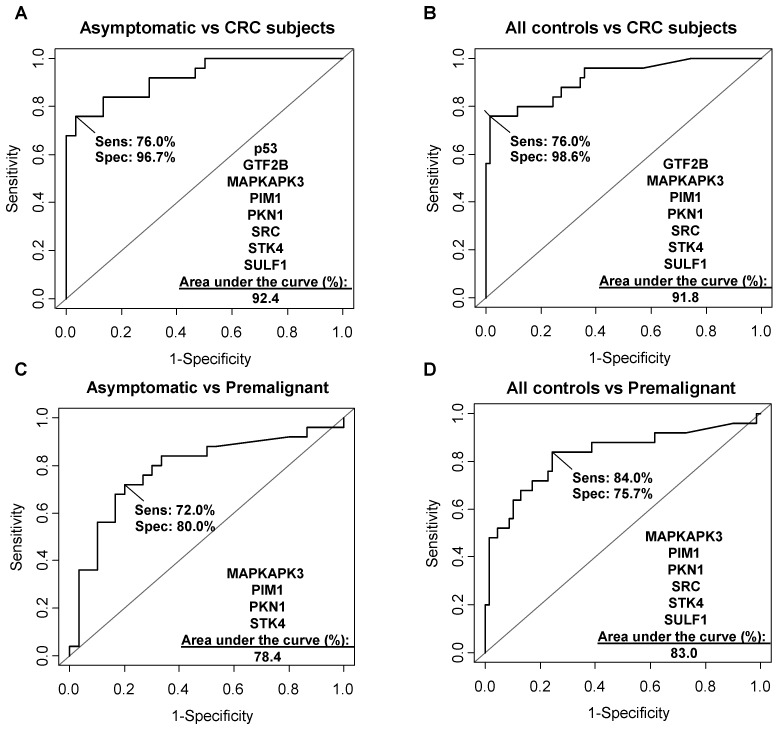
: The humoral immune response in cancer patients can be used for early detection of the disease. Autoantibodies raised against tumor-associated antigens (TAAs) are promising clinical biomarkers for reliable cancer diagnosis, prognosis, and therapy monitoring. In this study, an electrochemical disposable multiplexed immunosensing platform able to integrate difficult- and easy-to-express colorectal cancer (CRC) TAAs is reported for the sensitive determination of eight CRC-specific autoantibodies. : The electrochemical immunosensing approach involves the use of magnetic microcarriers (MBs) as solid supports modified with covalently immobilized HaloTag fusion proteins for the selective capture of specific autoantibodies. After magnetic capture of the modified MBs onto screen-printed carbon working electrodes, the amperometric responses measured using the hydroquinone (HQ)/HO system were related to the levels of autoantibodies in plasma. : The biosensing platform was applied to the analysis of autoantibodies against 8 TAAs described for the first time in this work in plasma samples from healthy asymptomatic individuals (n=3), and patients with high-risk of developing CRC (n=3), and from patients already diagnosed with colorectal (n=3), lung (n=2) or breast (n=2) cancer. The developed bioplatform demonstrated an improved discrimination between CRC patients and controls (asymptomatic healthy individuals and breast and lung cancer patients) compared to an ELISA-like luminescence test. : The proposed methodology uses a just-in-time produced protein in a simpler protocol, with low sample volume, and involves cost-effective instrumentation, which could be used in a high-throughput manner for reliable population screening to facilitate the detection of early CRC patients at affordable cost.
: 癌症患者的体液免疫反应可用于疾病的早期检测。针对肿瘤相关抗原 (TAA) 的自身抗体是可靠的癌症诊断、预后和治疗监测的有前途的临床生物标志物。在这项研究中,报告了一种能够整合难以和易于表达的结直肠癌 (CRC) TAA 的电化学一次性多路免疫传感平台,用于灵敏测定八种 CRC 特异性自身抗体。 : 电化学免疫传感方法涉及使用磁性微载体 (MB) 作为固体载体,用共价固定的 HaloTag 融合蛋白进行修饰,用于选择性捕获特异性自身抗体。在将修饰的 MB 通过磁捕获到丝网印刷碳工作电极上之后,使用对苯二酚 (HQ)/HO 体系测量的安培响应与血浆中自身抗体的水平相关。 : 该生物传感平台应用于分析首次在这项工作中描述的针对 8 种 TAA 的自身抗体,在来自健康无症状个体 (n=3)、高风险发展为 CRC 的个体 (n=3) 以及已经诊断为结直肠癌 (n=3)、肺癌 (n=2) 或乳腺癌 (n=2) 的个体的血浆样本中进行了分析。与类似 ELISA 的发光试验相比,所开发的生物平台在 CRC 患者和对照(无症状健康个体和乳腺癌和肺癌患者)之间的区分方面表现出了改进。 : 所提出的方法使用即时产生的蛋白质在更简单的方案中,具有较小的样品体积,并涉及具有成本效益的仪器,可用于高通量方式进行可靠的人群筛查,以经济实惠的价格促进早期 CRC 患者的检测。