Department of Microbiology, New York University School of Medicine, New York, NY 10016, USA.
Department of Human Genetics, University of Utah School of Medicine, Salt Lake City, UT 84112, USA.
Sci Adv. 2020 Mar 11;6(11):eaax7515. doi: 10.1126/sciadv.aax7515. eCollection 2020 Mar.
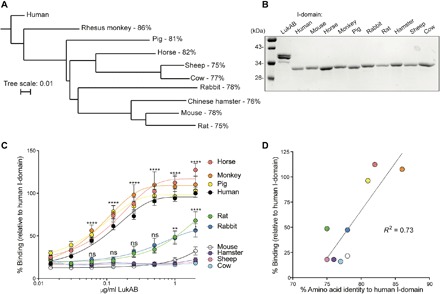
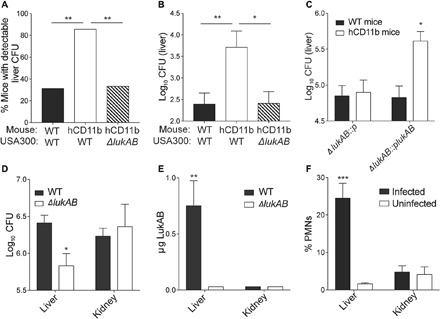
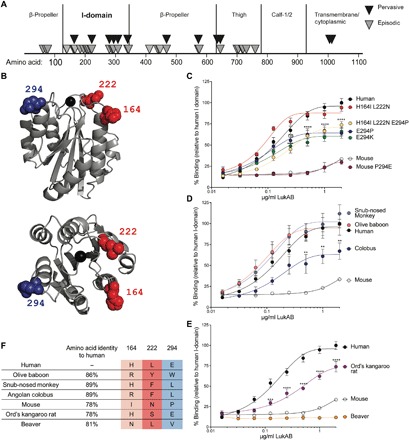
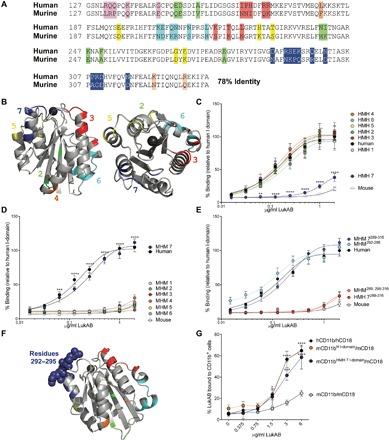
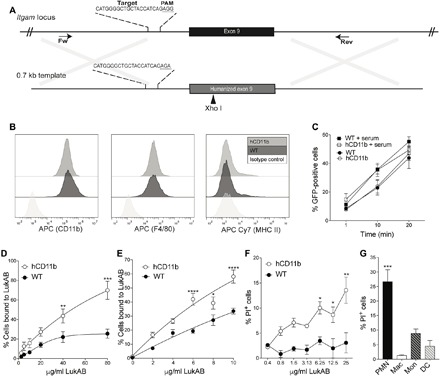
Many pathogens produce virulence factors that are specific toward their natural host. Clinically relevant methicillin-resistant (MRSA) isolates are highly adapted to humans and produce an array of human-specific virulence factors. One such factor is LukAB, a recently identified pore-forming toxin that targets human phagocytes by binding to the integrin component CD11b. LukAB exhibits strong tropism toward human, but not murine, CD11b. Here, phylogenetics and biochemical studies lead to the identification of an 11-residue domain required for the specificity of LukAB toward human CD11b, which is sufficient to render murine CD11b compatible with toxin binding. CRISPR-mediated gene editing was used to replace this domain, resulting in a "humanized" mouse. In vivo studies revealed that the humanized mice exhibit enhanced susceptibility to MRSA bloodstream infection, a phenotype mediated by LukAB. Thus, these studies establish LukAB as an important toxin for MRSA bacteremia and describe a new mouse model to study MRSA pathobiology.
许多病原体产生的毒力因子具有宿主特异性。临床上相关的耐甲氧西林金黄色葡萄球菌(MRSA)分离株高度适应人类,并产生一系列人类特异性的毒力因子。其中一种因子是 LukAB,这是一种最近发现的孔形成毒素,通过与整合素成分 CD11b 结合靶向人类吞噬细胞。LukAB 对人类而非小鼠的 CD11b 表现出强烈的嗜性。在这里,系统发育和生化研究导致鉴定出 LukAB 对人类 CD11b 特异性所必需的 11 残基结构域,该结构域足以使小鼠 CD11b 与毒素结合相容。使用 CRISPR 介导的基因编辑来替换该结构域,从而产生“人源化”小鼠。体内研究表明,人源化小鼠对 MRSA 血流感染的易感性增强,这一表型是由 LukAB 介导的。因此,这些研究确立了 LukAB 是 MRSA 菌血症的重要毒素,并描述了一种新的小鼠模型来研究 MRSA 病理生物学。