Thoraxcenter, Department of Cardiothoracic Surgery, Erasmus University Medical Center, Rotterdam, The Netherlands.
Department of Cardiothoracic and Vascular Surgery, German Heart Centre Berlin, Berlin, Germany.
ESC Heart Fail. 2020 Jun;7(3):1085-1094. doi: 10.1002/ehf2.12629. Epub 2020 Mar 20.
Sufficient myocardial recovery with the subsequent explantation of a left ventricular assist device (LVAD) occurs in approximately 1-2% of the cases. However, follow-up data about this condition are scarcely available in the literature. This study aimed to report the long-term outcomes and clinical management following LVAD explantation.
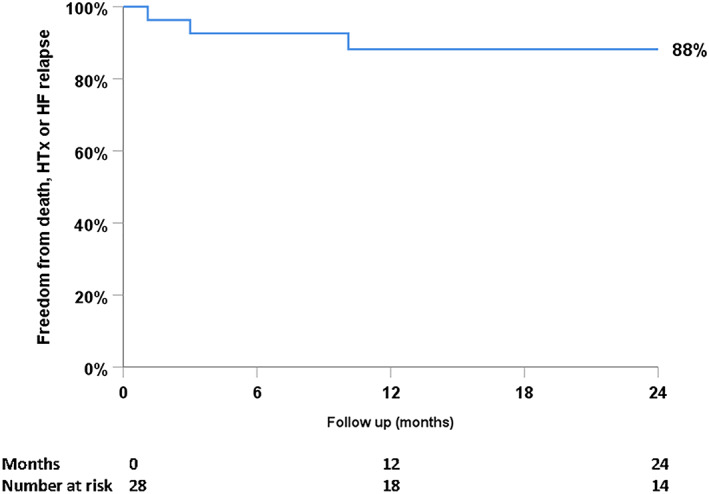
An analysis of the European Registry for Patients with Mechanical Circulatory Support was performed to identify all adult patients with myocardial recovery and successful explantation. Pre-implant characteristics were retrieved and compared with the non-recovery patients. The follow-up data after explantation were collected via a questionnaire. A Kaplan-Meier analysis for freedom of the composite endpoint of death, heart transplantation, LVAD reimplantion, or heart failure (HF) relapse was conducted. A total of 45 (1.4%) cases with myocardial recovery resulting in successful LVAD explantation were identified. Compared with those who did not experience myocardial recovery, the explanted patients were younger (44 vs. 56 years, P < 0.001), had a shorter duration of cardiac disease (P < 0.001), and were less likely to have ischaemic cardiomyopathy (9% vs. 41.8%, P < 0.001). Follow-up after explantation could be acquired in 28 (62%) cases. The median age at LVAD implantation was 43 years (inter-quartile range: 29-52), and 23 (82%) were male. Baseline left ventricular ejection fraction was 18% (inter-quartile range: 10-20%), and 60.7% of the patients had Interagency Registry for Mechanically Assisted Circulatory Support Profile 1 or 2. Aetiologies of HF were dilated cardiomyopathy in 36%, myocarditis in 32%, and ischaemic in 14% of the patients, and 18% had miscellaneous aetiologies. The devices implanted were HeartMate II in 14 (50%), HVAD in 11 (39%), HeartMate 3 in 2 (7%), and 1 unknown with a median duration of support of 410 days (range: 59-1286). The median follow-up after explantation was 26 months (range 0.3-73 months), and 82% of the patients were in New York Heart Association Class I or II. Beta-blockers were prescribed to 85%, angiotensin-converting enzyme inhibitors to 71%, and loop diuretics to 50% of the patients, respectively. Freedom from the composite endpoint was 100% after 30 days and 88% after 2 years.
The survival after LVAD explantation is excellent without the need for heart transplantation or LVAD reimplantation. Only a minority of the patients suffer from a relapse of significant HF.
大约有 1-2%的左心室辅助装置(LVAD)植入患者会出现充分的心肌恢复,并随后进行 LVAD 取出。然而,文献中几乎没有关于这种情况的随访数据。本研究旨在报告 LVAD 取出后的长期结果和临床管理。
对欧洲机械循环支持患者注册中心进行了分析,以确定所有出现心肌恢复并成功进行 LVAD 取出的成年患者。检索了植入前的特征,并与未出现心肌恢复的患者进行了比较。通过问卷调查收集了取出后的随访数据。对死亡、心脏移植、LVAD 再植入或心力衰竭(HF)复发的复合终点的无事件生存率进行了 Kaplan-Meier 分析。共确定了 45 例(1.4%)出现心肌恢复并成功进行 LVAD 取出的病例。与未出现心肌恢复的患者相比,接受 LVAD 取出的患者年龄更小(44 岁 vs. 56 岁,P<0.001),心脏疾病病程更短(P<0.001),缺血性心肌病的可能性更小(9% vs. 41.8%,P<0.001)。在 28 例(62%)患者中获取了取出后的随访数据。LVAD 植入时的中位年龄为 43 岁(四分位距:29-52),23 例(82%)为男性。植入前左心室射血分数为 18%(四分位距:10-20%),60.7%的患者有 Interagency Registry for Mechanically Assisted Circulatory Support Profile 1 或 2。HF 的病因分别为扩张型心肌病(36%)、心肌炎(32%)、缺血性(14%)和其他病因(18%)。植入的装置分别为 HeartMate II 14 例(50%)、HVAD 11 例(39%)、HeartMate 3 2 例(7%)和 1 例未知,中位支持时间为 410 天(范围:59-1286 天)。取出后的中位随访时间为 26 个月(范围 0.3-73 个月),82%的患者纽约心脏协会(NYHA)心功能分级为 I 或 II 级。分别有 85%、71%和 50%的患者处方了β受体阻滞剂、血管紧张素转换酶抑制剂和袢利尿剂。30 天后的复合终点无事件生存率为 100%,2 年后为 88%。
LVAD 取出后患者的存活率很高,无需心脏移植或 LVAD 再植入。只有少数患者出现严重 HF 复发。