Division of Microbiology, Graduate School of Medicine, The University of Tokyo, Tokyo, Japan.
Max-Planck Center for Integrative Inflammology, The University of Tokyo, Tokyo, Japan.
Cancer Sci. 2020 May;111(5):1596-1606. doi: 10.1111/cas.14391. Epub 2020 Apr 13.
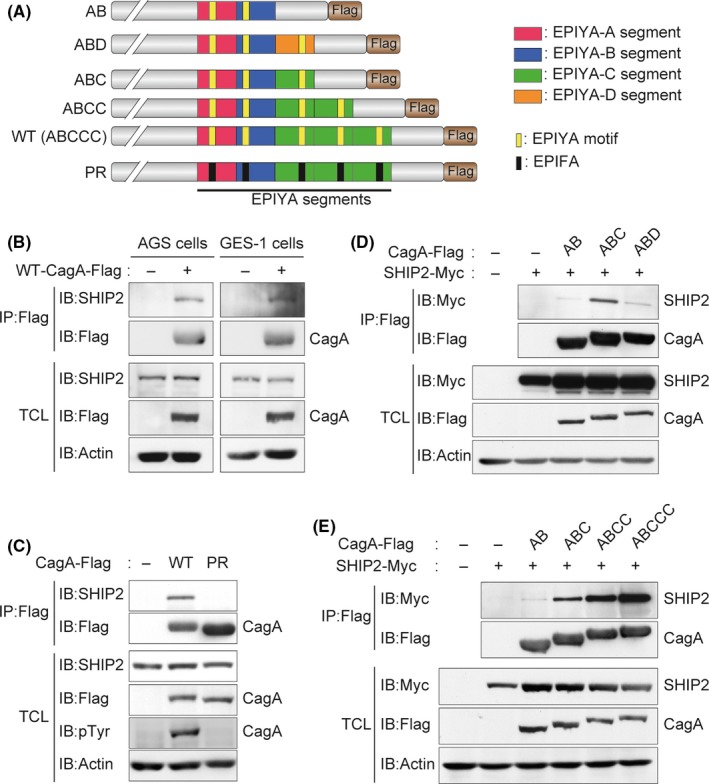
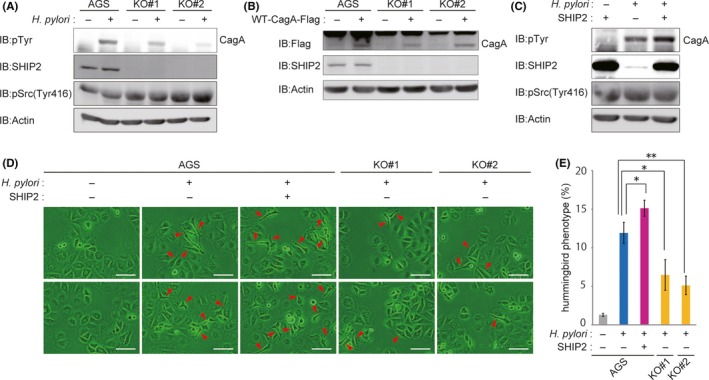
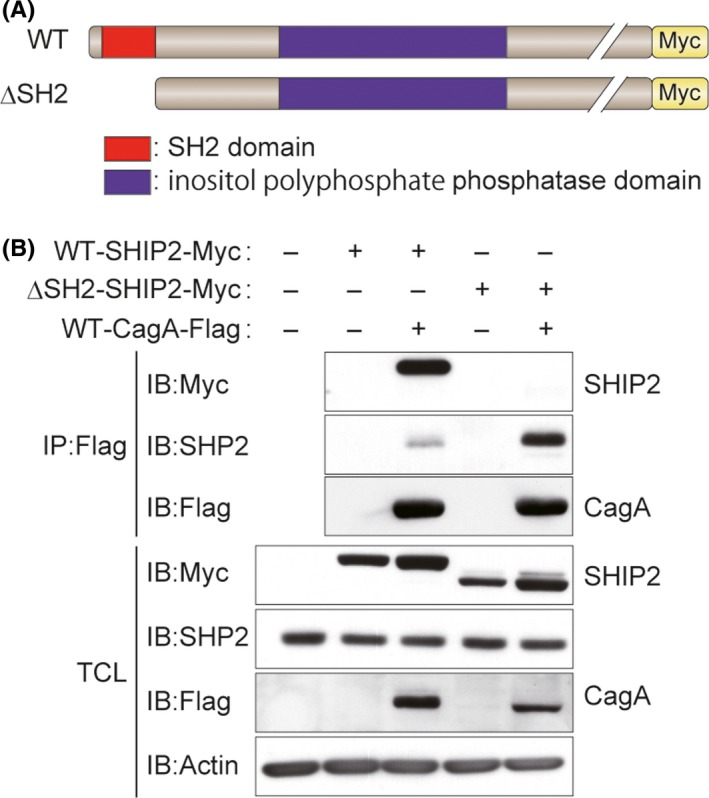
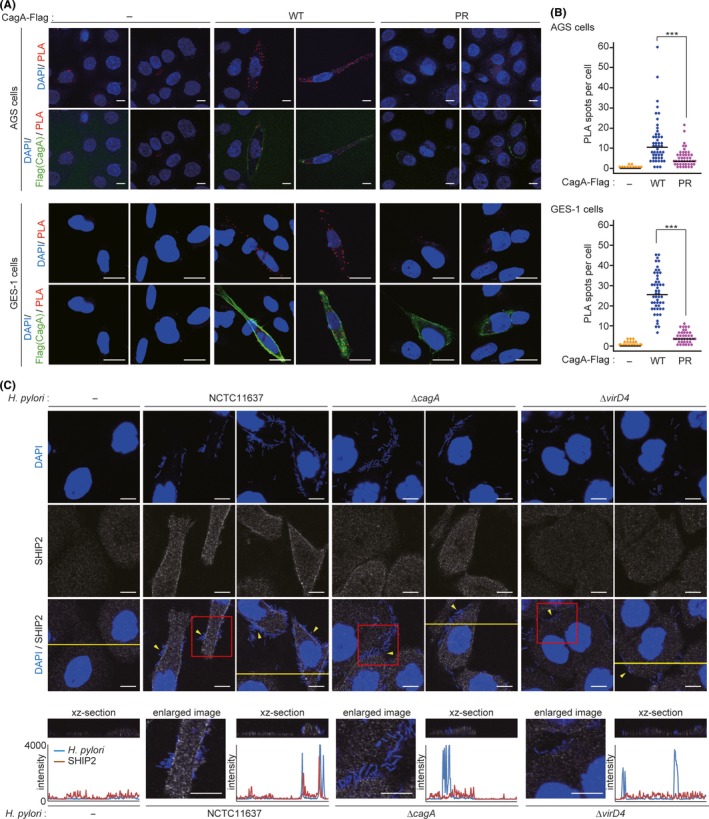
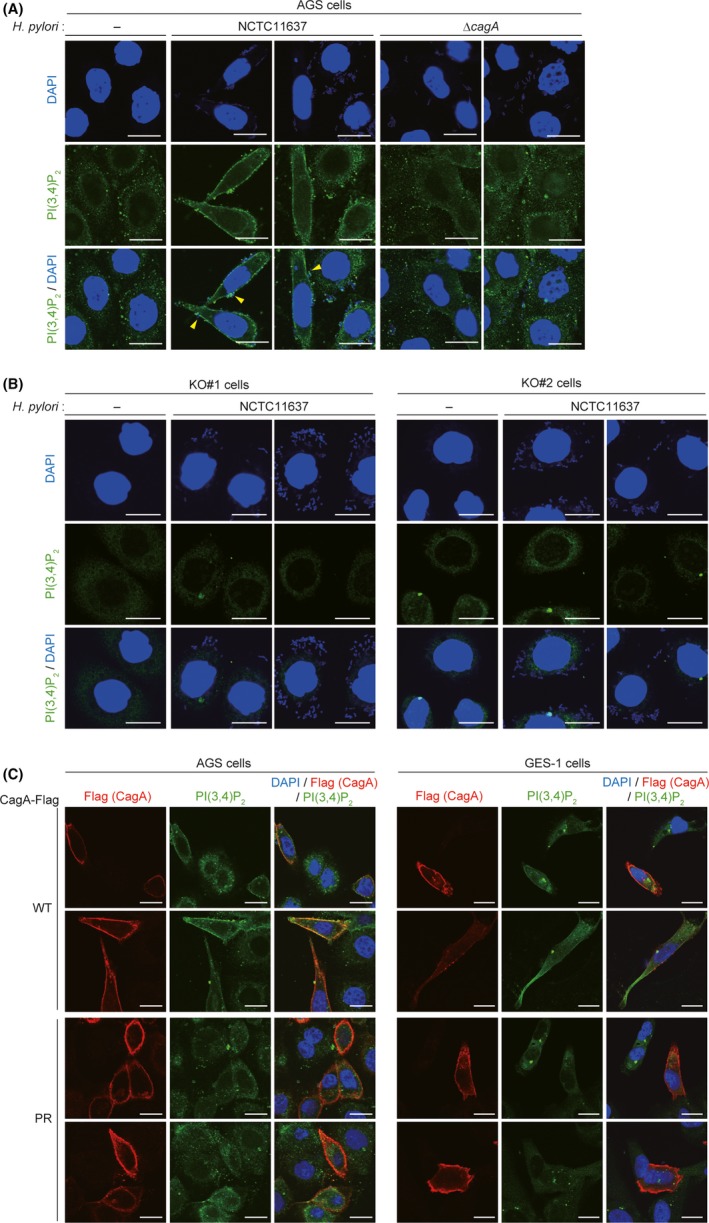
Chronic infection with Helicobacter pylori cagA-positive strains is causally associated with the development of gastric diseases, most notably gastric cancer. The cagA-encoded CagA protein, which is injected into gastric epithelial cells by bacterial type IV secretion, undergoes tyrosine phosphorylation at the Glu-Pro-Ile-Tyr-Ala (EPIYA) segments (EPIYA-A, EPIYA-B, EPIYA-C, and EPIYA-D), which are present in various numbers and combinations in its C-terminal polymorphic region, thereby enabling CagA to promiscuously interact with SH2 domain-containing host cell proteins, including the prooncogenic SH2 domain-containing protein tyrosine phosphatase 2 (SHP2). Perturbation of host protein functions by aberrant complex formation with CagA has been considered to contribute to the development of gastric cancer. Here we show that SHIP2, an SH2 domain-containing phosphatidylinositol 5'-phosphatase, is a hitherto undiscovered CagA-binding host protein. Similar to SHP2, SHIP2 binds to the Western CagA-specific EPIYA-C segment or East Asian CagA-specific EPIYA-D segment through the SH2 domain in a tyrosine phosphorylation-dependent manner. In contrast to the case of SHP2, however, SHIP2 binds more strongly to EPIYA-C than to EPIYA-D. Interaction with CagA tethers SHIP2 to the plasma membrane, where it mediates production of phosphatidylinositol 3,4-diphosphate [PI(3,4)P ]. The CagA-SHIP2 interaction also potentiates the morphogenetic activity of CagA, which is caused by CagA-deregulated SHP2. This study indicates that initially delivered CagA interacts with SHIP2 and thereby strengthens H. pylori-host cell attachment by altering membrane phosphatidylinositol compositions, which potentiates subsequent delivery of CagA that binds to and thereby deregulates the prooncogenic phosphatase SHP2.
慢性感染 cagA 阳性的幽门螺旋杆菌菌株与胃部疾病的发展有关,尤其是胃癌。cagA 编码的 CagA 蛋白通过细菌 IV 型分泌系统注入胃上皮细胞,在 Glu-Pro-Ile-Tyr-Ala(EPIYA)片段(EPIYA-A、EPIYA-B、EPIYA-C 和 EPIYA-D)上发生酪氨酸磷酸化,其 C 末端多态性区域存在各种数量和组合的 EPIYA 片段,从而使 CagA 能够与富含 SH2 结构域的宿主细胞蛋白随机相互作用,包括致癌性 SH2 结构域含有蛋白酪氨酸磷酸酶 2(SHP2)。CagA 通过与异常复合物的形成对宿主蛋白功能的干扰被认为有助于胃癌的发展。在这里,我们表明,SHIP2,一种含有 SH2 结构域的磷酸肌醇 5'-磷酸酶,是一种迄今未被发现的 CagA 结合宿主蛋白。与 SHP2 相似,SHIP2 通过 SH2 结构域以酪氨酸磷酸化依赖性方式与西方 CagA 特异性 EPIYA-C 片段或东亚 CagA 特异性 EPIYA-D 片段结合。然而,与 SHP2 不同的是,SHIP2 与 EPIYA-C 的结合强度强于与 EPIYA-D 的结合强度。与 CagA 的相互作用将 SHIP2 固定在质膜上,在质膜上它介导磷脂酰肌醇 3,4-二磷酸[PI(3,4)P2]的产生。CagA-SHIP2 相互作用还增强了 CagA 的形态发生活性,这是由 CagA 调节的 SHP2 引起的。这项研究表明,最初递送至宿主细胞的 CagA 与 SHIP2 相互作用,通过改变膜磷脂酰肌醇组成来增强 H. pylori-宿主细胞的附着,从而增强随后递送至与 SHP2 结合并调节致癌性磷酸酶 SHP2 的 CagA 的递呈。