Zhao Mutong, Liang Yuan, Shen Chunping, Wang Ying, Ma Lin, Ma Xiuhua
Department of Dermatology, Beijing Children's Hospital, National Center for Children's Health, Capital Medical University, Beijing, 100045, China.
Department of Obstetrics and Gynecology, Beijing Daxing District People's Hospital, Daxing Teaching Hospital, Capital Medical University, Beijing, 102600, China.
Dermatol Ther (Heidelb). 2020 Jun;10(3):449-464. doi: 10.1007/s13555-020-00365-z. Epub 2020 Mar 21.
Patient education is crucial for improving disease outcomes in atopic dermatitis (AD). This review aims to summarize evidence about the effectiveness of educational programs for parents of pediatric AD patients.
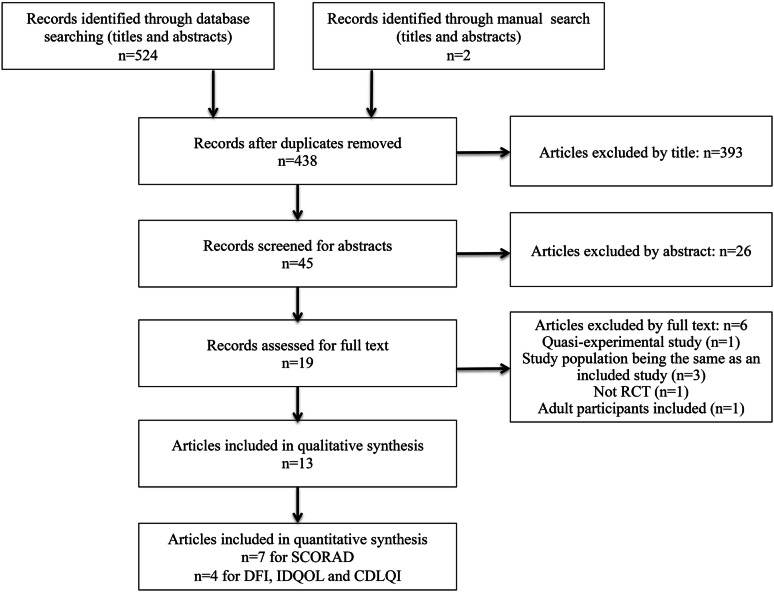
PubMed and Embase (inception to Feb 2020) were searched and randomized controlled trials (RCTs) in English were included. Risk of bias was assessed using Cochrane risk of bias tools and quality of evidence was assessed by Grading of Recommendations Assessment, Development and Evaluation (GRADE). Pooled standardized mean difference (SMD) and 95% confidence intervals (CIs) were calculated for the disease severity instrument (Scoring of Atopic Dermatitis, SCORAD) and quality of life (QoL) instruments using the random-effects model.
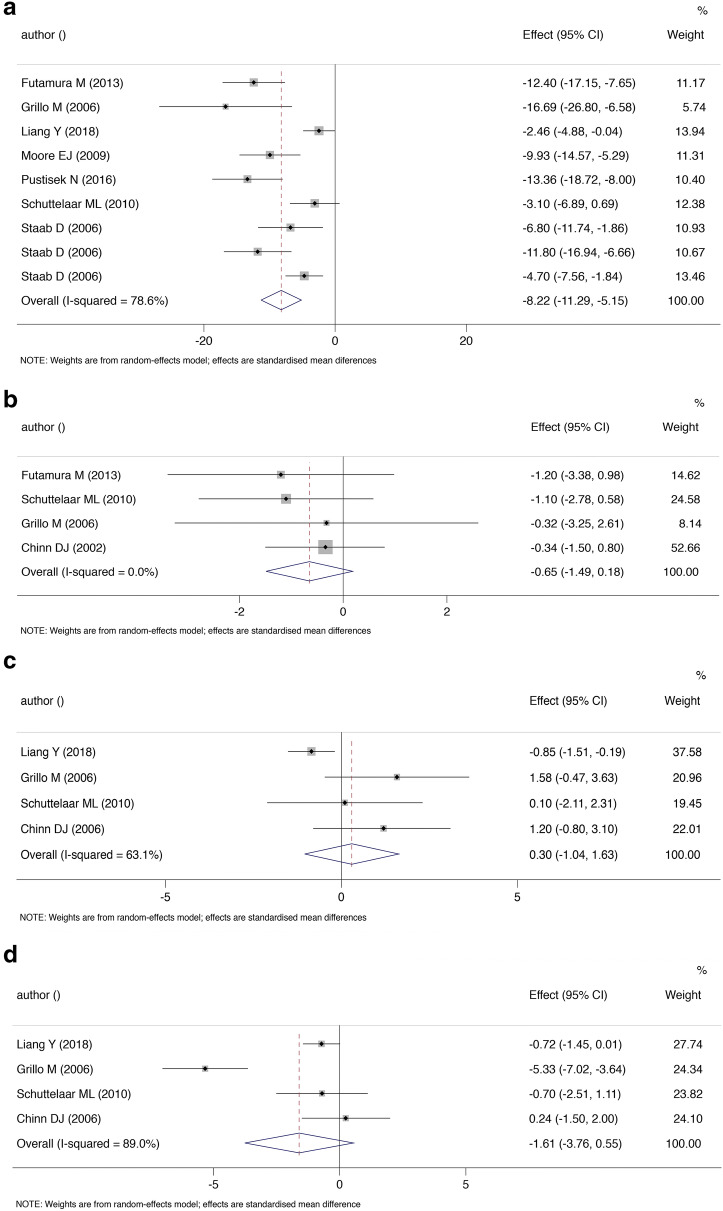
A total of 13 RCTs were included in the systematic review. The meta-analysis of SCORAD contained seven studies with a total of 1853 patients. The reduction in disease severity (SCORAD) was larger in the treatment group (SMD = - 8.22, 95% CI = - 11.29, - 5.15; P < 0.001; I = 78.6%). Subgroup analyses revealed that the association was modified by the frequency of sessions (P for Cochran Q < 0.01) and the duration of follow-up (P for Cochran Q < 0.01). No significant effect-modification was observed for disease severity and borderline significance was observed for session delivery (individual vs group session). The pooled effect sizes for QoL measures including Dermatitis Family Index (SMD = - 0.65, 95% CI = - 1.49, 0.18), Children's Dermatology Life Quality Index (SMD = - 1.61, 95% CI = - 3.76, 0.55; I= 89.0%) and Infants' Dermatology Quality of Life Index (SMD = 0.30, 95% CI = - 1.04, 1.63; I= 63.1%) were not significant.
Structured patient education is beneficial and should be implemented for the management of AD patients. However, an optimal delivery mode needs to be determined.
患者教育对于改善特应性皮炎(AD)的疾病预后至关重要。本综述旨在总结有关针对小儿AD患者家长的教育项目有效性的证据。
检索了PubMed和Embase(从创刊至2020年2月),纳入了英文随机对照试验(RCT)。使用Cochrane偏倚风险工具评估偏倚风险,并通过推荐分级评估、制定与评价(GRADE)对证据质量进行评估。使用随机效应模型计算疾病严重程度工具(特应性皮炎评分,SCORAD)和生活质量(QoL)工具的合并标准化均数差(SMD)及95%置信区间(CI)。
系统评价共纳入13项RCT。SCORAD的荟萃分析包含7项研究,共1853例患者。治疗组疾病严重程度(SCORAD)的降低幅度更大(SMD = -8.22,95%CI = -11.29,-5.15;P < 0.001;I² = 78.6%)。亚组分析显示,该关联因课程频率( Cochr an Q检验的P < 0.01)和随访时间( Cochr an Q检验的P < 0.01)而有所改变。对于疾病严重程度未观察到显著的效应修饰,对于课程授课方式(个体授课与小组授课)观察到临界显著性。包括皮炎家庭指数(SMD = -0.65,95%CI = -1.49,0.18)、儿童皮肤病生活质量指数(SMD = -1.61,95%CI = -3.76,0.55;I² = 89.0%)和婴儿皮肤病生活质量指数(SMD = 0.30,95%CI = -1.04,1.63;I² = 63.1%)在内的QoL测量的合并效应量不显著。
结构化的患者教育是有益的,应实施于AD患者的管理中。然而,需要确定最佳的授课方式。