INSERM CIC 1433 Nancy CHRU Inserm U1116 FCRIN INI-CRCT University of Lorraine Nancy France.
Paris University Paris France.
J Am Heart Assoc. 2020 Apr 7;9(7):e013836. doi: 10.1161/JAHA.119.013836. Epub 2020 Mar 21.
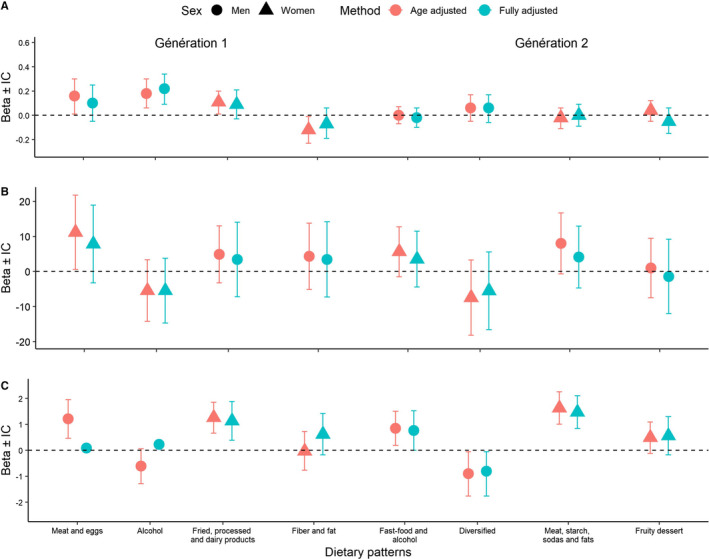
Background The diet impact on cardiovascular diseases has been investigated widely, but the association between dietary patterns (DPs) and subclinical cardiovascular damage remains unclear. More informative DPs could be provided by considering metabolic syndrome components as intermediate markers. This study aimed to identify DPs according to generation and sex using reduced-rank regression (RRR) with metabolic syndrome components as intermediate markers and assess their associations with intima-media thickness, left ventricular mass, and carotid-femoral pulse-wave velocity in an initially healthy population-based family study. Methods and Results This study included 1527 participants from the STANISLAS (Suivi Temporaire Annuel Non-Invasif de la Santé des Lorrains Assurés Sociaux) cohort fourth examination. DPs were derived using reduced-rank regression according to generation (G1: age ≥50 years; G2: age <50 years) and sex. Associations between DPs and cardiovascular damage were analyzed using multivariable linear regression models. Although identified DPs were correlated between generations and sex, qualitative differences were observed: whereas only unhealthy DPs were found for both men generations, healthy DPs were identified in G2 ("fruity desserts") and G1 ("fiber and w3 oil") women. The "alcohol," "fast food and alcohol," "fried, processed, and dairy products," and "meat, starch, sodas, and fat" DPs in G1 and G2 men and in G1 and G2 women, respectively, were associated with high left ventricular mass (β [95% CI], 0.23 [0.10-0.36], 0.76 [0.00-1.52], 1.71 [0.16-3.26], and 1.80 [0.45-3.14]). The "alcohol" DP in G1 men was positively associated with carotid-femoral pulse-wave velocity (0.22 [0.09-0.34]). Conclusions The DPs that explain the maximum variation in metabolic syndrome components had different associations with subclinical cardiovascular damage across generation and sex. Our results indicate that dietary recommendations should be tailored according to age and sex. Clinical Trial Registration URL: http://www.clinicaltrials.gov. Unique identifier: NCT01391442.
人们广泛研究了饮食对心血管疾病的影响,但饮食模式(DPs)与亚临床心血管损伤之间的关联仍不清楚。通过将代谢综合征成分作为中间标志物,可以提供更具信息量的 DPs。本研究旨在使用基于代谢综合征成分的降秩回归(RRR),根据世代和性别确定 DPs,并评估其与初始健康人群的内中膜厚度、左心室质量和颈动脉-股动脉脉搏波速度的关系。
本研究纳入了 STANISLAS(Suivi Temporaire Annuel Non-Invasif de la Santé des Lorrains Assurés Sociaux)队列第四次检查的 1527 名参与者。根据世代(G1:年龄≥50 岁;G2:年龄<50 岁)和性别使用降秩回归确定 DPs。使用多变量线性回归模型分析 DPs 与心血管损伤之间的关系。尽管确定的 DPs 在世代和性别之间存在相关性,但观察到了定性差异:尽管仅在两代男性中发现了不健康的 DPs,但在 G2 中发现了健康的 DPs(“水果甜点”),在 G1 中发现了健康的 DPs(“纤维和 w3 油”)。G1 和 G2 男性以及 G1 和 G2 女性中的“酒精”、“快餐和酒精”、“油炸、加工和乳制品”以及“肉类、淀粉、苏打水和脂肪”DPs 分别与左心室质量升高相关(β[95%CI],0.23[0.10-0.36],0.76[0.00-1.52],1.71[0.16-3.26]和 1.80[0.45-3.14])。G1 男性中的“酒精”DP 与颈动脉-股动脉脉搏波速度呈正相关(0.22[0.09-0.34])。
解释代谢综合征成分最大变化的 DPs 与亚临床心血管损伤的关联在世代和性别上存在差异。我们的研究结果表明,饮食建议应根据年龄和性别进行调整。