Xie Hao, Lafky Jacqueline M, Morlan Bruce W, Stella Philip J, Dakhil Shaker R, Gross Gerald G, Loui William S, Hubbard Joleen M, Alberts Steven R, Grothey Axel
Division of Medical Oncology, Mayo Clinic, Rochester, MN, USA.
Alliance Statistics and Data Center, Mayo Clinic, Rochester, MN, USA Department of Biostatistics, Mayo Clinic, Rochester, MN, USA.
Ther Adv Med Oncol. 2020 Mar 6;12:1758835920910913. doi: 10.1177/1758835920910913. eCollection 2020.
Bevacizumab (BEV), a monoclonal antibody against vascular endothelial growth factor-A (VEGF-A), is a standard component of medical therapy of metastatic colorectal cancer (mCRC). Activation of alternative angiogenesis pathways has been implicated in resistance to BEV. This phase II study examines the activity of combined vertical blockade of VEGF signaling with sorafenib and BEV as salvage therapy in patients with progressive disease (PD) on all standard therapy in mCRC.
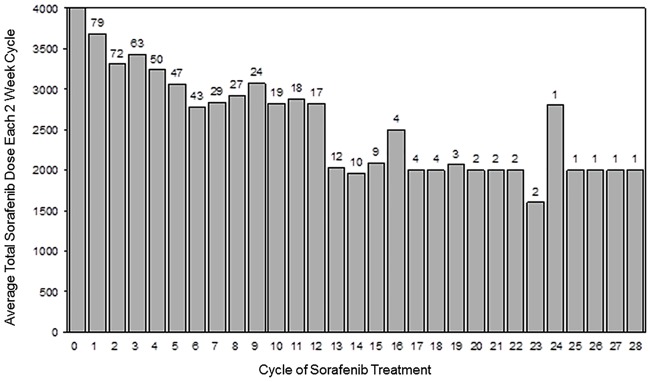
mCRC patients with documented PD on standard therapy, received sorafenib (200 mg orally twice daily, days 1-5 and 8-12) and BEV (5 mg/kg intravenously, day 1) every 2 weeks. Primary endpoint was 3-month progression-free survival (PFS) rate and secondary endpoints were overall survival (OS), response rate (RR), safety, and feasibility.
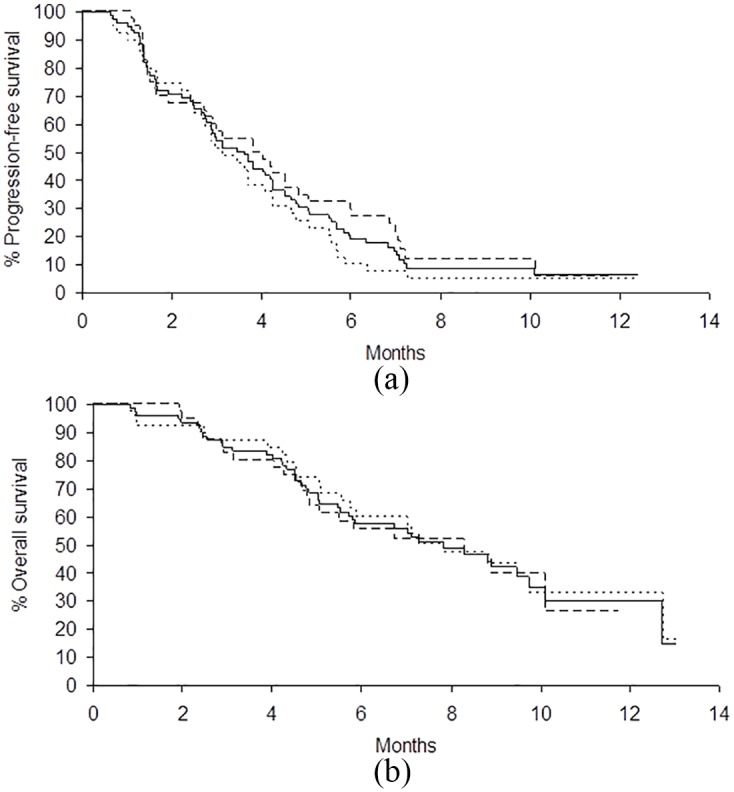
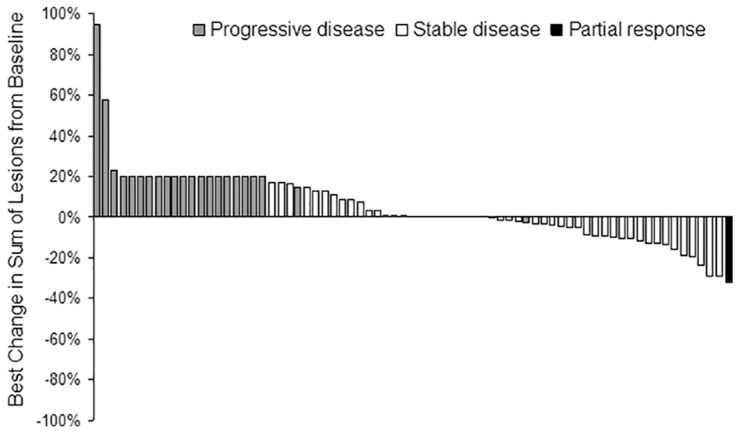
Of the 83 patients enrolled, 79 were evaluable. Of these, 42 (53%) were progression-free at 3 months. Median PFS was 3.5 months and median OS was 8.3 months. One patient had a partial response and 50 patients (63.3%) had at least one stable tumor assessment. Of 79 evaluable patients, 54 (68%) experienced grade 3/4 adverse events (AEs) at least possibly related to treatment. Most frequent grade 3/4 AEs were: fatigue (24.1%), hypertension (16.5%), elevated lipase (8.9%), hand-foot skin reaction (8.9%), diarrhea (7.6%), and proteinuria (7.6%). Reasons for treatment discontinuation were PD (72%), AEs (18%), patient refusal (8%), physician decision (1%), and death (1%).
The combination of BEV and sorafenib as salvage therapy in heavily pretreated mCRC patients is tolerable and manageable, with evidence of promising activity.
NCT00826540, URL:http://clinicaltrials.gov/ct2/show/NCT00826540.
贝伐单抗(BEV)是一种抗血管内皮生长因子-A(VEGF-A)的单克隆抗体,是转移性结直肠癌(mCRC)医学治疗的标准组成部分。替代血管生成途径的激活与对BEV的耐药性有关。这项II期研究考察了索拉非尼联合垂直阻断VEGF信号通路与BEV作为挽救疗法,用于mCRC中所有标准治疗后出现疾病进展(PD)患者的活性。
标准治疗后记录有PD的mCRC患者,每2周接受索拉非尼(200mg口服,每日2次,第1 - 5天和第8 - 12天)和BEV(5mg/kg静脉注射,第1天)治疗。主要终点为3个月无进展生存期(PFS)率,次要终点为总生存期(OS)、缓解率(RR)、安全性和可行性。
83例入组患者中,79例可评估。其中,42例(53%)在3个月时无进展。中位PFS为3.5个月,中位OS为8.3个月。1例患者部分缓解,50例患者(63.3%)至少有一次肿瘤稳定评估。79例可评估患者中,54例(68%)经历了至少可能与治疗相关的3/4级不良事件(AE)。最常见的3/4级AE为:疲劳(24.1%)、高血压(16.5%)、脂肪酶升高(8.9%)、手足皮肤反应(8.9%)、腹泻(7.6%)和蛋白尿(7.6%)。治疗中断的原因是PD(72%)、AE(18%)、患者拒绝(8%)、医生决定(1%)和死亡(1%)。
BEV和索拉非尼联合作为挽救疗法用于预处理严重的mCRC患者是可耐受和可管理的,有证据表明活性良好。
NCT00826540,网址:http://clinicaltrials.gov/ct2/show/NCT00826540 。