R&D Center, Metimedi Pharmaceuticals, 263, Central-ro, Yeonsu-gu, Incheon 22006, Korea.
Gachon Institute of Pharmaceutical Science, Gachon University, 191, Hambangmoe-ro, Yeonsu-gu, Incheon 21936, Korea.
Molecules. 2020 Nov 13;25(22):5299. doi: 10.3390/molecules25225299.
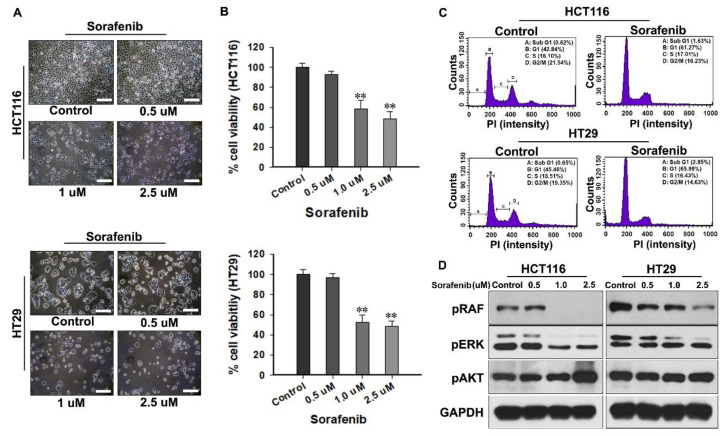
Sorafenib has been recently used for the treatment of patients with advanced colorectal cancer (CRC) and is recognized for its therapeutic value. However, the continuous use of sorafenib may cause resistance in the treatment of cancer patients. In this study, we investigated whether sorafenib exerts an enhanced anticancer effect on CRC cells via the calcium-mediated deactivation of the focal adhesion kinase (FAK) signaling pathways. The appropriate dose of sorafenib and lactate calcium salt (CaLa) for a combination treatment were determined using 3-(4,5-dimethylthiazol-2-yl)-2,5-diphenyltetrazolium bromide assays. Then, cell cycle analysis was performed following treatment with 2.5 μM sorafenib and/or 2.5 mM CaLa. CRC cells were found to be in the G1 phase by sorafenib treatment, and they accumulated in the sub-G1 phase with CaLa treatment. Western blots and enzyme-linked immunosorbent assays were performed to analyze the elements of the recombinant activated factor (RAF) and focal adhesion kinase (FAK) signaling cascades. Sorafenib-inhibited RAF-dependent signaling in CRC cells, however, either did not affect the expression of Akt or increased it. As the upstream signaling of FAK was suppressed by CaLa, we observed that the expression of the sub-signaling phospho (p) AKT and p-mammalian target of rapamycin was also suppressed. Treatment with a combination of sorafenib and CaLa enhanced the antitumor activity of CRC cells. The % viability of CRC cells was significantly decreased compared to the single treatment with sorafenib or CaLa, and the accumulation of Sub G1 of CRC cells was clearly confirmed. The migration ability of CRC cells was significantly reduced. The findings of this study indicate that sorafenib will show further improved antitumor efficacy against CRC due to overcoming resistance through the use of CaLa.
索拉非尼最近被用于治疗晚期结直肠癌(CRC)患者,其治疗价值得到了认可。然而,索拉非尼的连续使用可能会导致癌症患者产生耐药性。在这项研究中,我们研究了索拉非尼是否通过钙介导的粘着斑激酶(FAK)信号通路失活来增强对 CRC 细胞的抗癌作用。使用 3-(4,5-二甲基噻唑-2-基)-2,5-二苯基四氮唑溴盐(MTT)检测法确定了索拉非尼和乳酸钙盐(CaLa)的合适剂量用于联合治疗。然后,用 2.5 μM 索拉非尼和/或 2.5 mM CaLa 处理后进行细胞周期分析。结果显示,索拉非尼处理使 CRC 细胞处于 G1 期,而 CaLa 处理则使细胞在亚 G1 期积累。通过 Western blot 和酶联免疫吸附测定分析了重组激活因子(RAF)和粘着斑激酶(FAK)信号级联的元素。然而,索拉非尼抑制了 CRC 细胞中 RAF 依赖性信号,但对 Akt 的表达没有影响,反而增加了 Akt 的表达。由于 CaLa 抑制了 FAK 的上游信号,我们观察到亚信号磷酸化(p)AKT 和 p-雷帕霉素靶蛋白的表达也受到抑制。索拉非尼和 CaLa 联合治疗增强了 CRC 细胞的抗肿瘤活性。与单独使用索拉非尼或 CaLa 相比,CRC 细胞的存活率显著降低,并且 CRC 细胞的亚 G1 期积累明显。CRC 细胞的迁移能力显著降低。这项研究的结果表明,由于通过使用 CaLa 克服耐药性,索拉非尼将对 CRC 显示出进一步提高的抗肿瘤疗效。