White River Junction VA Medical Center, White River Junction, VT, United States of America.
Section of Urology Dartmouth Hitchcock Medical Center, Lebanon, NH, United States of America.
PLoS One. 2020 Mar 23;15(3):e0230417. doi: 10.1371/journal.pone.0230417. eCollection 2020.
To assess the association of low- vs. guideline-recommended high-intensity cystoscopic surveillance with outcomes among patients with high-risk non-muscle invasive bladder cancer (NMIBC).
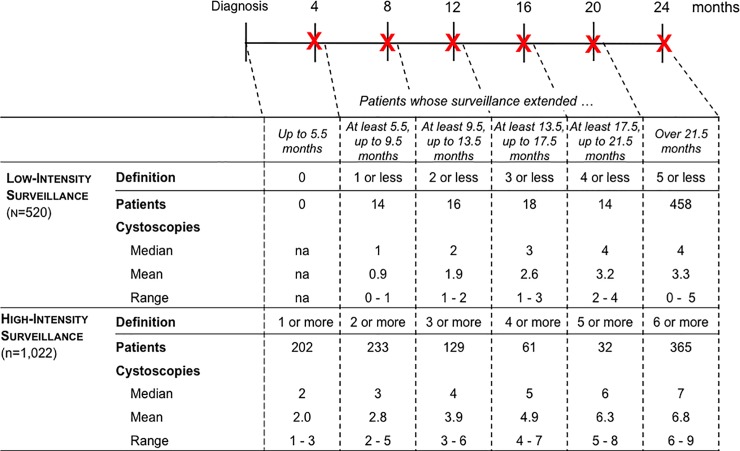
MATERIALS & METHODS: A retrospective cohort study of Veterans Affairs patients diagnosed with high-risk NMIBC between 2005 and 2011 with follow-up through 2014. Patients were categorized by number of surveillance cystoscopies over two years following diagnosis: low- (1-5) vs. high-intensity (6 or more) surveillance. Propensity score adjusted regression models were used to assess the association of low-intensity cystoscopic surveillance with frequency of transurethral resections, and risk of progression to invasive disease and bladder cancer death.
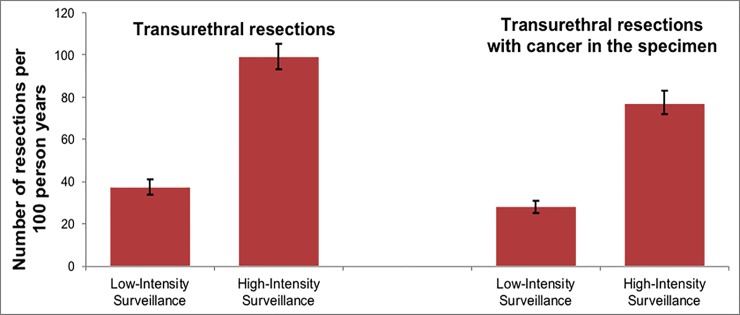
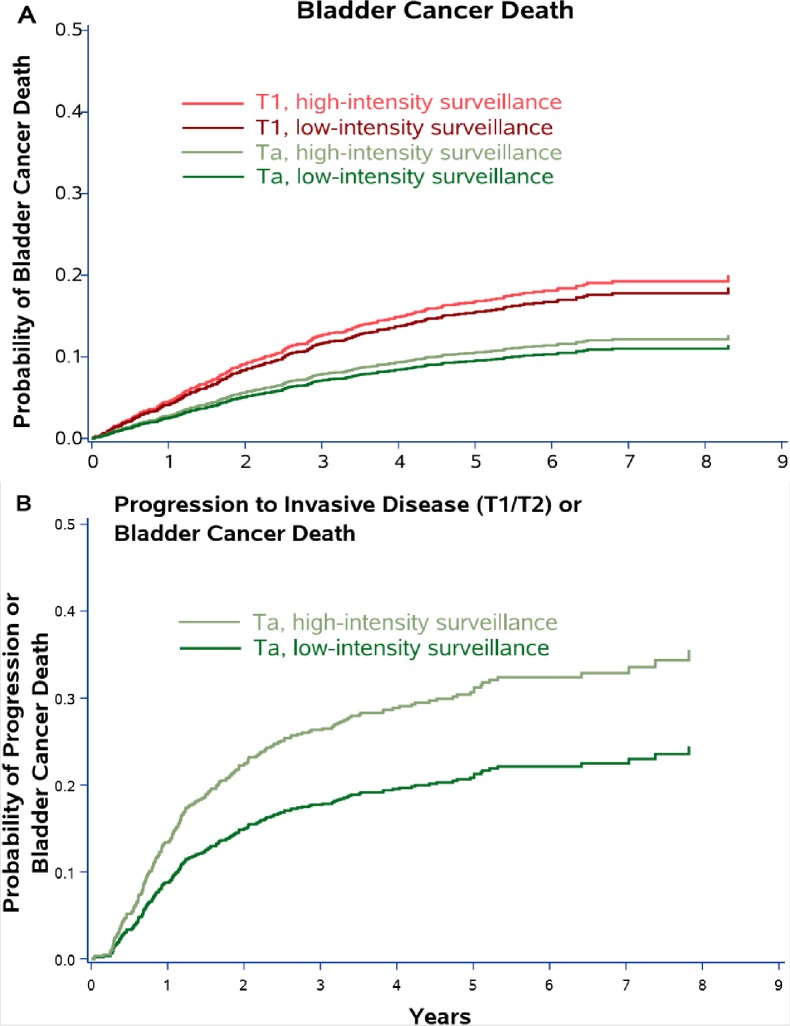
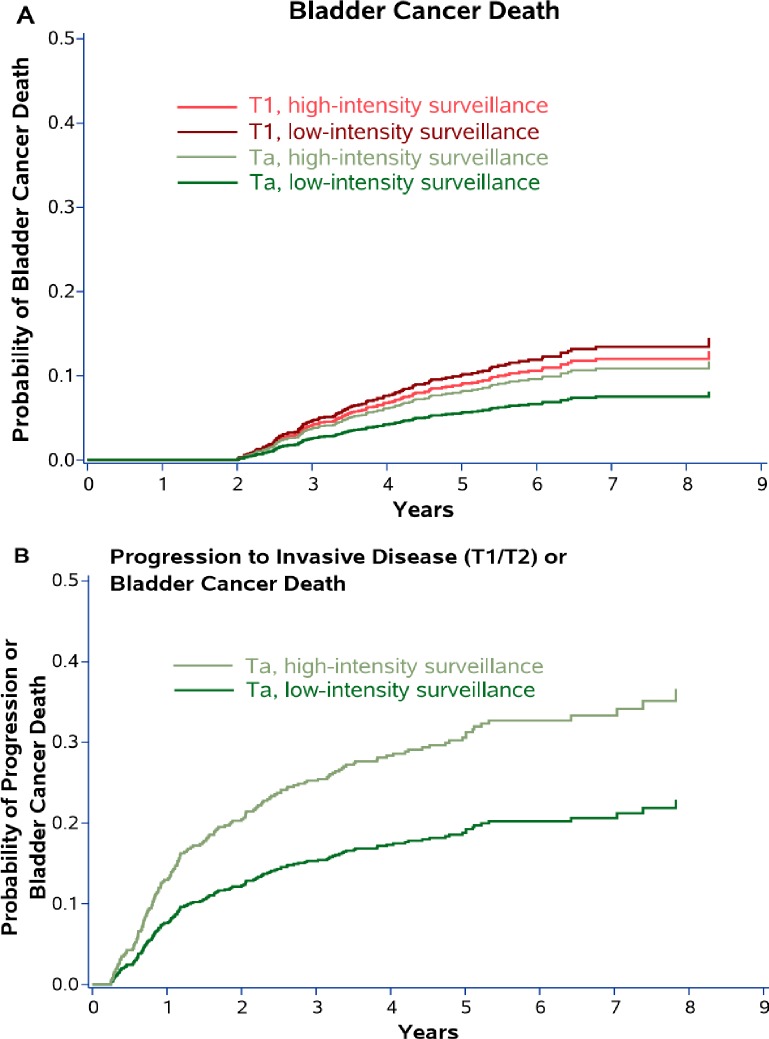
Among 1,542 patients, 520 (33.7%) underwent low-intensity cystoscopic surveillance. Patients undergoing low-intensity surveillance had fewer transurethral resections (37 vs. 99 per 100 person-years; p<0.001). Risk of death from bladder cancer did not differ significantly by low (cumulative incidence [CIn] 8.4% [95% CI 6.5-10.9) at 5 years) vs. high-intensity surveillance (CIn 9.1% [95% CI 7.4-11.2) at 5 years, p = 0.61). Low vs. high-intensity surveillance was not associated with increased risk of bladder cancer death among patients with Ta (CIn 5.7% vs. 8.2% at 5 years p = 0.24) or T1 disease at diagnosis (CIn 10.2% vs. 9.1% at 5 years, p = 0.58). Among patients with Ta disease, low-intensity surveillance was associated with decreased risk of progression to invasive disease (T1 or T2) or bladder cancer death (CIn 19.3% vs. 31.3% at 5 years, p = 0.002).
Patients with high-risk NMIBC undergoing low- vs. high-intensity cystoscopic surveillance underwent fewer transurethral resections, but did not experience an increased risk of progression or bladder cancer death. These findings provide a strong rationale for a clinical trial to determine whether low-intensity surveillance is comparable to high-intensity surveillance for cancer control in high-risk NMIBC.
评估低强度与指南推荐的高强度膀胱镜监测在高危非肌肉浸润性膀胱癌(NMIBC)患者中的结局。
这是一项退伍军人事务部患者的回顾性队列研究,这些患者在 2005 年至 2011 年间被诊断为高危 NMIBC,并在 2014 年之前进行了随访。根据诊断后两年内接受的膀胱镜检查次数,患者被分为低强度(1-5 次)与高强度(6 次或更多次)监测组。采用倾向评分调整回归模型来评估低强度膀胱镜监测与经尿道切除术频率、进展为侵袭性疾病和膀胱癌死亡风险之间的关系。
在 1542 名患者中,520 名(33.7%)接受了低强度膀胱镜监测。接受低强度监测的患者接受的经尿道切除术更少(每 100 人年 37 次 vs. 99 次;p<0.001)。膀胱癌死亡风险在低强度(5 年累积发病率 [CIn] 8.4%[95%CI 6.5-10.9])和高强度监测组(CIn 9.1%[95%CI 7.4-11.2])之间无显著差异(p = 0.61)。低强度与高强度监测与诊断时 Ta(5 年 CIn 5.7% vs. 8.2%,p = 0.24)或 T1 疾病(5 年 CIn 10.2% vs. 9.1%,p = 0.58)患者的膀胱癌死亡风险增加无关。在 Ta 疾病患者中,低强度监测与进展为侵袭性疾病(T1 或 T2)或膀胱癌死亡的风险降低相关(5 年 CIn 19.3% vs. 31.3%,p = 0.002)。
高危 NMIBC 患者行低强度与高强度膀胱镜监测,前者接受的经尿道切除术更少,但进展或膀胱癌死亡风险无增加。这些发现为高危 NMIBC 患者的临床试验提供了强有力的理由,以确定低强度监测是否与高强度监测一样可实现癌症控制。