Department of Community Health Sciences, University of Manitoba, Manitoba, Canada.
Department of Psychology, Brandon University, Manitoba, Canada.
PLoS One. 2020 Mar 23;15(3):e0230673. doi: 10.1371/journal.pone.0230673. eCollection 2020.
Although a large body of research has focused on social isolation and loneliness, few studies have examined social isolation and loneliness together. The objectives of this study were to examine: 1) the relationship between four groups derived from combining social isolation and loneliness (socially isolated and lonely; only socially isolated; only lonely; neither socially isolated nor lonely) and the desire for more social participation, and social support; and 2) the relationship between the four groups and psychological distress.
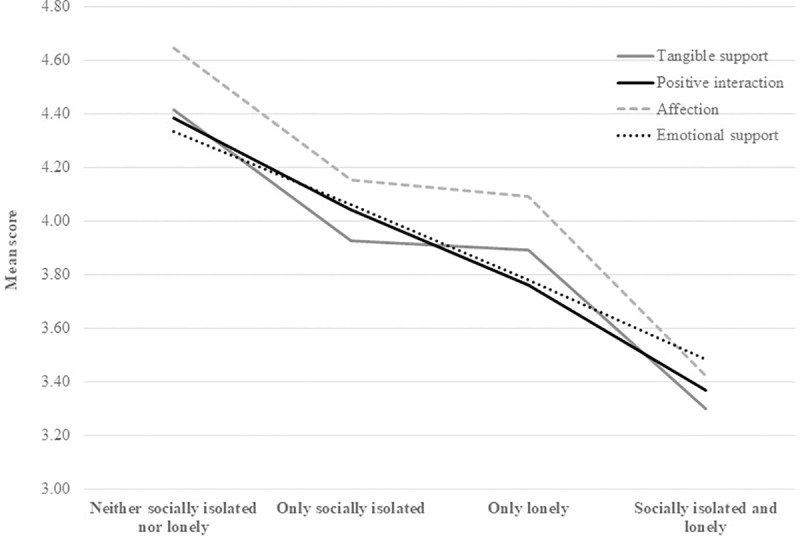
The study was based on the Comprehensive Cohort of the Canadian Longitudinal Study on Aging. Using CLSA baseline data (unweighted N = 30,079), ordinary and logistic regression analysis was used to examine the cross-sectional relationship between the four social isolation/loneliness groups and desire for more social participation and four types of social support (tangible, positive interaction, affection, and emotional support). Prospective logistic regression analysis was possible for psychological distress, which was derived from the Maintaining Contact Questionnaire administered about 18 months after the baseline questionnaire (unweighted N = 28,789).
Findings indicate that being socially isolated and lonely was associated with the most social support gaps; this group also had an increased likelihood of psychological distress, relative to those who were neither socially isolated nor lonely. Participants who were only socially isolated, and those only lonely also perceived some social support gaps. In addition, the only lonely group was more likely to be psychologically distressed than the only socially isolated group and the neither isolated nor lonely group.
Examining the four social isolation/loneliness was useful, as it provided more nuanced risk profiles than would have been possible had we examined social isolation and loneliness separately. Findings may suggest avenues for interventions tailored to the unique needs of at-risk individuals.
尽管大量研究集中在社会孤立和孤独上,但很少有研究同时考察社会孤立和孤独。本研究的目的是检验:1)将社会孤立和孤独相结合而得出的四个群体(既社会孤立又孤独;仅社会孤立;仅孤独;既不社会孤立也不孤独)与渴望更多社会参与和社会支持之间的关系;2)这四个群体与心理困扰之间的关系。
该研究基于加拿大老龄化纵向研究的综合队列。使用 CLSA 基线数据(未加权 N=30079),采用普通和逻辑回归分析,检验了四个社会孤立/孤独群体与渴望更多社会参与和四种类型的社会支持(有形支持、积极互动、情感和情感支持)之间的横断面关系。对于大约在基线问卷 18 个月后进行的《保持联系问卷》中得出的心理困扰,可进行前瞻性逻辑回归分析(未加权 N=28789)。
研究结果表明,既社会孤立又孤独与最大的社会支持差距有关;与既不社会孤立也不孤独的人相比,该群体出现心理困扰的可能性也增加了。仅社会孤立的参与者和仅孤独的参与者也感觉到了一些社会支持差距。此外,与仅社会孤立的群体和既不孤立也不孤独的群体相比,仅孤独的群体更有可能出现心理困扰。
考察四个社会孤立/孤独是有用的,因为它提供了比单独考察社会孤立和孤独更细致的风险特征。研究结果可能为针对高危个体的特定需求的干预措施提供途径。