Microscopy Service Laboratory, Basic Research Division, Department of Medical Research, Taipei Veterans General Hospital, Taipei 11217, Taiwan.
Institute of Biophotonics, School of Medical Technology & Engineering, National Yang-Ming University, Taipei 11221, Taiwan.
Sensors (Basel). 2020 Mar 19;20(6):1712. doi: 10.3390/s20061712.
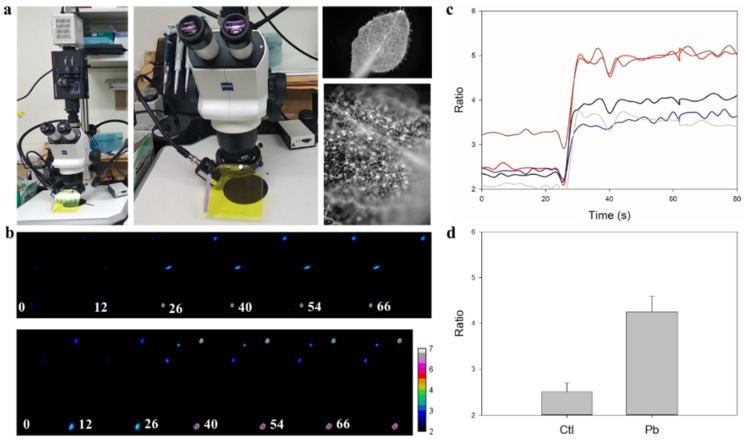
The harmful impact of the heavy metal lead on human health has been known for years. However, materials that contain lead remain in the environment. Measuring the blood lead level (BLL) is the only way to officially evaluate the degree of exposure to lead. The so-called "safe value" of the BLL seems to unreliably represent the secure threshold for children. In general, lead's underlying toxicological mechanism remains unclear and needs to be elucidated. Therefore, we developed a novel genetically encoded fluorescence resonance energy transfer (FRET)-based lead biosensor, Met-lead, and applied it to transgenic Drosophila to perform further investigations. We combined Met-lead with the system to the sensor protein specifically expressed within certain regions of fly brains. Using a suitable imaging platform, including a fast epifluorescent or confocal laser-scanning/two-photon microscope with high resolution, we recorded the changes in lead content inside fly brains ex vivo and in vivo and at different life stages. The blood-brain barrier was found to play an important role in the protection of neurons in the brain against damage due to the heavy metal lead, either through food or microinjection into the abdomen. Met-lead has the potential to be a powerful tool for the sensing of lead within living organisms by employing either a fast epi-FRET microscope or high-resolution brain imaging.
多年来,人们已经了解重金属铅对人类健康的有害影响。然而,含有铅的材料仍然存在于环境中。测量血铅水平(BLL)是正式评估铅暴露程度的唯一方法。所谓的 BLL“安全值”似乎不可靠地代表了儿童的安全阈值。一般来说,铅的潜在毒理学机制仍不清楚,需要加以阐明。因此,我们开发了一种新型的基于遗传编码的荧光共振能量转移(FRET)的铅生物传感器 Met-lead,并将其应用于转基因果蝇中进行进一步研究。我们将 Met-lead 与系统结合,将传感器蛋白特异性表达在果蝇大脑的特定区域内。使用合适的成像平台,包括具有高分辨率的快速落射荧光或共聚焦激光扫描/双光子显微镜,我们记录了果蝇大脑内铅含量的变化,无论是在体外、体内还是在不同的生命阶段。发现血脑屏障在保护大脑神经元免受重金属铅的损伤方面发挥了重要作用,无论是通过食物还是通过腹部微注射。Met-lead 有可能成为一种强大的工具,通过使用快速 epi-FRET 显微镜或高分辨率大脑成像来检测生物体内的铅。