Griseti Elena, Merbahi Nofel, Golzio Muriel
CNRS UMR 5089, Institut de Pharmacologie et de Biologie Structurale, IPBS, 205 Route de Narbonne, 31077 Toulouse, France.
CNRS UMR 5213, Laboratoire des Plasmas et Conversion d'Énergie, Université Toulouse III- Paul Sabatier, LAPLACE, 118 Route de Narbonne-Bât, 3R3-31062 Toulouse, France.
Cancers (Basel). 2020 Mar 19;12(3):721. doi: 10.3390/cancers12030721.
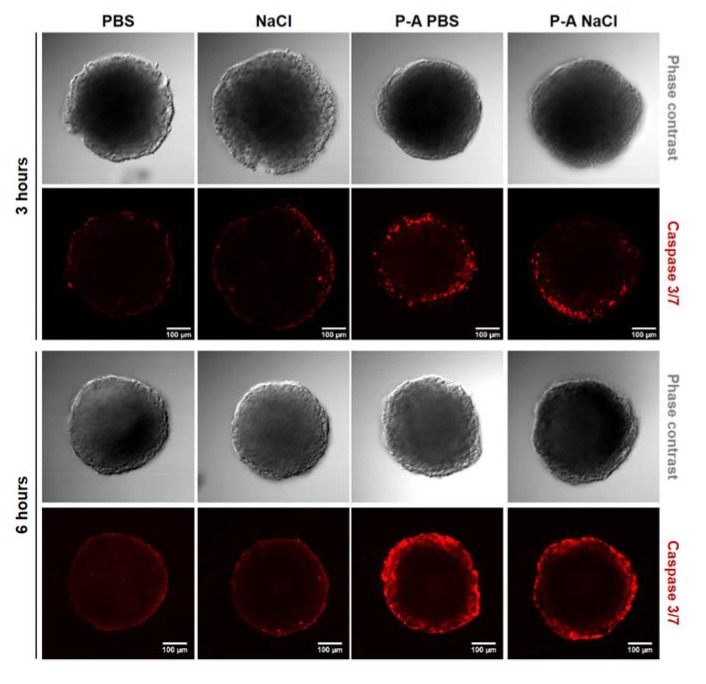
Cold atmospheric plasma-exposed culture medium may efficiently kill cancer cells in vitro. Due to the complexity of the medium obtained after plasma exposure, less complex physiological liquids, such as saline solutions and saline buffers, are gathering momentum. Among the plethora of reactive oxygen and nitrogen species (RONS) that are produced in these plasma-activated liquids, hydrogen peroxide, nitrite and nitrate appear to be mainly responsible for cytotoxic and genotoxic effects. Here, we evaluated the anti-cancer potential of plasma-activated phosphate-buffered saline (P-A PBS) and sodium chloride 0.9% (P-A NaCl), using a three-dimensional tumor model. Two epithelial cancer cell lines were used to evaluate cellular effects of either P-A PBS or P-A NaCl. Human colorectal cancer cells HCT 116 and human ovarian carcinoma, SKOV-3 were used to investigate the manner by which different cell types respond to different plasma-activated liquids treatments. Our investigations indicate that P-A PBS is more efficient than P-A NaCl mainly because RONS are produced in larger quantities. Indeed, we show that the cytotoxicity of these liquids directly correlates with the concentration of hydrogen peroxide and nitrite. Moreover, P-A PBS induced a faster-occurring and more pronounced cell death, which arose within deeper layers of the 3D multicellular spheroid models.
冷大气等离子体处理过的培养基在体外可能有效地杀死癌细胞。由于等离子体处理后获得的培养基成分复杂,成分较简单的生理液体,如盐溶液和盐缓冲液,正越来越受到关注。在这些等离子体激活液体中产生的大量活性氧和氮物种(RONS)中,过氧化氢、亚硝酸盐和硝酸盐似乎是细胞毒性和基因毒性作用的主要原因。在此,我们使用三维肿瘤模型评估了等离子体激活的磷酸盐缓冲盐水(P-A PBS)和0.9%氯化钠(P-A NaCl)的抗癌潜力。使用两种上皮癌细胞系评估P-A PBS或P-A NaCl的细胞效应。用人结肠癌细胞HCT 116和人卵巢癌细胞SKOV-3研究不同细胞类型对不同等离子体激活液体处理的反应方式。我们的研究表明,P-A PBS比P-A NaCl更有效,主要是因为产生的RONS数量更多。事实上,我们表明这些液体的细胞毒性与过氧化氢和亚硝酸盐的浓度直接相关。此外,P-A PBS诱导更快发生且更明显的细胞死亡,这种细胞死亡发生在三维多细胞球体模型的更深层。