Wang Norman C
Heart and Vascular Institute University of Pittsburgh Medical Center Pittsburgh PA.
J Am Heart Assoc. 2020 Apr 7;9(7):e015959. doi: 10.1161/JAHA.120.015959. Epub 2020 Mar 24.
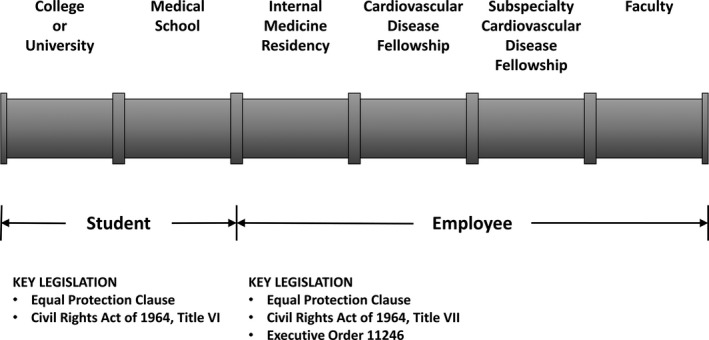
Since 1969, racial and ethnic preferences have existed throughout the American medical academy. The primary purpose has been to increase the number of blacks and Hispanics within the physician workforce as they were deemed to be "underrepresented in medicine." To this day, the goal continues to be population parity or proportional representation. These affirmative action programs were traditionally voluntary, created and implemented at the state or institutional level, limited to the premedical and medical school stages, and intended to be temporary. Despite these efforts, numerical targets for underrepresented minorities set by the Association of American Medical Colleges have consistently fallen short. Failures have largely been attributable to the limited qualified applicant pool and legal challenges to the use of race and ethnicity in admissions to institutions of higher education. In response, programs under the appellation of diversity, inclusion, and equity have recently been created to increase the number of blacks and Hispanics as medical school students, internal medicine trainees, cardiovascular disease trainees, and cardiovascular disease faculty. These new diversity programs are mandatory, created and implemented at the national level, imposed throughout all stages of academic medicine and cardiology, and intended to be permanent. The purpose of this white paper is to provide an overview of policies that have been created to impact the racial and ethnic composition of the cardiology workforce, to consider the evolution of racial and ethnic preferences in legal and medical spheres, to critically assess current paradigms, and to consider potential solutions to anticipated challenges.
自1969年以来,美国医学学术界一直存在种族和族裔偏好。其主要目的是增加医生队伍中黑人和西班牙裔的数量,因为他们被认为在医学领域“代表性不足”。直到今天,目标仍然是人口均等或比例代表制。这些平权行动项目传统上是自愿的,由州或机构层面创建和实施,仅限于医学预科和医学院阶段,并且旨在是临时性的。尽管做出了这些努力,美国医学院协会为代表性不足的少数族裔设定的数字目标一直未能实现。失败主要归因于合格申请人库有限以及高等教育招生中使用种族和族裔面临的法律挑战。作为回应,最近创建了以多样性、包容性和公平性为名义的项目,以增加作为医学院学生、内科实习生、心血管疾病实习生和心血管疾病教员的黑人和西班牙裔人数。这些新的多样性项目是强制性的,在国家层面创建和实施,适用于学术医学和心脏病学的所有阶段,并且旨在是永久性的。本白皮书的目的是概述为影响心脏病学劳动力的种族和族裔构成而制定的政策,考虑法律和医学领域种族和族裔偏好的演变,批判性地评估当前的范式,并考虑应对预期挑战的潜在解决方案。