Davies Timothy J, Stoesser Nicole, Sheppard Anna E, Abuoun Manal, Fowler Philip, Swann Jeremy, Quan T Phuong, Griffiths David, Vaughan Alison, Morgan Marcus, Phan Hang T T, Jeffery Katie J, Andersson Monique, Ellington Matt J, Ekelund Oskar, Woodford Neil, Mathers Amy J, Bonomo Robert A, Crook Derrick W, Peto Tim E A, Anjum Muna F, Walker A Sarah
Nuffield Department of Medicine, Oxford University, Oxford, United Kingdom
National Institute for Health Research Health Protection Research Unit on Healthcare Associated Infections and Antimicrobial Resistance at the University of Oxford, Oxford, United Kingdom.
Antimicrob Agents Chemother. 2020 May 21;64(6). doi: 10.1128/AAC.02026-19.
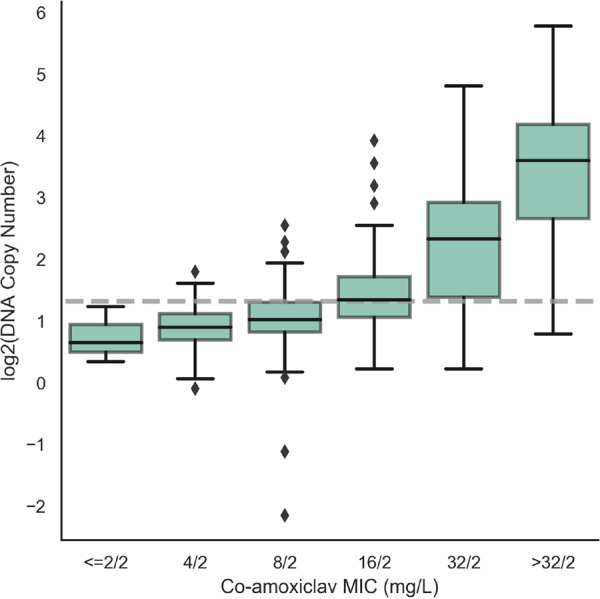
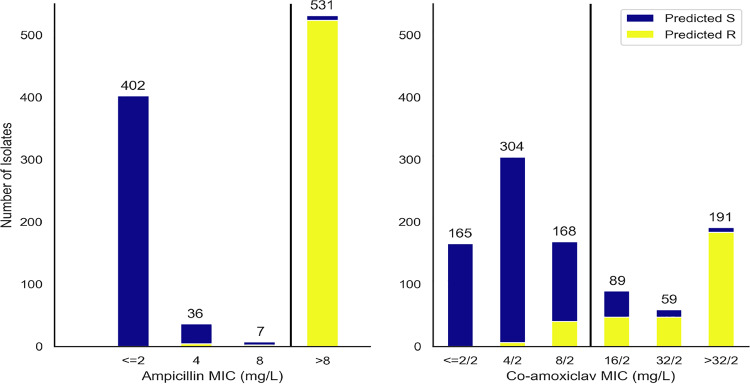
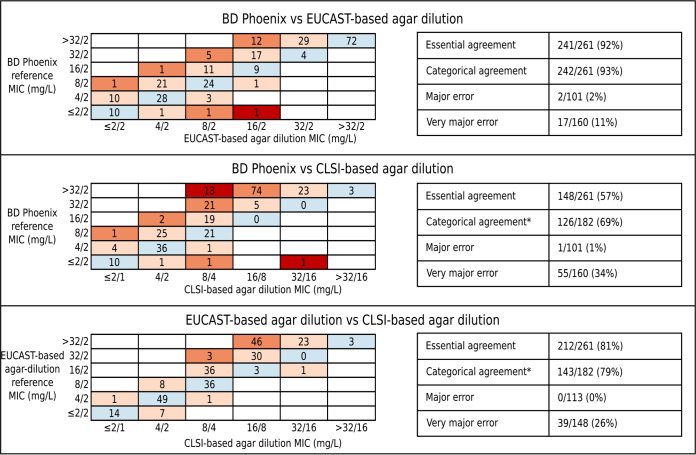
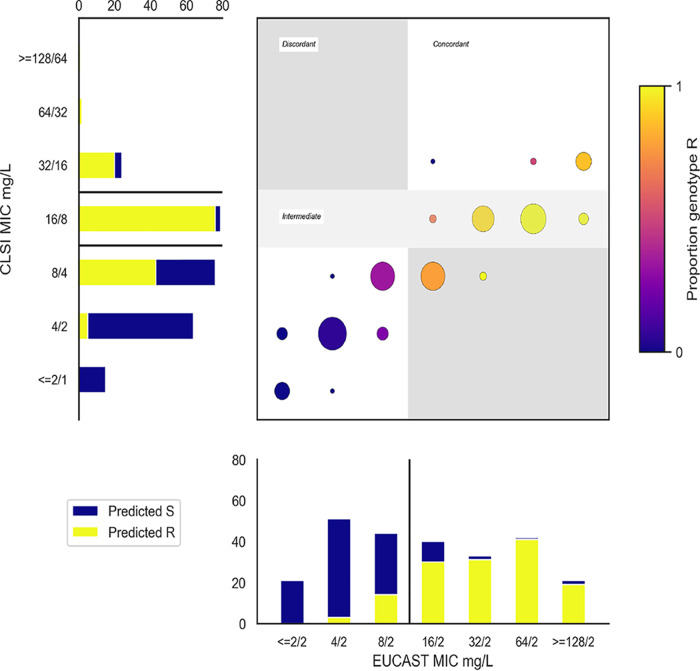
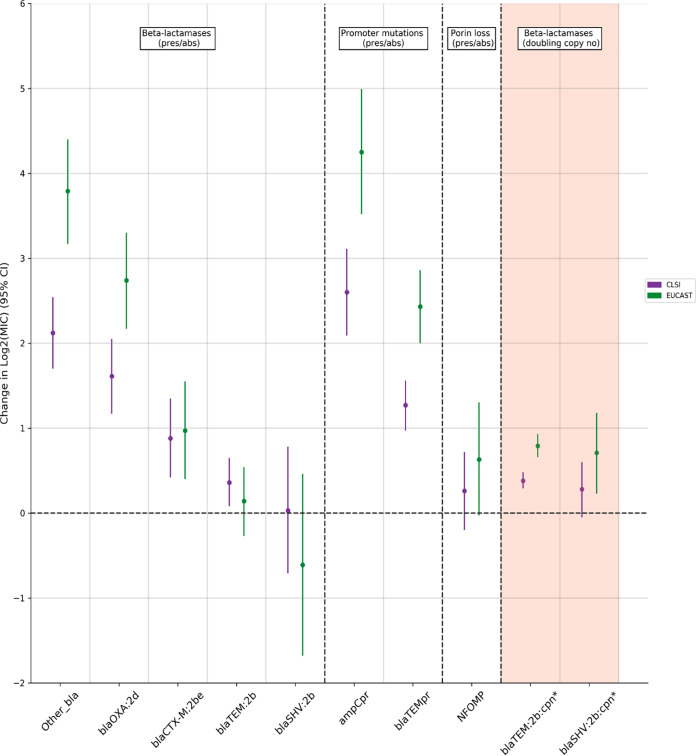
Resistance to amoxicillin-clavulanate, a widely used beta-lactam/beta-lactamase inhibitor combination antibiotic, is rising globally, and yet susceptibility testing remains challenging. To test whether whole-genome sequencing (WGS) could provide a more reliable assessment of susceptibility than traditional methods, we predicted resistance from WGS for 976 bloodstream infection isolates from Oxfordshire, United Kingdom, comparing against phenotypes from the BD Phoenix (calibrated against EUCAST guidelines). A total of 339/976 (35%) isolates were amoxicillin-clavulanate resistant. Predictions based solely on beta-lactamase presence/absence performed poorly (sensitivity, 23% [78/339]) but improved when genetic features associated with penicillinase hyperproduction (e.g., promoter mutations and copy number estimates) were considered (sensitivity, 82% [277/339]; < 0.0001). Most discrepancies occurred in isolates with MICs within ±1 doubling dilution of the breakpoint. We investigated two potential causes: the phenotypic reference and the binary resistant/susceptible classification. We performed reference standard, replicated phenotyping in a random stratified subsample of 261/976 (27%) isolates using agar dilution, following both EUCAST and CLSI guidelines, which use different clavulanate concentrations. As well as disagreeing with each other, neither agar dilution phenotype aligned perfectly with genetic features. A random-effects model investigating associations between genetic features and MICs showed that some genetic features had small, variable and additive effects, resulting in variable resistance classification. Using model fixed-effects to predict MICs for the non-agar dilution isolates, predicted MICs were in essential agreement (±1 doubling dilution) with observed (BD Phoenix) MICs for 691/715 (97%) isolates. This suggests amoxicillin-clavulanate resistance in is quantitative, rather than qualitative, explaining the poorly reproducible binary (resistant/susceptible) phenotypes and suboptimal concordance between different phenotypic methods and with WGS-based predictions.
对阿莫西林-克拉维酸(一种广泛使用的β-内酰胺/β-内酰胺酶抑制剂联合抗生素)的耐药性在全球范围内呈上升趋势,然而药敏试验仍然具有挑战性。为了测试全基因组测序(WGS)是否能比传统方法提供更可靠的药敏评估,我们根据英国牛津郡976株血流感染分离株的WGS预测耐药性,并与BD Phoenix的表型结果(根据EUCAST指南校准)进行比较。总共976株中有339株(35%)对阿莫西林-克拉维酸耐药。仅基于β-内酰胺酶的存在与否进行预测的效果较差(敏感性为23%[78/339]),但在考虑与青霉素酶高产相关的遗传特征(如启动子突变和拷贝数估计)时有所改善(敏感性为82%[277/339];P<0.0001)。大多数差异出现在MIC值在断点±1个稀释倍数范围内的分离株中。我们调查了两个潜在原因:表型参考标准和二元耐药/敏感分类。我们对976株中的261株(27%)分离株进行随机分层抽样,按照EUCAST和CLSI指南(使用不同的克拉维酸浓度),采用琼脂稀释法进行参考标准的重复表型分析。琼脂稀释法的两种表型结果不仅相互不一致,而且均未与遗传特征完全匹配。一项研究遗传特征与MIC之间关联的随机效应模型表明,一些遗传特征具有微小、可变且累加的效应,导致耐药分类结果可变。使用模型固定效应预测非琼脂稀释法分离株的MIC,预测的MIC与观察到的(BD Phoenix)MIC在691/715株(97%)分离株中基本一致(±1个稀释倍数)。这表明血流感染中的阿莫西林-克拉维酸耐药性是定量的,而非定性的,这解释了二元(耐药/敏感)表型的重复性差以及不同表型方法之间和与基于WGS的预测之间的一致性欠佳。