Xu Ziqi, Li Mingyao, Lyu Jinhao, Hou Zhikai, He Jianfeng, Mo Dapeng, Gao Feng, Liu Xin, Sui Binbin, Shen Mi, Pan Yuesong, Wang Yongjun, Lou Xin, Miao Zhongrong, Luo Benyan, Ma Ning
Department of Neurology, The First Affiliated Hospital, College of Medicine, Zhejiang University, Hangzhou, China.
Department of Interventional Neuroradiology, Beijing Tiantan Hospital, Capital Medical University, China National Clinical Research Center for Neurological Diseases, Center of Stroke, Beijing Institute for Brain Disorders, Beijing, China.
Ther Adv Neurol Disord. 2020 Mar 13;13:1756286420909991. doi: 10.1177/1756286420909991. eCollection 2020.
We constructed a high-volume registry to identify whether risk factors of intracranial atherosclerotic plaque (ICAP) features differ in the posterior and anterior circulation in patients with symptomatic intracranial atherosclerotic stenosis (ICAS) investigated by high-resolution magnetic resonance imaging (HRMRI).
The registry was constructed for patients with symptomatic ICAS who underwent HRMRI for culprit plaques. ICAP-vulnerable features included positive remodelling, diffuse distribution, intraplaque haemorrhage and strong enhancement.
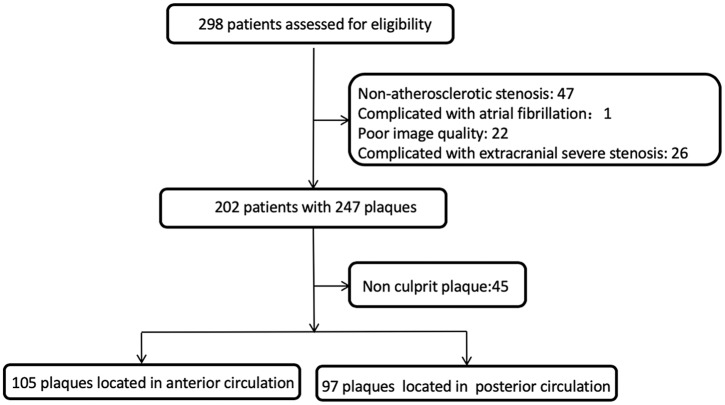
We analysed risk factors for the same ICAP features between the posterior and anterior circulation in data of 97 patients in the posterior circulation and 105 patients in the anterior circulation ICAPs. In patients with diffuse distribution, the probability of being female were lower [odds ratio (OR):0.08; 95% confidence interval (CI):0.02-0.34; = 0.001] and having diabetes mellitus was higher (OR: 7.75; 95% CI:1.75-34.39; = 0.007) in posterior circulation patients. In patients with strong enhancement, the probability of having diabetes was higher in posterior circulation patients (OR:6.71; 95% CI:1.37-32.81; = 0.019).
Our results demonstrate more risk factors in the posterior than in the anterior circulation in patients with the same ICAP-vulnerable features, highlighting the need for stratification of risk factors in symptomatic ICAPs.
URL: http://www.clinicaltrials.gov. Unique identifier: NCT02705599.
我们构建了一个大容量登记系统,以确定在通过高分辨率磁共振成像(HRMRI)研究的有症状颅内动脉粥样硬化狭窄(ICAS)患者中,颅内动脉粥样硬化斑块(ICAP)特征的危险因素在后循环和前循环中是否存在差异。
该登记系统针对因罪犯斑块接受HRMRI检查的有症状ICAS患者构建。ICAP易损特征包括阳性重塑、弥漫分布、斑块内出血和强化明显。
我们分析了后循环97例患者和前循环105例患者ICAP数据中相同ICAP特征的危险因素。在弥漫分布的患者中,后循环患者为女性的概率较低[比值比(OR):0.08;95%置信区间(CI):0.02 - 0.34;P = 0.001],患糖尿病的概率较高(OR:7.75;95% CI:1.75 - 34.39;P = 0.007)。在强化明显的患者中,后循环患者患糖尿病的概率较高(OR:6.71;95% CI:1.37 - 32.81;P = 0.019)。
我们的结果表明,具有相同ICAP易损特征的患者中,后循环的危险因素比前循环更多,这突出了对有症状ICAP危险因素进行分层的必要性。