Department of Radiation Oncology, The First People's Hospital of Nantong, Nantong, Jiangsu, China (mainland).
Department of Radiation Oncology, The First Affiliated Hospital of Soochow University, Suzhou, Jiangsu, China (mainland).
Med Sci Monit. 2020 Mar 24;26:e920642. doi: 10.12659/MSM.920642.
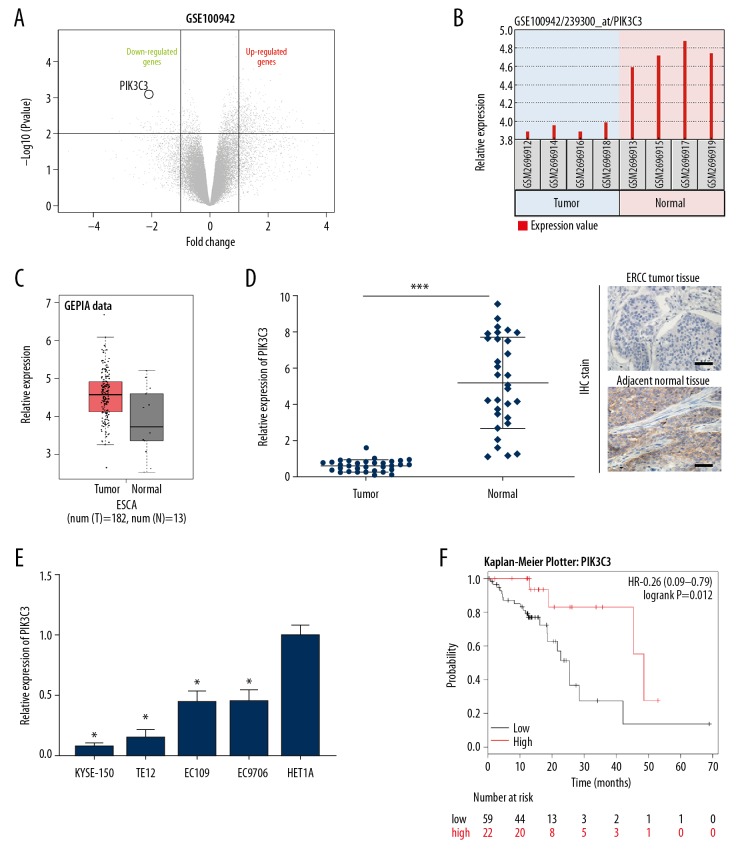
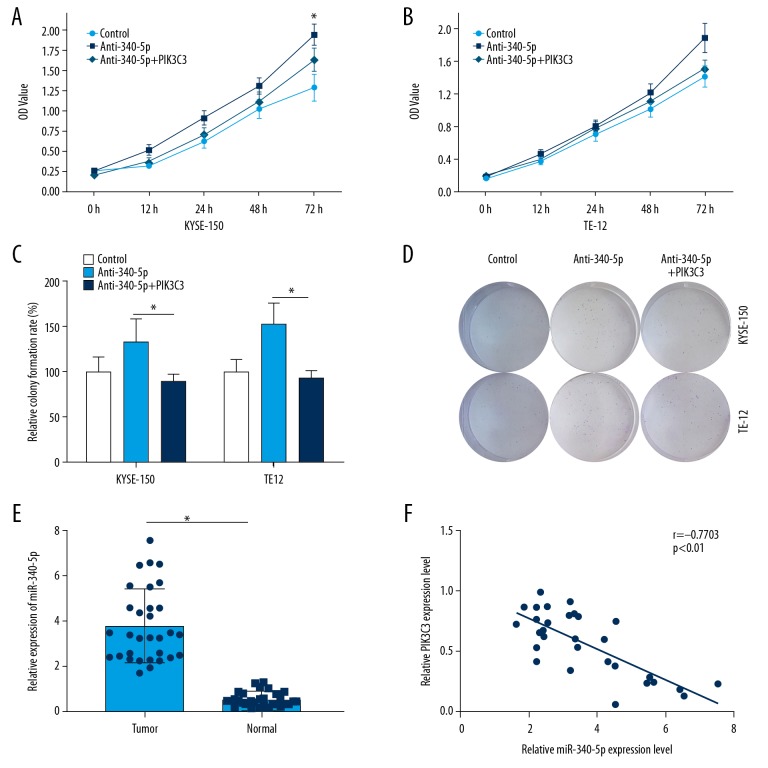
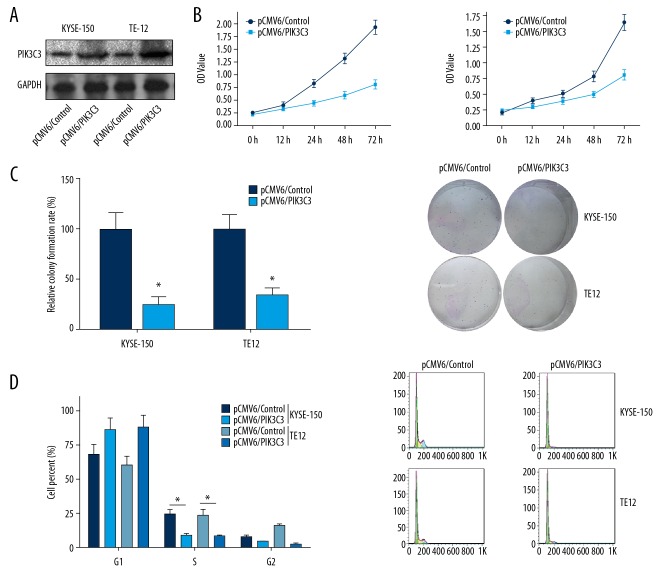
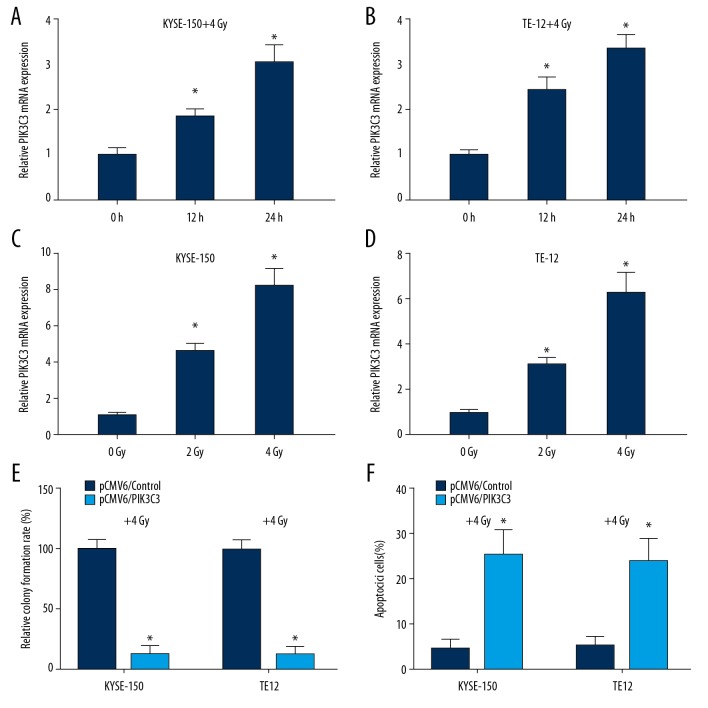
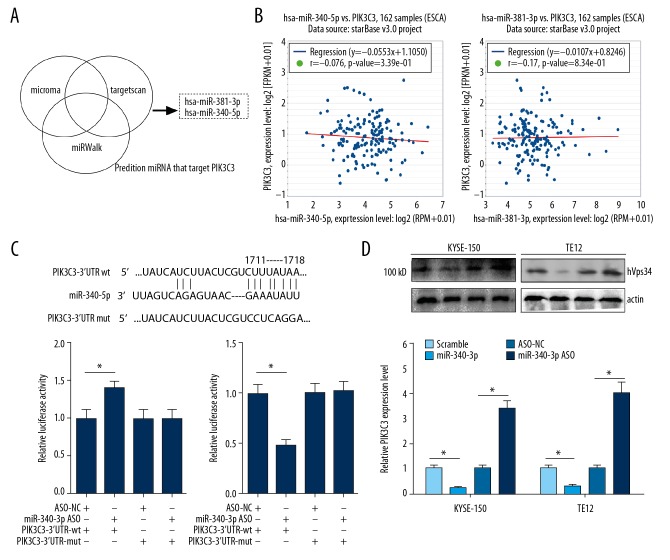
BACKGROUND Esophageal squamous cell carcinoma (ESCC), a major histological subtype of esophageal cancer, is a common cause of tumor-related deaths in the world. Due to the lack of understanding of the pathogenesis of ESCC, its clinical treatment is still a big challenge. In the present study, we aimed to identify an ESCC-related gene in the GEO dataset, and to explore its function and mechanism in ESCC. MATERIAL AND METHODS The GSE dataset (GSE100492) consisting of 10 samples was analyzed using GEO2R for identifying the differentially expressed genes between ESCC and normal samples. Expression levels of mRNA and miRNA in ESCC tissues and cells were detected via quantitative real-time polymerase chain reaction. Protein expression was analyzed by western blot. Cell proliferation viability was determined through MTT and colony formation. Cell distribution and apoptosis was detected by flow cytometry. MiRNA target prediction was analyzed by bioinformatics. The interplay between miR-340-5p and PIK3C3 was validated by dual-luciferase reporter assay. RESULTS PIK3C3 was lowly expressed in ESCC tissue and indicated a poor prognosis in patents. Overexpression of PIK3C3 in vitro repressed cell proliferation of KYSE-150 and TE-12 cells. Moreover, PIK3C3 overexpression was demonstrated to enhance the sensitivity of KYSE-150 and TE-12 cells to irradiation. In addition, miR-340-5p was revealed to directly bind and negatively modulate PIK3C3 expression in ESCC. Blockage of miR-340-5p promoted ESCC cell proliferation, while rescue of PIK3C3 reversed this effect. MiR-340-5p was highly expressed in ESCC tissue and it exhibited a negative correlation with PIK3C3 expression. CONCLUSIONS MiR-340-5p functioned as an oncogene of ESCC by directly binding and repressing the expression of PIK3C3.
食管鳞状细胞癌(ESCC)是食管癌的主要组织学亚型,是全球肿瘤相关死亡的主要原因。由于对 ESCC 发病机制的了解不足,其临床治疗仍然是一个巨大的挑战。在本研究中,我们旨在从 GEO 数据集中鉴定出一个与 ESCC 相关的基因,并探讨其在 ESCC 中的功能和机制。
使用 GEO2R 分析包含 10 个样本的 GEO 数据集(GSE100492),以鉴定 ESCC 与正常样本之间的差异表达基因。通过定量实时聚合酶链反应检测 ESCC 组织和细胞中 mRNA 和 miRNA 的表达水平。通过 Western blot 分析蛋白表达。通过 MTT 和集落形成测定细胞增殖活力。通过流式细胞术检测细胞分布和凋亡。通过生物信息学分析预测 miRNA 靶标。通过双荧光素酶报告基因测定验证 miR-340-5p 和 PIK3C3 之间的相互作用。
PIK3C3 在 ESCC 组织中低表达,并提示患者预后不良。体外过表达 PIK3C3 抑制 KYSE-150 和 TE-12 细胞的增殖。此外,过表达 PIK3C3 增强了 KYSE-150 和 TE-12 细胞对辐射的敏感性。此外,研究表明 miR-340-5p 可直接结合并负调控 ESCC 中的 PIK3C3 表达。阻断 miR-340-5p 促进 ESCC 细胞增殖,而恢复 PIK3C3 则逆转了这一作用。miR-340-5p 在 ESCC 组织中高表达,与 PIK3C3 表达呈负相关。
miR-340-5p 通过直接结合并抑制 PIK3C3 的表达,作为 ESCC 的致癌基因发挥作用。