Department of Radiation Oncology, The First Affiliated Hospital of Soochow University, Suzhou 215006, Jiangsu, P.R. China.
Department of Radiation Oncology, The First People's Hospital of Nantong, Nantong 226001, Jiangsu, P.R. China.
J Radiat Res. 2022 May 18;63(3):331-341. doi: 10.1093/jrr/rrac004.
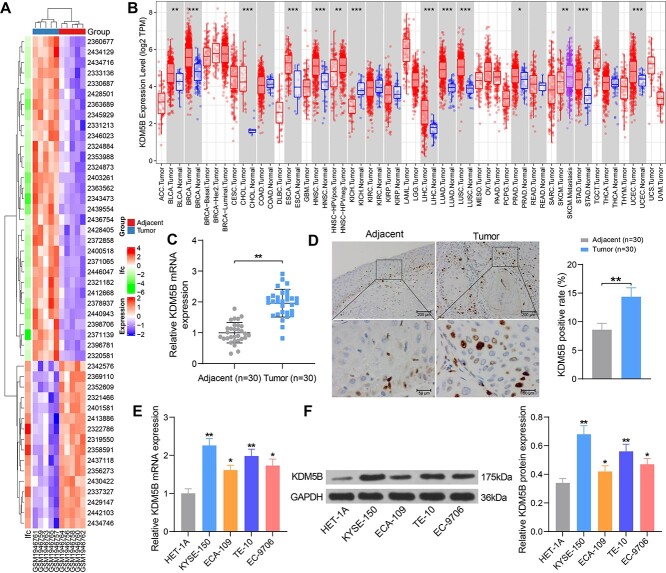
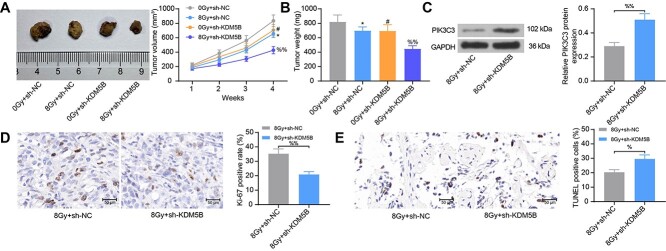
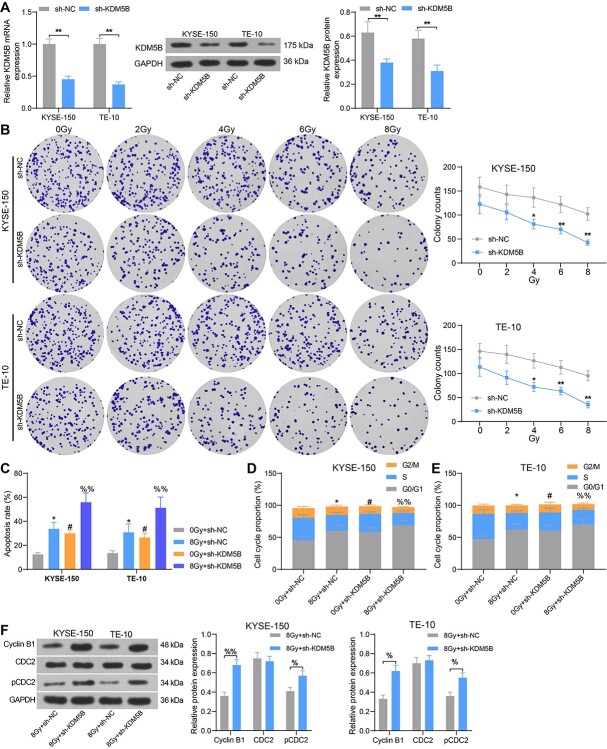
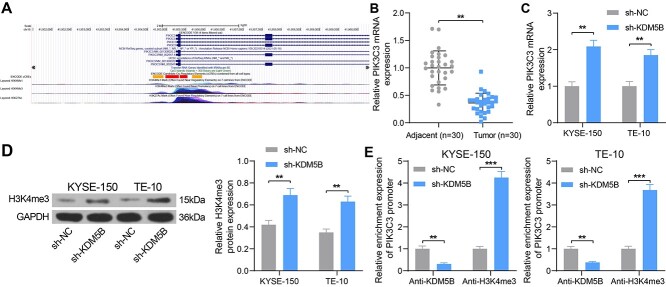
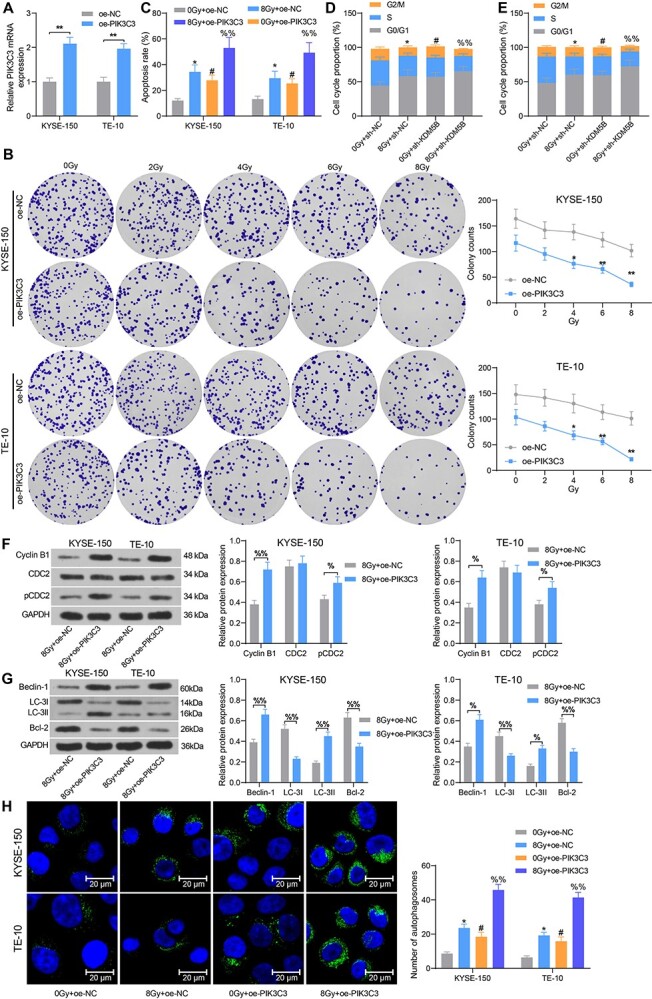
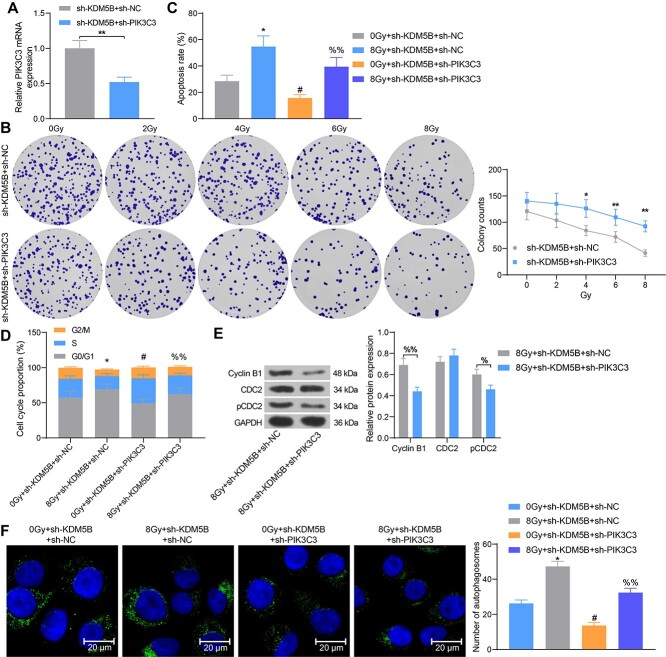
Many patients with esophageal squamous cell carcinoma (ESCC) are inoperable because of old age or the advanced stage of the disease; thus radio- and chemotherapy are believed as the standard treatments for these patients. However, due to the radio-resistance of tumor cells that may develop during radiotherapy, results remain unsatisfactory. In this article, the possible relationship between the expression of lysine demethylase 5B (KDM5B) and ESCC radio-resistance is clarified, and the underlying mechanism is evaluated. Using the GSE75241 microarray, we identified KDM5B as a potential oncogene in ESCC. KDM5B was overexpressed in ESCC patients and cells. Inhibition of KDM5B enhanced the H3K4me3 methylation of phosphatidylinositol 3-kinase catalytic subunit type 3 (PIK3C3) promoter and induced the expression of PIK3C3. Knockdown of KDM5B or overexpression of PIK3C3 in KYSE-150 and TE-10 cells promoted apoptosis, cell cycle arrest, autophagy, and increased sensitivity to radiotherapy. Silencing of PIK3C3 attenuated the promoting effect of sh-KDM5B on the sensitivity of ESCC cells to radiotherapy. The inhibition of sh-KDM5B in radio-resistance of ESCC cells was also reproduced in vivo. Taken together, our findings provide evidence that reduced expression of KDM5B has a critical role in promoting ESCC radio-sensitivity by upregulating PIK3C3, suggesting KDM5B may function as an oncogene in ESCC.
许多患有食管鳞状细胞癌(ESCC)的患者由于年龄较大或疾病处于晚期而无法手术;因此,放射和化学疗法被认为是这些患者的标准治疗方法。然而,由于肿瘤细胞在放射治疗过程中可能产生的放射抗性,治疗效果仍不理想。在本文中,阐明了赖氨酸去甲基酶 5B(KDM5B)的表达与 ESCC 放射抗性之间的可能关系,并评估了其潜在机制。使用 GSE75241 微阵列,我们确定 KDM5B 是 ESCC 中的一种潜在致癌基因。KDM5B 在 ESCC 患者和细胞中过度表达。抑制 KDM5B 增强了磷脂酰肌醇 3-激酶催化亚基 3(PIK3C3)启动子的 H3K4me3 甲基化,并诱导了 PIK3C3 的表达。在 KYSE-150 和 TE-10 细胞中敲低 KDM5B 或过表达 PIK3C3 可促进细胞凋亡、细胞周期停滞、自噬,并增加对放射治疗的敏感性。沉默 PIK3C3 可减弱 sh-KDM5B 对 ESCC 细胞对放射治疗敏感性的促进作用。在体内也重现了 sh-KDM5B 抑制 ESCC 细胞放射抗性的作用。总之,我们的研究结果表明,降低 KDM5B 的表达通过上调 PIK3C3 在促进 ESCC 放射敏感性方面起着关键作用,这表明 KDM5B 可能在 ESCC 中发挥致癌基因的作用。