Gregorčič Peter
Faculty of Mechanical Engineering, University of Ljubljana, Aškerčeva 6, Ljubljana 1000, Slovenia.
ACS Appl Mater Interfaces. 2021 Jan 20;13(2):2117-2127. doi: 10.1021/acsami.9b23462. Epub 2020 Apr 2.
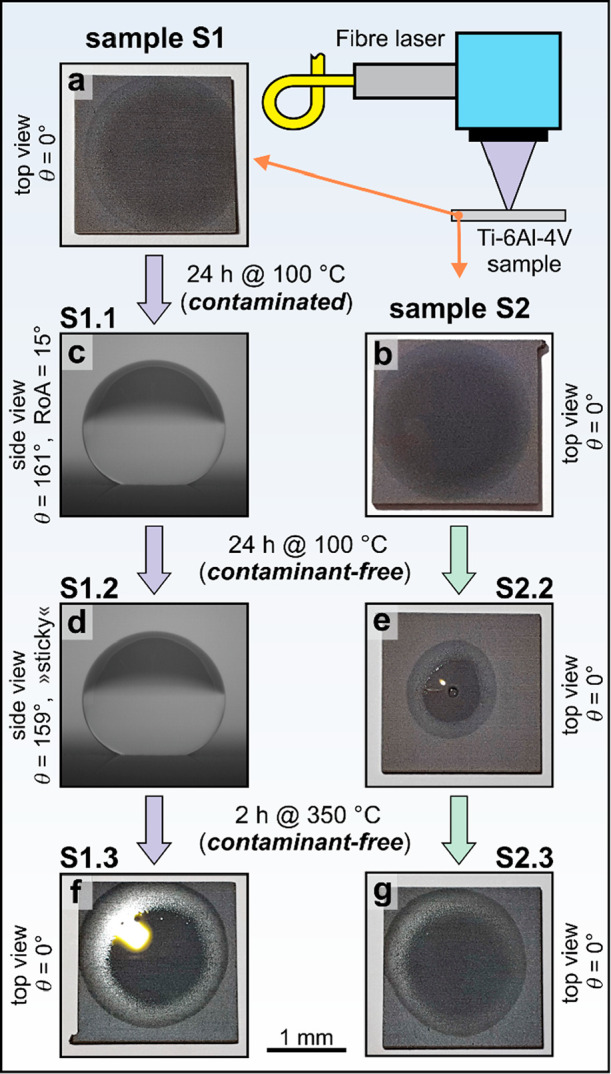
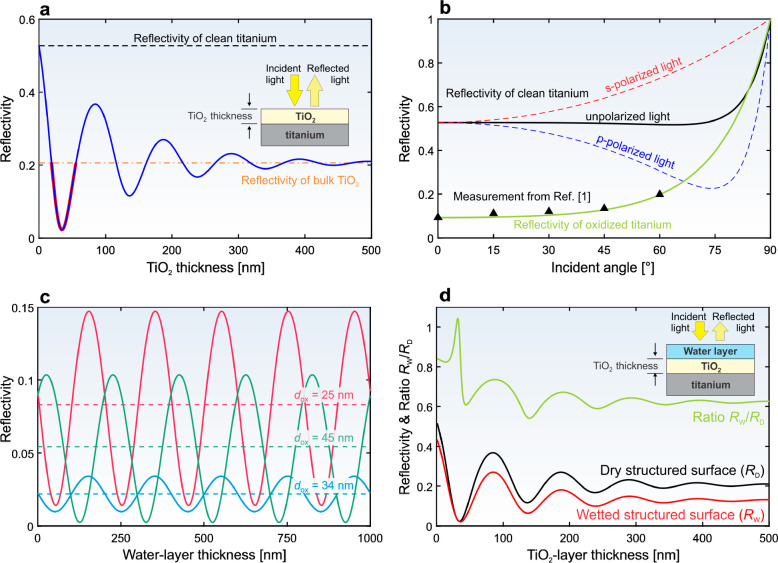
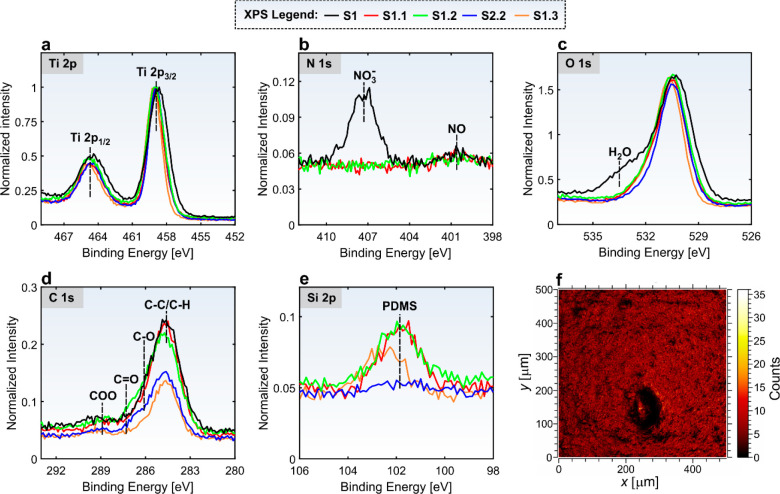
Laser-textured surfaces enabling reversible wettability switching and improved optical properties are gaining importance in cutting-edge applications, including self-cleaning interfaces, tunable optical lenses, microfluidics, and lab-on-chip systems. Fabrication of such surfaces by combining nanosecond-laser texturing and low-temperature annealing of titanium Ti-6Al-4V alloy was demonstrated by Lian et al. in . , (5), 6573-6580. However, it is difficult to agree with their contradictory explanation of the wettability transition due to low-temperature annealing and their theoretical description of the optical behavior of the laser-textured titanium surface. This comment provides an alternative view-supported by both experimental results and theoretical investigation-on how the results by Lian et al. could be interpreted more correctly. The annealing experiments clarify that controlled contamination is crucial in obtaining consistent surface wettability alterations after low-temperature annealing. Annealing of laser-textured titanium at 100 °C in and furnaces leads to completely different wettability transitions. Analysis of the surface chemistry by XPS and ToF-SIMS reveals that (usually overlooked) contamination with hydrophobic polydimethylsiloxane (PDMS) may arise from the silicone components of the furnace. In this case, a homogeneous thin PDMS film over the entire surface results in water repellency (contact angle of 161° and roll-off angle of 15°). In contrast, annealing under the same conditions but in a contaminant-free furnace preserves the initial superhydrophilicity, whereas the annealing at 350 °C turns the hydrophobicity "off". The theoretical calculations of optical properties demonstrate that the laser-induced oxide layer formed during the laser texturing significantly influences the surface optical behavior. Consequently, the interference of light reflected by the air-oxide and the oxide-metal interfaces should not be neglected and enables several advanced approaches to exploit such optical properties.
具有可逆润湿性切换和改善光学性能的激光纹理表面在前沿应用中变得越来越重要,这些应用包括自清洁界面、可调谐光学透镜、微流体以及芯片实验室系统。Lian等人在[文献出处](5),6573 - 6580中展示了通过结合纳秒激光纹理化和钛Ti - 6Al - 4V合金的低温退火来制造此类表面的方法。然而,很难认同他们对低温退火导致润湿性转变的矛盾解释以及对激光纹理化钛表面光学行为的理论描述。本评论提供了一种基于实验结果和理论研究的不同观点,关于如何能更正确地解释Lian等人的结果。退火实验表明,受控污染对于在低温退火后获得一致的表面润湿性变化至关重要。在[具体环境1]和[具体环境2]炉中于100°C对激光纹理化的钛进行退火会导致完全不同的润湿性转变。通过XPS和ToF - SIMS对表面化学进行分析表明,(通常被忽视的)疏水性聚二甲基硅氧烷(PDMS)污染可能源于炉体的有机硅成分。在这种情况下,整个表面上均匀的薄PDMS膜导致拒水性(接触角为161°,滚落角为15°)。相比之下,在相同条件下但在无污染的炉中退火则保留了初始的超亲水性,而在350°C退火会使疏水性“消失”。光学性能的理论计算表明,激光纹理化过程中形成的激光诱导氧化层对表面光学行为有显著影响。因此,由空气 - 氧化物和氧化物 - 金属界面反射的光的干涉不应被忽视,并且使得能够采用几种先进方法来利用此类光学性能。