Inflexxion, Costa Mesa, CA, United States.
Office of Disease Prevention, National Institutes of Health, Rockville, MD, United States.
JMIR Public Health Surveill. 2020 Mar 25;6(1):e16038. doi: 10.2196/16038.
Opioid use disorder (OUD) poses medical and societal concerns. Although most individuals with OUD in the United States are not in drug abuse treatment, buprenorphine is considered a safe and effective OUD treatment, which reduces illicit opioid use, mortality, and other drug-related harms. However, as buprenorphine prescriptions increase, so does evidence of misused, abused, or diverted buprenorphine. Users' motivations for extratreatment use of buprenorphine (ie, misuse or abuse of one's own prescription or use of diverted medication) may be different from the motivations involved in analgesic opioid products. Previous research is based on small sample sizes and use surveys, and none directly compare the motivations for using buprenorphine products (ie, tablet or film) with other opioid products having known abuse potential.
The aim of the study was to describe and compare the motivation-to-use buprenorphine products, including buprenorphine/naloxone (BNX) sublingual film and oxycodone extended-release (ER), as discussed in online forums.
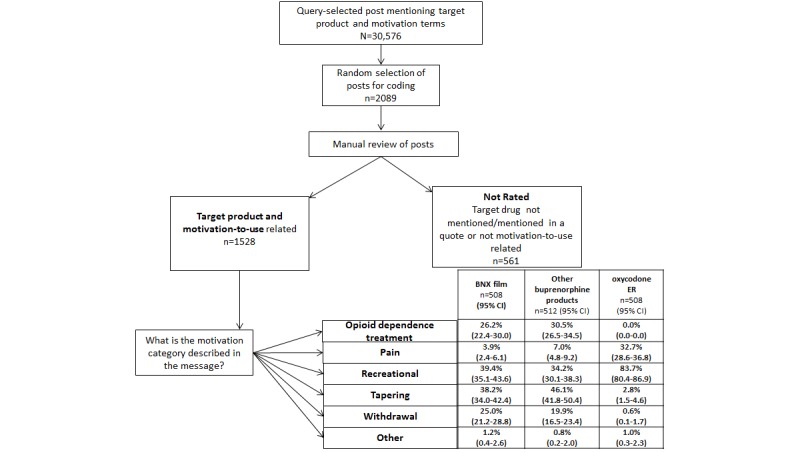
Web-based posts from 2012 to 2016 were collected from online forums using the Web Informed Services internet monitoring archive. A random sample of posts was coded for motivation to use. These posts were coded into the following motivation categories: (1) use to avoid withdrawal, (2) pain relief, (3) tapering from other drugs, (4) opioid addiction treatment, (5) recreational use (ie, to get high), and (6) other use. Oxycodone ER, an opioid analgesic with known abuse potential, was selected as a comparator.
Among all posts, 0.81% (30,576/3,788,922) discussed motivation to use one of the target products. The examination of query-selected posts revealed significantly greater discussion of buprenorphine products than oxycodone ER (P<.001). The posts mentioning buprenorphine products were more likely than oxycodone ER to discuss treatment for OUD, tapering down use, and/or withdrawal management (P<.001). Buprenorphine-related posts discussed recreational use (375/1020, 36.76%), although much less often than in oxycodone ER posts (425/508, 83.7%). Despite some differences, the overall pattern of motivation to use was similar for BNX sublingual film and other buprenorphine products.
An analysis of spontaneous, Web-based discussion among recreational substance users who post on online drug forums supports the contention that motivation-to-use patterns associated with buprenorphine products are different from those reported for oxycodone ER. Although the findings presented here are not expected to reflect the actual use of the target products, they may represent the interests and motivations of those posting on the online forums. Buprenorphine-related posts were more likely to discuss treatment for OUD, tapering, and withdrawal management than oxycodone ER. Although the findings are consistent with a purported link between the limited availability of medication-assisted therapies for substance use disorders and use of diverted buprenorphine products for self-treatment, recreational use was a motivation expressed in more than one-third of buprenorphine posts.
阿片类药物使用障碍(OUD)引起了医学和社会关注。尽管美国大多数患有 OUD 的人并未接受药物滥用治疗,但丁丙诺啡被认为是一种安全有效的 OUD 治疗方法,可减少非法阿片类药物的使用、死亡率和其他与药物相关的危害。然而,随着丁丙诺啡处方的增加,滥用、误用或转用丁丙诺啡的证据也越来越多。患者在治疗外使用丁丙诺啡(即滥用或误用自己的处方或使用转用药物)的动机可能与阿片类药物的镇痛产品的动机不同。以前的研究基于小样本量和使用调查,并且没有一项研究直接比较丁丙诺啡产品(即片剂或薄膜)与其他具有已知滥用潜力的阿片类产品的使用动机。
本研究的目的是描述和比较丁丙诺啡产品(包括丁丙诺啡/纳洛酮舌下片和羟考酮缓释片)的使用动机,这些信息是从在线论坛中收集的。
使用 Web 智能服务互联网监测档案,从 2012 年至 2016 年的在线论坛中收集基于网络的帖子。对随机抽样的帖子进行使用动机编码。这些帖子被编码为以下动机类别:(1)使用以避免戒断,(2)缓解疼痛,(3)从其他药物逐渐减少使用,(4)阿片类药物成瘾治疗,(5)娱乐性使用(即获得快感)和(6)其他用途。羟考酮缓释片是一种具有已知滥用潜力的阿片类镇痛药,被选为比较药物。
在所有帖子中,0.81%(30,576/3,788,922)讨论了使用目标产品之一的动机。对查询选择的帖子进行检查后发现,讨论丁丙诺啡产品的帖子明显多于羟考酮缓释片(P<.001)。提到丁丙诺啡产品的帖子比羟考酮缓释片更有可能讨论 OUD 的治疗、逐渐减少使用和/或戒断管理(P<.001)。丁丙诺啡相关帖子讨论了娱乐性使用(375/1020, 36.76%),尽管比羟考酮缓释片的帖子(425/508, 83.7%)要少得多。尽管存在一些差异,但 BNX 舌下片和其他丁丙诺啡产品的使用动机总体模式相似。
对在在线毒品论坛上发布帖子的娱乐性药物使用者的自发、基于网络的讨论进行分析,支持这样一种观点,即与丁丙诺啡产品相关的使用动机模式与羟考酮缓释片报告的模式不同。尽管这里提出的发现预计不会反映目标产品的实际使用情况,但它们可能代表了在在线论坛上发布帖子的人的兴趣和动机。与羟考酮缓释片相比,丁丙诺啡相关帖子更有可能讨论 OUD 的治疗、逐渐减少使用和戒断管理。尽管这些发现与治疗物质使用障碍的药物辅助疗法的有限可用性和转用丁丙诺啡产品进行自我治疗之间存在关联,但娱乐性使用是丁丙诺啡帖子中表达的动机之一,超过三分之一的帖子都表达了这种动机。
