• 文献检索
  • 文档翻译
  • 深度研究
  • 学术资讯
  • Suppr Zotero 插件Zotero 插件
  • 邀请有礼
  • 套餐&价格
  • 历史记录
应用&插件
Suppr Zotero 插件Zotero 插件浏览器插件Mac 客户端Windows 客户端微信小程序
定价
高级版会员购买积分包购买API积分包
服务
文献检索文档翻译深度研究API 文档MCP 服务
关于我们
关于 Suppr公司介绍联系我们用户协议隐私条款
关注我们

Suppr 超能文献

核心技术专利:CN118964589B侵权必究
粤ICP备2023148730 号-1Suppr @ 2026

文献检索

告别复杂PubMed语法,用中文像聊天一样搜索,搜遍4000万医学文献。AI智能推荐,让科研检索更轻松。

立即免费搜索

文件翻译

保留排版,准确专业,支持PDF/Word/PPT等文件格式,支持 12+语言互译。

免费翻译文档

深度研究

AI帮你快速写综述,25分钟生成高质量综述,智能提取关键信息,辅助科研写作。

立即免费体验

Rare diseases 2030: how augmented AI will support diagnosis and treatment of rare diseases in the future.

作者信息

Hirsch Martin Christian, Ronicke Simon, Krusche Martin, Wagner Annette Doris

机构信息

Institute for AI in Medicine, University Hospital of Giessen and Marburg, Marburg, Germany.

Ada Health GmbH, Berlin, Germany.

出版信息

Ann Rheum Dis. 2020 Jun;79(6):740-743. doi: 10.1136/annrheumdis-2020-217125. Epub 2020 Mar 24.
DOI:10.1136/annrheumdis-2020-217125
PMID:32209541
原文链接:https://pmc.ncbi.nlm.nih.gov/articles/PMC7286047/
Abstract
摘要
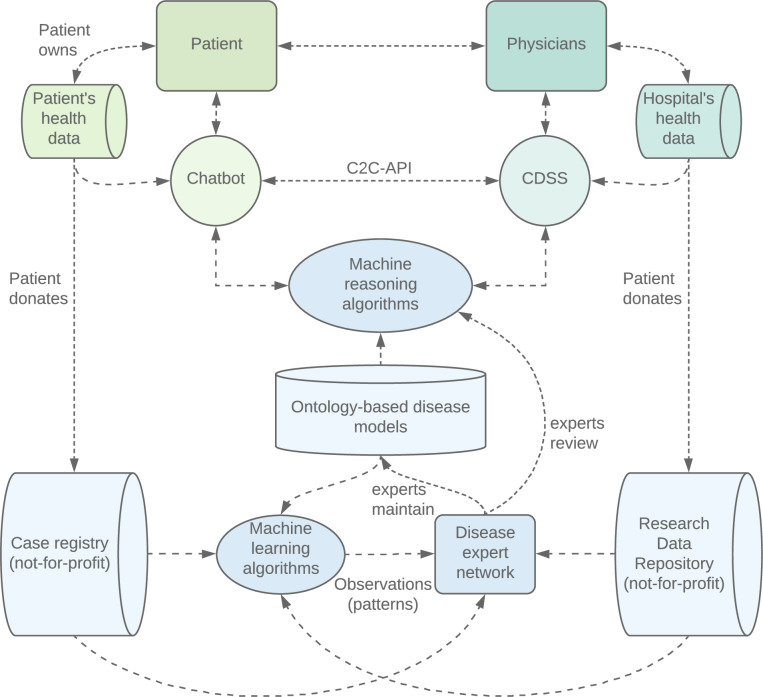
https://cdn.ncbi.nlm.nih.gov/pmc/blobs/4c5c/7286047/ea5bb7294891/annrheumdis-2020-217125f01.jpg

相似文献

1
Rare diseases 2030: how augmented AI will support diagnosis and treatment of rare diseases in the future.2030年的罕见病:增强人工智能将如何在未来支持罕见病的诊断和治疗
Ann Rheum Dis. 2020 Jun;79(6):740-743. doi: 10.1136/annrheumdis-2020-217125. Epub 2020 Mar 24.
2
Reliability of a generative artificial intelligence tool for pediatric familial Mediterranean fever: insights from a multicentre expert survey.生成式人工智能工具在儿科家族性地中海热中的可靠性:来自多中心专家调查的见解。
Pediatr Rheumatol Online J. 2024 Aug 23;22(1):78. doi: 10.1186/s12969-024-01011-0.
3
[Artificial intelligence in the diagnosis of rare disorders: the development of phenotype analysis].[人工智能在罕见病诊断中的应用:表型分析的发展]
Bundesgesundheitsblatt Gesundheitsforschung Gesundheitsschutz. 2022 Nov;65(11):1159-1163. doi: 10.1007/s00103-022-03602-2. Epub 2022 Oct 24.
4
Patient management and the association of less common familial Mediterranean fever symptoms with other disorders.患者管理以及不太常见的家族性地中海热症状与其他疾病的关联。
Genet Med. 2014 Mar;16(3):258-63. doi: 10.1038/gim.2013.112. Epub 2013 Aug 1.
5
A rare cause of ascites: Familial Mediterranean fever.腹水的罕见病因:家族性地中海热。
Turk J Gastroenterol. 2008 Mar;19(1):64-8.
6
Rare disease diagnosis using knowledge guided retrieval augmentation for ChatGPT.利用知识引导检索增强的 ChatGPT 进行罕见病诊断。
J Biomed Inform. 2024 Sep;157:104702. doi: 10.1016/j.jbi.2024.104702. Epub 2024 Jul 29.
7
Familial Mediterranean Fever without Fever.无发热的家族性地中海热
Intern Med. 2020 May 15;59(10):1267-1270. doi: 10.2169/internalmedicine.3175-19. Epub 2020 Feb 12.
8
Artificial Intelligence-Augmented Clinical Decision Support Systems for Pregnancy Care: Systematic Review.用于孕期护理的人工智能增强型临床决策支持系统:系统评价
J Med Internet Res. 2024 Sep 16;26:e54737. doi: 10.2196/54737.
9
Familial Mediterranean fever. A review of the disease and clinical and laboratory findings in 105 patients.家族性地中海热。105例患者的疾病、临床及实验室检查结果综述。
Dig Liver Dis. 2000 Aug-Sep;32(6):504-9. doi: 10.1016/s1590-8658(00)80008-0.
10
[Computer-assisted diagnosis of rare diseases].[罕见病的计算机辅助诊断]
Internist (Berl). 2018 Apr;59(4):391-400. doi: 10.1007/s00108-017-0218-z.

引用本文的文献

1
Reliability of a generative artificial intelligence tool for pediatric familial Mediterranean fever: insights from a multicentre expert survey.生成式人工智能工具在儿科家族性地中海热中的可靠性:来自多中心专家调查的见解。
Pediatr Rheumatol Online J. 2024 Aug 23;22(1):78. doi: 10.1186/s12969-024-01011-0.
2
Integration of artificial intelligence and multi-omics in kidney diseases.人工智能与多组学在肾脏疾病中的整合
Fundam Res. 2022 Mar 16;3(1):126-148. doi: 10.1016/j.fmre.2022.01.037. eCollection 2023 Jan.
3
Does an App a Day Keep the Doctor Away? AI Symptom Checker Applications, Entrenched Bias, and Professional Responsibility.

本文引用的文献

1
Electronic Consultation in Primary Care Between Providers and Patients: Systematic Review.基层医疗中提供者与患者之间的电子会诊:系统评价
JMIR Med Inform. 2019 Dec 3;7(4):e13042. doi: 10.2196/13042.
2
The emerging world of digital therapeutics.数字疗法的新兴领域。
Nature. 2019 Sep;573(7775):S106-S109. doi: 10.1038/d41586-019-02873-1.
3
Impact of remote patient monitoring on clinical outcomes: an updated meta-analysis of randomized controlled trials.远程患者监测对临床结局的影响:随机对照试验的最新荟萃分析
一天一个 App ,能否让医生远离我?人工智能症状检查应用程序、根深蒂固的偏见与专业责任。
J Med Internet Res. 2024 Jun 5;26:e50344. doi: 10.2196/50344.
4
Citizen data sovereignty is key to wearables and wellness data reuse for the common good.公民数据主权是可穿戴设备和健康数据为公共利益而重复使用的关键。
NPJ Digit Med. 2024 Feb 12;7(1):27. doi: 10.1038/s41746-024-01004-z.
5
COVID-19 and the rare disease organization response during pandemic: the 'Italian model'.新冠疫情期间的新冠肺炎与罕见病组织应对:“意大利模式”
Future Rare Dis. 2022 Mar;2(1):FRD21. doi: 10.2217/frd-2022-0001. Epub 2022 Mar 30.
6
[Faster diagnosis of rare diseases with artificial intelligence-A precept of ethics, economy and quality of life].[利用人工智能更快地诊断罕见病——伦理、经济与生活质量的准则]
Inn Med (Heidelb). 2023 Nov;64(11):1033-1040. doi: 10.1007/s00108-023-01599-7. Epub 2023 Oct 20.
7
Rare diseases: why is a rapid referral to an expert center so important?罕见病:为什么快速转诊至专家中心如此重要?
BMC Health Serv Res. 2023 Aug 23;23(1):904. doi: 10.1186/s12913-023-09886-7.
8
Patient Acceptability of Symptom Screening and Patient Education Using a Chatbot for Autoimmune Inflammatory Diseases: Survey Study.使用聊天机器人进行自身免疫性炎症疾病症状筛查和患者教育的患者可接受性:调查研究
JMIR Form Res. 2023 Dec 28;7:e49239. doi: 10.2196/49239.
9
Investigating the Potential for Clinical Decision Support in Sub-Saharan Africa With AFYA (Artificial Intelligence-Based Assessment of Health Symptoms in Tanzania): Protocol for a Prospective, Observational Pilot Study.利用AFYA(坦桑尼亚基于人工智能的健康症状评估)调查撒哈拉以南非洲临床决策支持的潜力:一项前瞻性观察性试点研究方案。
JMIR Res Protoc. 2022 Jun 7;11(6):e34298. doi: 10.2196/34298.
10
mEDUrare: Supporting Integrated Care for Rare Diseases by Better Connecting Health and Education Through Policy.mEDUrare:通过政策更好地连接卫生与教育,支持罕见病综合关怀
Yale J Biol Med. 2021 Dec 29;94(4):693-702. eCollection 2021 Dec.
NPJ Digit Med. 2018 Jan 15;1:20172. doi: 10.1038/s41746-017-0002-4. eCollection 2018.
4
Evaluation of the diagnostic accuracy of laboratory-based screening for hepatitis C in dried blood spot samples: A systematic review and meta-analysis.基于实验室的干血斑样本检测用于丙型肝炎的诊断准确性评估:系统评价和荟萃分析。
Sci Rep. 2019 May 13;9(1):7316. doi: 10.1038/s41598-019-41139-8.
5
Internet videoconferencing for patient-clinician consultations in long-term conditions: A review of reviews and applications in line with guidelines and recommendations.用于长期病症患者与临床医生会诊的互联网视频会议:基于指南和建议的综述及应用
Digit Health. 2019 Apr 23;5:2055207619845831. doi: 10.1177/2055207619845831. eCollection 2019 Jan-Dec.
6
Can a decision support system accelerate rare disease diagnosis? Evaluating the potential impact of Ada DX in a retrospective study.决策支持系统能否加速罕见病诊断?一项回顾性研究评估 Ada DX 的潜在影响。
Orphanet J Rare Dis. 2019 Mar 21;14(1):69. doi: 10.1186/s13023-019-1040-6.
7
High-performance medicine: the convergence of human and artificial intelligence.高性能医学:人机智能融合。
Nat Med. 2019 Jan;25(1):44-56. doi: 10.1038/s41591-018-0300-7. Epub 2019 Jan 7.
8
Identifying facial phenotypes of genetic disorders using deep learning.利用深度学习识别遗传疾病的面部表型。
Nat Med. 2019 Jan;25(1):60-64. doi: 10.1038/s41591-018-0279-0. Epub 2019 Jan 7.
9
Living with autoinflammatory diseases: identifying unmet needs of children, adolescents and adults.与自身炎症性疾病共存:识别儿童、青少年和成人未满足的需求。
Pediatr Rheumatol Online J. 2018 Dec 20;16(1):81. doi: 10.1186/s12969-018-0300-7.
10
Safety of patient-facing digital symptom checkers.面向患者的数字症状检查器的安全性。
Lancet. 2018 Nov 24;392(10161):2263-2264. doi: 10.1016/S0140-6736(18)32819-8. Epub 2018 Nov 6.