Department of Clinical and Population Science, Leeds Institute of Cardiovascular and Metabolic Medicine, University of Leeds, Leeds, U.K.
Department of Medicine, Sinai Health System, Toronto, Ontario, Canada.
Diabetes Care. 2020 Jun;43(6):1178-1184. doi: 10.2337/dc19-2527. Epub 2020 Mar 24.
To determine if temporal glucose profiles differed between ) women who were randomized to real-time continuous glucose monitoring (RT-CGM) or self-monitored blood glucose (SMBG), ) women who used insulin pumps or multiple daily insulin injections (MDIs), and ) women whose infants were born large for gestational age (LGA) or not, by assessing CGM data obtained from the Continuous Glucose Monitoring in Women With Type 1 Diabetes in Pregnancy Trial (CONCEPTT).
Standard summary metrics and functional data analysis (FDA) were applied to CGM data from the CONCEPTT trial (RT-CGM, = 100; SMBG, = 100) taken at baseline and at 24- and 34-weeks' gestation. Multivariable regression analysis determined if temporal differences in 24-h glucose profiles occurred between comparators in each of the three groups.
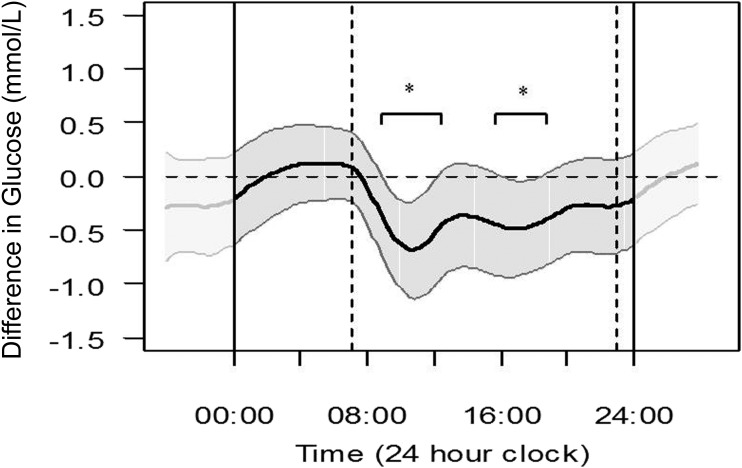
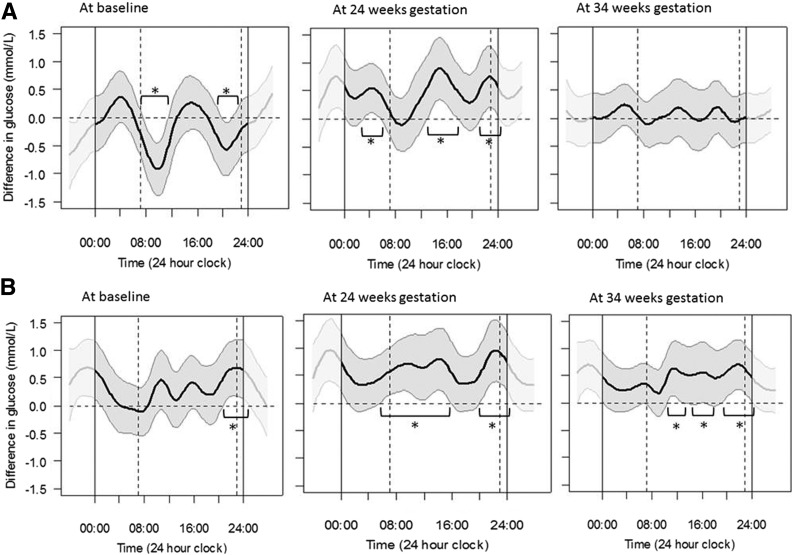
FDA revealed that women using RT-CGM had significantly lower glucose (0.4-0.8 mmol/L [7-14 mg/dL]) for 7 h/day (0800 h to 1200 h and 1600 h to 1900 h) compared with those with SMBG. Women using pumps had significantly higher glucose (0.4-0.9 mmol/L [7-16 mg/dL]) for 12 h/day (0300 h to 0600 h, 1300 h to 1800 h, and 2030 h to 0030 h) at 24 weeks with no difference at 34 weeks compared with MDI. Women who had an LGA infant ran a significantly higher glucose by 0.4-0.7 mmol/L (7-13 mg/dL) for 4.5 h/day at baseline, by 0.4-0.9 mmol/L (7-16 mg/dL) for 16 h/day at 24 weeks, and by 0.4-0.7 mmol/L (7-13 mg/dL) for 14 h/day at 34 weeks.
FDA of temporal glucose profiles gives important information about differences in glucose control and its timing, which are undetectable by standard summary metrics. Women using RT-CGM were able to achieve better daytime glucose control, reducing fetal exposure to maternal glucose.
通过评估来自妊娠合并 1 型糖尿病连续血糖监测研究(CONCEPTT)的连续血糖监测(CGM)数据,确定接受实时连续血糖监测(RT-CGM)或自我监测血糖(SMBG)、使用胰岛素泵或多次每日胰岛素注射(MDI)、以及其婴儿为大于胎龄儿(LGA)或非 LGA 的女性之间的时间性血糖谱是否存在差异。
将标准汇总指标和功能数据分析(FDA)应用于来自 CONCEPTT 试验(RT-CGM,n=100;SMBG,n=100)的基线和 24 周及 34 周妊娠时的 CGM 数据。多变量回归分析确定了在每组的三个比较组中,24 小时血糖谱是否存在时间性差异。
FDA 显示,与 SMBG 相比,使用 RT-CGM 的女性每天有 7 小时(0800 时至 1200 时和 1600 时至 1900 时)的血糖显著降低(0.4-0.8mmol/L [7-14mg/dL])。使用泵的女性在 24 周时每天有 12 小时(0300 时至 0600 时、1300 时至 1800 时和 2030 时至 0030 时)的血糖显著升高(0.4-0.9mmol/L [7-16mg/dL]),而在 34 周时没有差异。与 MDI 相比,婴儿为 LGA 的女性在基线时有 4.5 小时/天(0.4-0.7mmol/L [7-13mg/dL])、在 24 周时有 16 小时/天(0.4-0.9mmol/L [7-16mg/dL])、在 34 周时有 14 小时/天(0.4-0.7mmol/L [7-13mg/dL])的血糖显著升高。
CGM 时间性血糖谱的 FDA 提供了有关血糖控制及其时间性的重要信息,这些信息无法通过标准汇总指标检测到。使用 RT-CGM 的女性能够实现更好的日间血糖控制,减少胎儿暴露于母体血糖的时间。