Li Yu-Li, Wang Lu, Wu Jin-Wei, Ye Xin-Ping, Garber Paul A, Yan Ying, Liu Jia-Hui, Li Bao-Guo, Qi Xiao-Guang
Shaanxi Key Laboratory for Animal Conservation, College of Life Science, Northwest University, Xi'an, 710069, China.
College of Life Science, Shaanxi Normal University, Xi'an, 710119, China.
Curr Zool. 2020 Apr;66(2):113-122. doi: 10.1093/cz/zoaa006. Epub 2020 Feb 20.
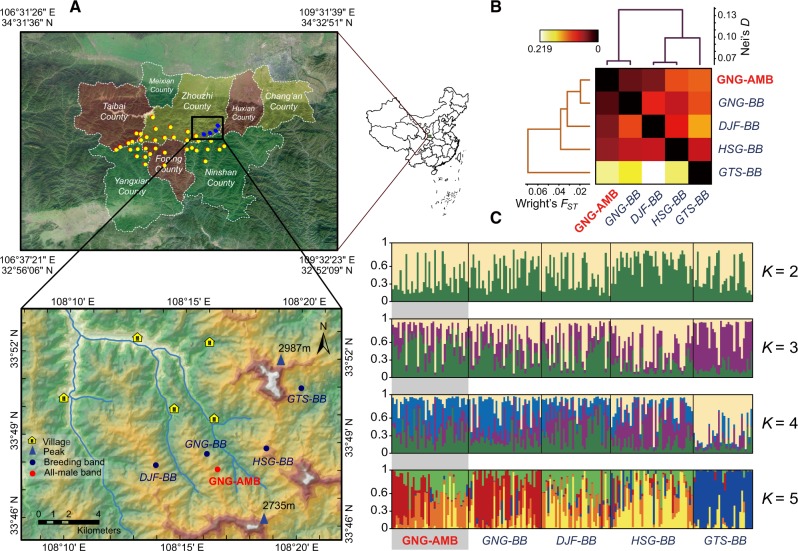
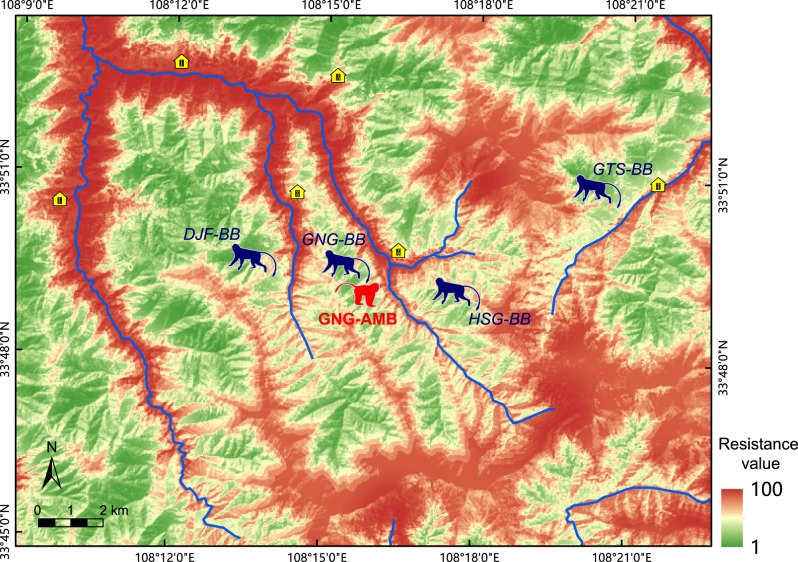
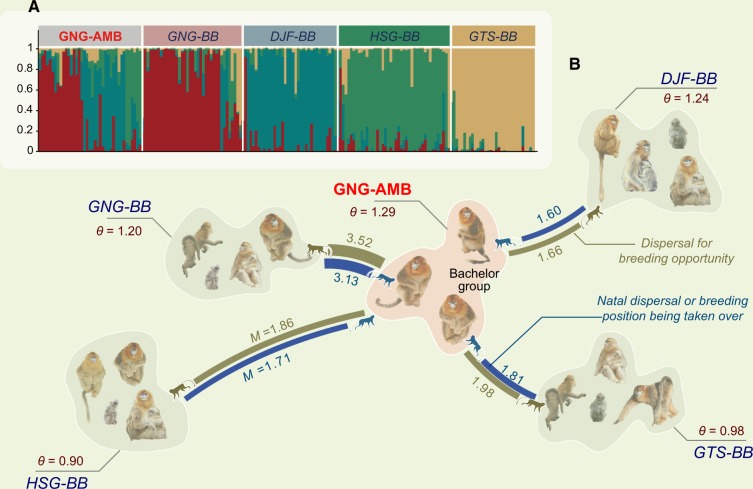
In the face of ongoing habitat fragmentation, many primate species have experienced reduced gene flow resulting in a reduction of genetic diversity, population bottlenecks, and inbreeding depression, including golden snub-nosed monkeys . Golden snub-nosed monkeys live in a multilevel society composed of several 1 male harem units that aggregate to form a cohesive breeding band, which is followed by one or more bachelor groups composed of juvenile, subadult, and adult male members. In this research, we examine the continuous landscape resistance surface, the genetic diversity and patterns of gene flow among 4 isolated breeding bands and 1 all-male band in the Qinling Mountains, China. Landscape surface modeling suggested that human activities and ecological factors severely limit the movement of individuals among breeding bands. Although these conditions are expected to result in reduced gene flow, reduced genetic diversity, and an increased opportunity for a genetic bottleneck, based on population genetic analyses of 13 microsatellite loci from 188 individuals inhabiting 4 isolated breeding bands and 1 all-male band, we found high levels of genetic diversity but low levels of genetic divergence, as well as high rates of gene flow between males residing in the all-male band and each of the 4 breeding bands. Our results indicate that the movement of bachelor males across the landscape, along with their association with several different breeding bands, appears to provide a mechanism for promoting gene flows and maintaining genetic diversity that may counteract the otherwise isolating effects of habitat fragmentation.
面对持续的栖息地破碎化,许多灵长类物种经历了基因流动减少,导致遗传多样性降低、种群瓶颈和近亲繁殖衰退,川金丝猴也不例外。川金丝猴生活在一个多层次社会中,由几个单雄多雌单元组成,这些单元聚集形成一个有凝聚力的繁殖群,后面跟着一个或多个由幼年、亚成年和成年雄性成员组成的单身群体。在本研究中,我们研究了中国秦岭地区4个孤立繁殖群和1个全雄群之间的连续景观抗性表面、遗传多样性和基因流动模式。景观表面建模表明,人类活动和生态因素严重限制了个体在繁殖群之间的移动。尽管预计这些情况会导致基因流动减少、遗传多样性降低以及出现遗传瓶颈的机会增加,但基于对来自4个孤立繁殖群和1个全雄群的188个个体的13个微卫星位点的群体遗传分析,我们发现遗传多样性水平较高,但遗传分化水平较低,并且居住在全雄群中的雄性与4个繁殖群中的每一个之间的基因流动率也很高。我们的结果表明,单身雄性在景观中的移动,以及它们与几个不同繁殖群的关联,似乎提供了一种促进基因流动和维持遗传多样性的机制,这可能抵消栖息地破碎化原本的隔离效应。