Pfeifer M, Lefebvre V, Peres C A, Banks-Leite C, Wearn O R, Marsh C J, Butchart S H M, Arroyo-Rodríguez V, Barlow J, Cerezo A, Cisneros L, D'Cruze N, Faria D, Hadley A, Harris S M, Klingbeil B T, Kormann U, Lens L, Medina-Rangel G F, Morante-Filho J C, Olivier P, Peters S L, Pidgeon A, Ribeiro D B, Scherber C, Schneider-Maunoury L, Struebig M, Urbina-Cardona N, Watling J I, Willig M R, Wood E M, Ewers R M
School of Biology, Newcastle University, Newcastle Upon Tyne NE1 7RU, UK.
Imperial College London, Silwood Park Campus, Buckhurst Road, Ascot SL5 7PY, UK.
Nature. 2017 Nov 9;551(7679):187-191. doi: 10.1038/nature24457. Epub 2017 Nov 1.
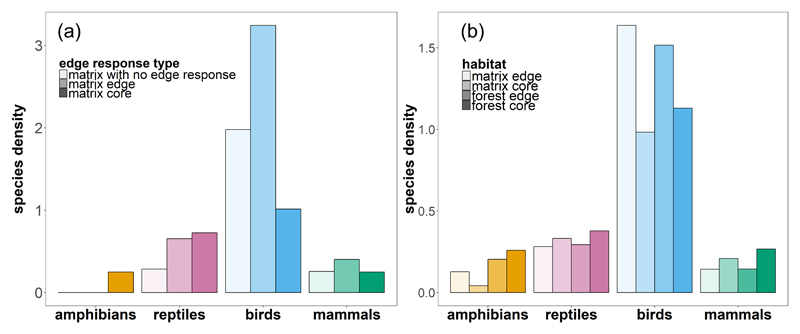
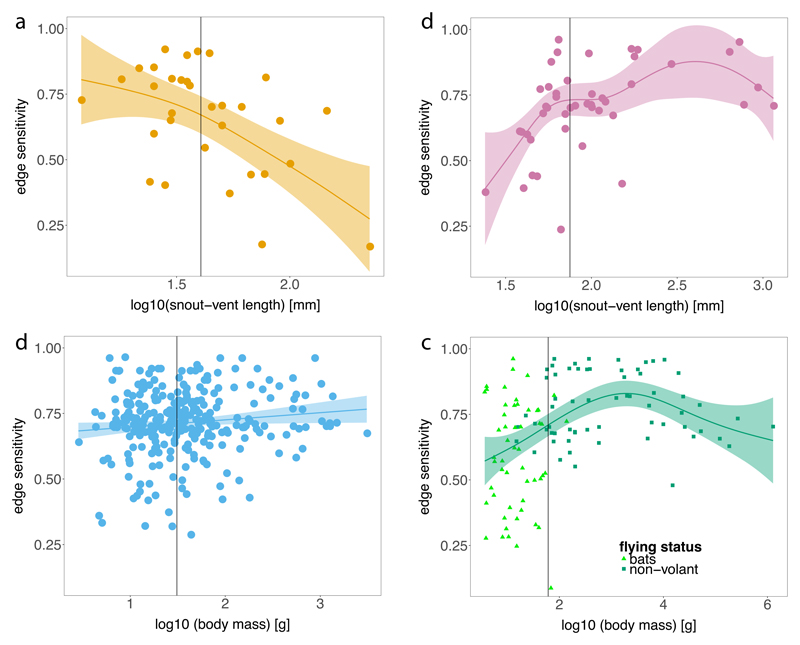
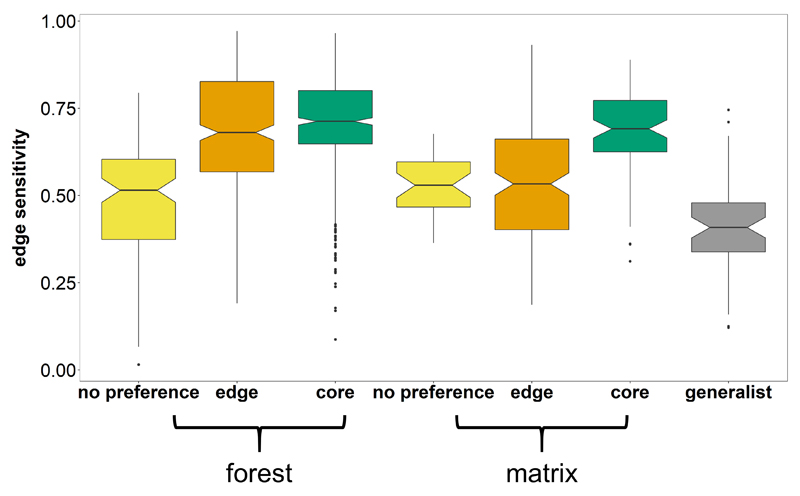
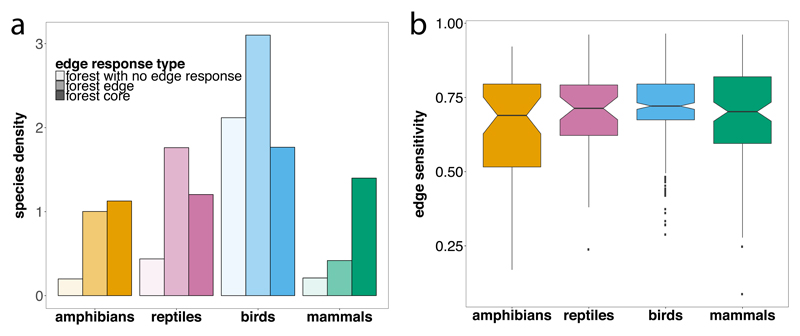
Forest edges influence more than half of the world's forests and contribute to worldwide declines in biodiversity and ecosystem functions. However, predicting these declines is challenging in heterogeneous fragmented landscapes. Here we assembled a global dataset on species responses to fragmentation and developed a statistical approach for quantifying edge impacts in heterogeneous landscapes to quantify edge-determined changes in abundance of 1,673 vertebrate species. We show that the abundances of 85% of species are affected, either positively or negatively, by forest edges. Species that live in the centre of the forest (forest core), that were more likely to be listed as threatened by the International Union for Conservation of Nature (IUCN), reached peak abundances only at sites farther than 200-400 m from sharp high-contrast forest edges. Smaller-bodied amphibians, larger reptiles and medium-sized non-volant mammals experienced a larger reduction in suitable habitat than other forest-core species. Our results highlight the pervasive ability of forest edges to restructure ecological communities on a global scale.
森林边缘影响着全球一半以上的森林,并导致全球生物多样性和生态系统功能下降。然而,在异质破碎化景观中预测这些下降情况具有挑战性。在这里,我们收集了一个关于物种对破碎化反应的全球数据集,并开发了一种统计方法来量化异质景观中的边缘影响,以量化1673种脊椎动物物种数量受边缘影响而发生的变化。我们发现,85%的物种数量受到森林边缘的影响,这种影响既有正面的也有负面的。生活在森林中心(森林核心区)的物种,更有可能被国际自然保护联盟(IUCN)列为受威胁物种,它们仅在距离清晰的高对比度森林边缘200 - 400米以外的地方数量达到峰值。体型较小的两栖动物、体型较大的爬行动物和中型非飞行哺乳动物比其他森林核心区物种的适宜栖息地减少得更多。我们的研究结果凸显了森林边缘在全球范围内重构生态群落的普遍能力。