Department of Anthropology, University College London, London, WC1H 0BW, UK.
Bristol Medical School: Population Health Sciences, University of Bristol, Bristol, BS8 2BN, UK.
Nat Commun. 2017 Dec 5;8(1):1853. doi: 10.1038/s41467-017-02036-8.
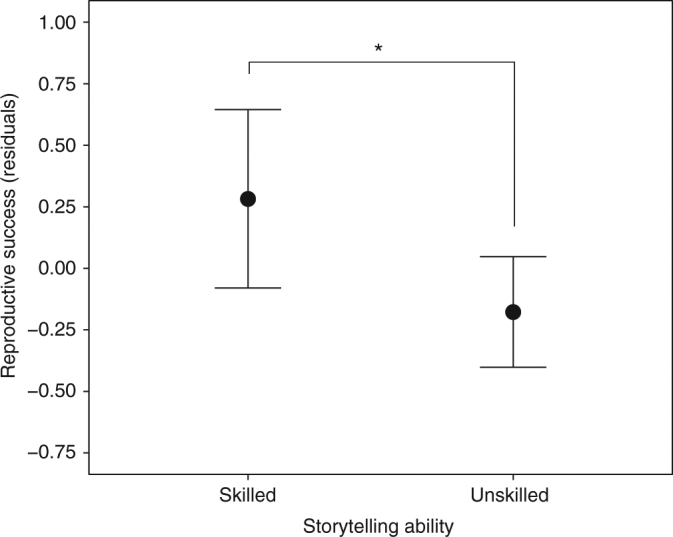
Storytelling is a human universal. From gathering around the camp-fire telling tales of ancestors to watching the latest television box-set, humans are inveterate producers and consumers of stories. Despite its ubiquity, little attention has been given to understanding the function and evolution of storytelling. Here we explore the impact of storytelling on hunter-gatherer cooperative behaviour and the individual-level fitness benefits to being a skilled storyteller. Stories told by the Agta, a Filipino hunter-gatherer population, convey messages relevant to coordinating behaviour in a foraging ecology, such as cooperation, sex equality and egalitarianism. These themes are present in narratives from other foraging societies. We also show that the presence of good storytellers is associated with increased cooperation. In return, skilled storytellers are preferred social partners and have greater reproductive success, providing a pathway by which group-beneficial behaviours, such as storytelling, can evolve via individual-level selection. We conclude that one of the adaptive functions of storytelling among hunter gatherers may be to organise cooperation.
讲故事是人类的普遍行为。从聚集在篝火旁讲述祖先的故事,到观看最新的电视连续剧,人类是天生的故事创作者和消费者。尽管讲故事无处不在,但人们很少关注理解其功能和演变。在这里,我们探讨了讲故事对狩猎采集者合作行为的影响,以及作为一个熟练讲故事者对个体适应度的好处。菲律宾狩猎采集者阿格塔人的故事传达了与觅食生态中协调行为相关的信息,例如合作、性别平等和平均主义。这些主题也存在于其他狩猎社会的叙述中。我们还表明,优秀讲故事者的存在与合作的增加有关。作为回报,熟练的讲故事者是更受欢迎的社交伙伴,并且具有更大的生殖成功,为通过个体水平选择来进化诸如讲故事等对群体有益的行为提供了途径。我们得出结论,讲故事在狩猎采集者中的一个适应功能可能是组织合作。