Coimbra Institute for Biomedical Imaging and Translational Research (CIBIT), University of Coimbra, Coimbra, Portugal.
Institute of Nuclear Sciences Applied to Health (ICNAS), University of Coimbra, Coimbra, Portugal.
Neural Plast. 2020 Feb 25;2020:4795267. doi: 10.1155/2020/4795267. eCollection 2020.
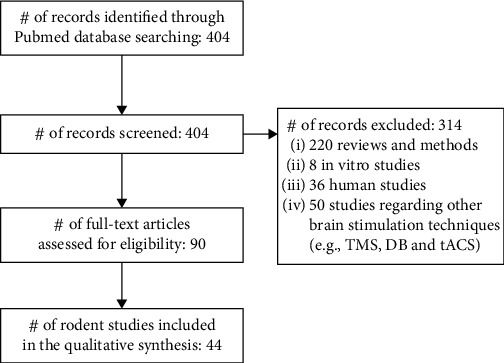
Brain stimulation techniques, including transcranial direct current stimulation (tDCS), were identified as promising therapeutic tools to modulate synaptic plasticity abnormalities and minimize memory and learning deficits in many neuropsychiatric diseases. Here, we revised the effect of tDCS on the modulation of neuroplasticity and cognition in several animal disease models of brain diseases affecting plasticity and cognition. Studies included in this review were searched following the terms ("transcranial direct current stimulation") AND (mice OR mouse OR animal) and according to the PRISMA statement requirements. Overall, the studies collected suggest that tDCS was able to modulate brain plasticity due to synaptic modifications within the stimulated area. Changes in plasticity-related mechanisms were achieved through induction of long-term potentiation (LTP) and upregulation of neuroplasticity-related proteins, such as , brain-derived neurotrophic factor (BDNF), or N-methyl-D-aspartate receptors (NMDARs). Taken into account all revised studies, tDCS is a safe, easy, and noninvasive brain stimulation technique, therapeutically reliable, and with promising potential to promote cognitive enhancement and neuroplasticity. Since the use of tDCS has increased as a novel therapeutic approach in humans, animal studies are important to better understand its mechanisms as well as to help improve the stimulation protocols and their potential role in different neuropathologies.
脑刺激技术,包括经颅直流电刺激(tDCS),被认为是一种有前途的治疗工具,可以调节突触可塑性异常,减轻许多神经精神疾病的记忆和学习缺陷。在这里,我们修订了 tDCS 对影响可塑性和认知的几种动物疾病模型中神经可塑性和认知的调节作用。本综述中纳入的研究是根据以下术语(“经颅直流电刺激”)和(“老鼠”或“小鼠”或“动物”)进行搜索的,并根据 PRISMA 声明的要求进行了筛选。总的来说,所收集的研究表明,tDCS 能够通过刺激区域内的突触修饰来调节大脑的可塑性。通过诱导长时程增强(LTP)和上调与神经可塑性相关的蛋白质(如脑源性神经营养因子(BDNF)或 N-甲基-D-天冬氨酸受体(NMDAR))来实现对可塑性相关机制的改变。考虑到所有修订后的研究,tDCS 是一种安全、简单、非侵入性的脑刺激技术,具有可靠的治疗效果,并有很大的潜力促进认知增强和神经可塑性。由于 tDCS 作为一种新的治疗方法在人类中的应用增加,动物研究对于更好地理解其机制以及帮助改进刺激方案及其在不同神经病理学中的潜在作用非常重要。