• 文献检索
  • 文档翻译
  • 深度研究
  • 学术资讯
  • Suppr Zotero 插件Zotero 插件
  • 邀请有礼
  • 套餐&价格
  • 历史记录
应用&插件
Suppr Zotero 插件Zotero 插件浏览器插件Mac 客户端Windows 客户端微信小程序
定价
高级版会员购买积分包购买API积分包
服务
文献检索文档翻译深度研究API 文档MCP 服务
关于我们
关于 Suppr公司介绍联系我们用户协议隐私条款
关注我们

Suppr 超能文献

核心技术专利:CN118964589B侵权必究
粤ICP备2023148730 号-1Suppr @ 2026

文献检索

告别复杂PubMed语法,用中文像聊天一样搜索,搜遍4000万医学文献。AI智能推荐,让科研检索更轻松。

立即免费搜索

文件翻译

保留排版,准确专业,支持PDF/Word/PPT等文件格式,支持 12+语言互译。

免费翻译文档

深度研究

AI帮你快速写综述,25分钟生成高质量综述,智能提取关键信息,辅助科研写作。

立即免费体验

年龄、性别、人体测量学指标和身体成分在6至12岁非肥胖儿童体能决定因素中的作用

The role of age, sex, anthropometry, and body composition as determinants of physical fitness in nonobese children aged 6-12.

作者信息

Milanese Chiara, Sandri Marco, Cavedon Valentina, Zancanaro Carlo

机构信息

Laboratory of Anthropometry and Body Composition, Department of Neurosciences, Biomedicine and Movement Sciences, University of Verona, Verona, Italy.

出版信息

PeerJ. 2020 Mar 17;8:e8657. doi: 10.7717/peerj.8657. eCollection 2020.

DOI:10.7717/peerj.8657
PMID:32211229
原文链接:https://pmc.ncbi.nlm.nih.gov/articles/PMC7083165/
Abstract

PURPOSE

The determinants of physical fitness in children have been given limited attention. In particular, the relative role of chronological age, sex, anthropometry, and body composition in physical fitness of children has been barely investigated. This cross-sectional study investigated determinants of physical fitness using a set of predictive variables including, in addition to chronological age and sex, a large panel of anthropometric measurements as well as body composition. The study was carried out in a convenience sample of children aged 6-12 participating in a summer camp.

METHODS

One-hundred-ninety-three children (128 males) fulfilled all requirements and entered analysis. Health-related physical fitness components (speed, muscular power and balance) were explored by means of field tests, namely the 30-m dash test for running speed, the standing long jump and the seated chest pass test for lower limbs and upper body muscular power, respectively, and the flamingo balance test for static balance. Determinants of physical fitness were investigated by regression analysis using chronological age, sex, anthropometry, and body composition in a hierarchical approach. To minimize the expected effect of collinearity in predictor variables, an original statistical approach using Random Forests analysis was adopted.

RESULTS

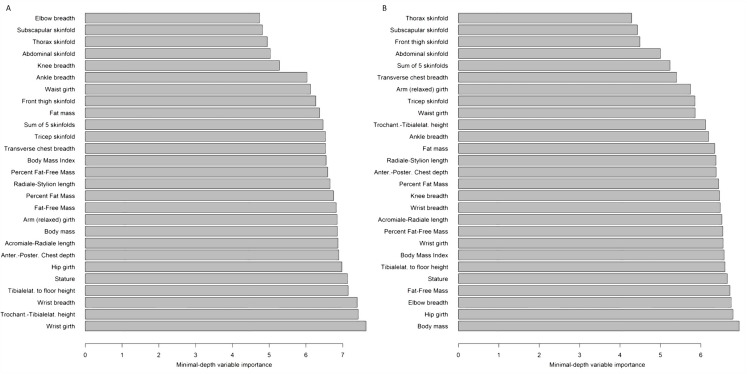
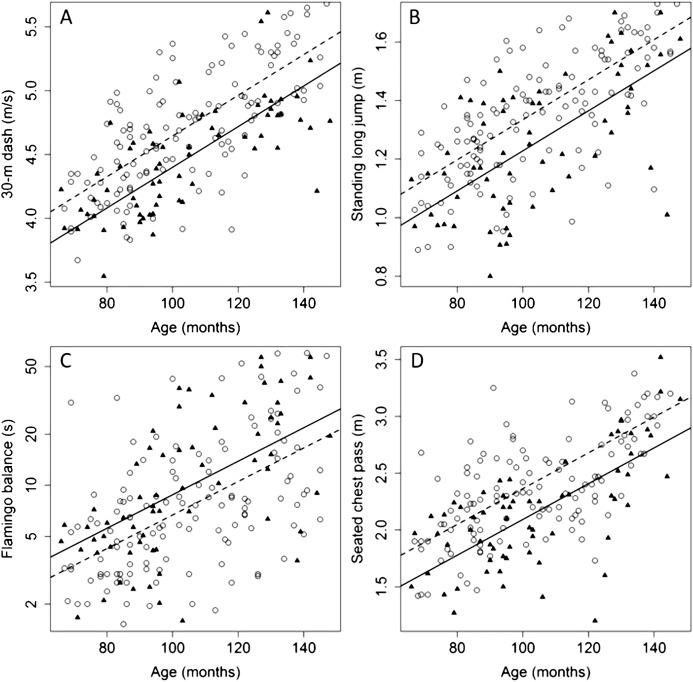
Age predicted 45.2%, 43.6%, 35.6% and 25.6%; and sex 9.5%, 10.7%, 6.3% and 2.0% of variance in the 30-m dash, seated chest pass, standing long jump, and flamingo balance test, respectively. Anthropometry and body composition explained a limited or no percentage of variance. The adjusted (root mean square error) was 0.61 (0.31 s), 0.45 (0.32 m), 0.58 (0.15 m) and 0.41 (0.75 logs) for the 30-m dash, seated chest pass, standing long jump, and flamingo balance test, respectively making these models useful when physical fitness tests are not feasible.

CONCLUSIONS

We highlighted the respective role of chronological age, sex, anthropometry, and body composition in physical fitness of children in the wide age range 6-12 years. Data confirm and expand on previous literature by showing with a strictly conservative statistical approach that chronological age is a main determinant of physical fitness of both boys and girls, sex playing a limited role. The role of anthropometry was even less important, and no role was found for body composition. These findings should be considered when planning/implementing motor development or physical education programs.

摘要

目的

儿童体能的决定因素受到的关注有限。特别是,实足年龄、性别、人体测量学和身体成分在儿童体能中的相对作用几乎未被研究。这项横断面研究使用了一组预测变量来调查体能的决定因素,除实足年龄和性别外,还包括大量人体测量指标以及身体成分。该研究在一个参加夏令营的6至12岁儿童的便利样本中进行。

方法

193名儿童(128名男性)满足所有要求并进入分析。通过现场测试来探究与健康相关的体能成分(速度、肌肉力量和平衡能力),即通过30米短跑测试跑步速度,分别通过立定跳远和坐姿推胸测试下肢和上身的肌肉力量,以及通过火烈鸟平衡测试静态平衡能力。使用实足年龄、性别、人体测量学和身体成分,采用分层方法通过回归分析来研究体能的决定因素。为了尽量减少预测变量中共线性的预期影响,采用了一种使用随机森林分析的原始统计方法。

结果

年龄分别预测了30米短跑、坐姿推胸、立定跳远和火烈鸟平衡测试中45.2%、43.6%、35.6%和25.6%的方差;性别分别预测了9.5%、10.7%、6.3%和2.0%的方差。人体测量学和身体成分解释的方差比例有限或为零。30米短跑、坐姿推胸、立定跳远和火烈鸟平衡测试的调整后均方根误差分别为0.61(0.31秒)、0.45(0.32米)、0.58(0.15米)和0.41(0.75对数),这使得这些模型在体能测试不可行时很有用。

结论

我们强调了实足年龄、性别、人体测量学和身体成分在6至12岁这个较宽年龄范围内儿童体能中的各自作用。数据通过严格保守的统计方法表明实足年龄是男孩和女孩体能的主要决定因素,性别起的作用有限,从而证实并扩展了先前的文献。人体测量学的作用甚至更小,未发现身体成分有作用。在规划/实施运动发展或体育教育项目时应考虑这些发现。
https://cdn.ncbi.nlm.nih.gov/pmc/blobs/87de/7083165/66cf7918c776/peerj-08-8657-g002.jpg
https://cdn.ncbi.nlm.nih.gov/pmc/blobs/87de/7083165/2af2a172febf/peerj-08-8657-g001.jpg
https://cdn.ncbi.nlm.nih.gov/pmc/blobs/87de/7083165/66cf7918c776/peerj-08-8657-g002.jpg
https://cdn.ncbi.nlm.nih.gov/pmc/blobs/87de/7083165/2af2a172febf/peerj-08-8657-g001.jpg
https://cdn.ncbi.nlm.nih.gov/pmc/blobs/87de/7083165/66cf7918c776/peerj-08-8657-g002.jpg

相似文献

1
The role of age, sex, anthropometry, and body composition as determinants of physical fitness in nonobese children aged 6-12.年龄、性别、人体测量学指标和身体成分在6至12岁非肥胖儿童体能决定因素中的作用
PeerJ. 2020 Mar 17;8:e8657. doi: 10.7717/peerj.8657. eCollection 2020.
2
Body composition and physical fitness of undernourished South African rural primary school children.营养不良的南非农村小学生的身体成分与身体素质
Eur J Clin Nutr. 2005 Jul;59(7):877-83. doi: 10.1038/sj.ejcn.1602153.
3
Can anthropometry and physical fitness testing explain physical activity levels in children and adolescents with obesity?人体测量学和体能测试能否解释肥胖儿童和青少年的身体活动水平?
J Sci Med Sport. 2020 Jun;23(6):580-585. doi: 10.1016/j.jsams.2019.12.005. Epub 2019 Dec 12.
4
Physical Fitness Percentiles of German Children Aged 9-12 Years: Findings from a Longitudinal Study.9至12岁德国儿童的体能百分位数:一项纵向研究的结果
PLoS One. 2015 Nov 6;10(11):e0142393. doi: 10.1371/journal.pone.0142393. eCollection 2015.
5
Physical Fitness and Anthropometric Values Among Lithuanian Primary School Children: Population-Based Cross-Sectional Study.立陶宛小学生的体能和人体测量值:基于人群的横断面研究。
J Strength Cond Res. 2020 Feb;34(2):414-421. doi: 10.1519/JSC.0000000000003387.
6
Maturation-, age-, and sex-specific anthropometric and physical fitness percentiles of German elite young athletes.德国精英年轻运动员的成熟度、年龄和性别特异性人体测量和体能百分位数。
PLoS One. 2020 Aug 13;15(8):e0237423. doi: 10.1371/journal.pone.0237423. eCollection 2020.
7
Deleterious effects of obesity on physical fitness in pre-pubertal children.肥胖对青春期前儿童体能的有害影响。
Eur J Sport Sci. 2016;16(2):271-8. doi: 10.1080/17461391.2015.1030454. Epub 2015 Apr 13.
8
Relationship between body mass index and physical fitness in Italian prepubertal schoolchildren.意大利青春期前学童的体重指数与身体健康之间的关系。
PLoS One. 2020 May 22;15(5):e0233362. doi: 10.1371/journal.pone.0233362. eCollection 2020.
9
Two-year longitudinal health-related fitness, anthropometry and body composition status amongst adolescents in Tlokwe Municipality: The PAHL Study.特洛奎市青少年两年纵向健康相关体能、人体测量学及身体成分状况:PAHL研究
Afr J Prim Health Care Fam Med. 2015 Oct 30;7(1):896. doi: 10.4102/phcfm.v7i1.896.
10
Regular participation in sports is associated with enhanced physical fitness and lower fat mass in prepubertal boys.青春期前男孩经常参加体育活动与增强体质和降低体脂有关。
Int J Obes Relat Metab Disord. 2004 Dec;28(12):1585-93. doi: 10.1038/sj.ijo.0802754.

引用本文的文献

1
Global Comparisons of Age, Gender and Socioeconomic Status Differences of Physical Fitness Health Risk in South African Primary School Children: Longitudinal Data from the NW-CHILD Study.南非小学生身体素质健康风险的年龄、性别和社会经济地位差异的全球比较:来自NW-CHILD研究的纵向数据
Int J Environ Res Public Health. 2024 Nov 25;21(12):1554. doi: 10.3390/ijerph21121554.
2
Physical fitness and nutritional anthropometric status of children from disadvantaged communities in the Nelson Mandela Bay region.纳尔逊·曼德拉湾地区弱势社区儿童的身体素质与营养人体测量状况
S Afr J Sports Med. 2020 Jan 1;32(1):v32i1a8158. doi: 10.17159/2078-516X/2020/v32i1a8158. eCollection 2020.
3

本文引用的文献

1
Developmental Change in Motor Competence: A Latent Growth Curve Analysis.运动能力的发展变化:潜在增长曲线分析
Front Physiol. 2019 Oct 2;10:1273. doi: 10.3389/fphys.2019.01273. eCollection 2019.
2
The Relationship between Body Fat Percentage and Some Anthropometric and Physical Fitness Characteristics in Pre- and Peripubertal Boys.青春期前和青春期男孩体脂百分比与一些人体测量学和体能特征的关系。
Int J Environ Res Public Health. 2019 Apr 1;16(7):1170. doi: 10.3390/ijerph16071170.
3
Multivariate Relationships among Morphology, Fitness and Motor Coordination in Prepubertal Girls.
Increase in peak oxygen uptake and Andersen test performance in children from age six to ten: The Health Oriented Pedagogical Project (HOPP).
6至10岁儿童峰值摄氧量及安徒生测试表现的提升:健康导向型教学项目(HOPP)
Front Physiol. 2022 Sep 29;13:976505. doi: 10.3389/fphys.2022.976505. eCollection 2022.
4
Influence of Sport Practice and Body Weight on Physical Fitness in Schoolchildren Living in the Campania Region.运动实践和体重对坎帕尼亚地区学龄儿童身体素质的影响。
Int J Environ Res Public Health. 2022 Jun 16;19(12):7412. doi: 10.3390/ijerph19127412.
5
Fat-free mass and maturity status are determinants of physical fitness performance in schoolchildren and adolescents.去脂体重和成熟度是儿童和青少年体能表现的决定因素。
J Pediatr (Rio J). 2023 Jan-Feb;99(1):38-44. doi: 10.1016/j.jped.2022.03.007. Epub 2022 Jun 5.
6
Can Anthropometry and Body Composition Explain Physical Fitness Levels in School-Aged Children?人体测量学和身体成分能解释学龄儿童的体能水平吗?
Children (Basel). 2021 May 31;8(6):460. doi: 10.3390/children8060460.
7
Balance Tests in Pre-Adolescent Children: Retest Reliability, Construct Validity, and Relative Ability.青少年前期儿童平衡测试:重测信度、结构效度和相对能力。
Int J Environ Res Public Health. 2020 Jul 29;17(15):5474. doi: 10.3390/ijerph17155474.
8
Influence of Body Composition on Physical Fitness in Adolescents.体质成分对青少年体质健康的影响。
Medicina (Kaunas). 2020 Jul 2;56(7):328. doi: 10.3390/medicina56070328.
青春期前女孩形态、体能与运动协调性的多元关系。
J Sports Sci Med. 2018 May 14;17(2):197-204. eCollection 2018 Jun.
4
Physical activity, diet and other behavioural interventions for improving cognition and school achievement in children and adolescents with obesity or overweight.身体活动、饮食及其他行为干预对改善肥胖或超重儿童及青少年认知和学业成绩的作用
Cochrane Database Syst Rev. 2018 Jan 29;1(1):CD009728. doi: 10.1002/14651858.CD009728.pub3.
5
Relationship between motor proficiency and body composition in 6- to 10-year-old children.6至10岁儿童运动能力与身体成分之间的关系。
J Paediatr Child Health. 2017 Apr;53(4):348-353. doi: 10.1111/jpc.13446. Epub 2017 Jan 3.
6
Physical Activity, Fitness, Cognitive Function, and Academic Achievement in Children: A Systematic Review.儿童的身体活动、健康状况、认知功能与学业成绩:一项系统综述
Med Sci Sports Exerc. 2016 Jun;48(6):1223-4. doi: 10.1249/MSS.0000000000000966.
7
Determinant factors of physical fitness in European children.欧洲儿童体能的决定因素。
Int J Public Health. 2016 Jun;61(5):573-82. doi: 10.1007/s00038-016-0811-2. Epub 2016 Apr 4.
8
Concurrent Training in Prepubescent Children: The Effects of 8 Weeks of Strength and Aerobic Training on Explosive Strength and V[Combining Dot Above]O2max.青春期前儿童的同时训练:8周力量训练和有氧训练对爆发力和最大摄氧量的影响。
J Strength Cond Res. 2016 Jul;30(7):2019-32. doi: 10.1519/JSC.0000000000001294.
9
Physical Fitness Percentiles of German Children Aged 9-12 Years: Findings from a Longitudinal Study.9至12岁德国儿童的体能百分位数:一项纵向研究的结果
PLoS One. 2015 Nov 6;10(11):e0142393. doi: 10.1371/journal.pone.0142393. eCollection 2015.
10
PREDICTORS AND TRENDS OF GROSS MOTOR SKILL PERFORMANCE IN AT-RISK ELEMENTARY SCHOOL-AGED CHILDREN.小学适龄高危儿童大运动技能表现的预测因素及趋势
Percept Mot Skills. 2015 Aug;121(1):284-99. doi: 10.2466/10.15.PMS.121c14x6. Epub 2015 Aug 24.