Cho So Mi Jemma, Lee Hokyou, Kim Hyeon Chang
Department of Public Health, Yonsei University Graduate School, Seoul, Korea.
Department of Preventive Medicine, Yonsei University College of Medicine, Seoul, Korea.
Korean Circ J. 2020 Jun;50(6):485-498. doi: 10.4070/kcj.2019.0347. Epub 2020 Feb 18.
This study compared the potential impacts of the 2017 American College of Cardiology/American Heart Association (ACC/AHA) and the 2018 Korean Society of Hypertension (KSH) guidelines on prevalence of hypertension, recommended antihypertensive treatment, and achievement of target blood pressure (BP) in Korean population.
We analyzed the 2007-2017 Korea National Health and Nutrition Examination Survey data to calculate guideline-specific hypertension prevalence and treatment implications on 59,767 adults aged 20 years or older by sex and age.
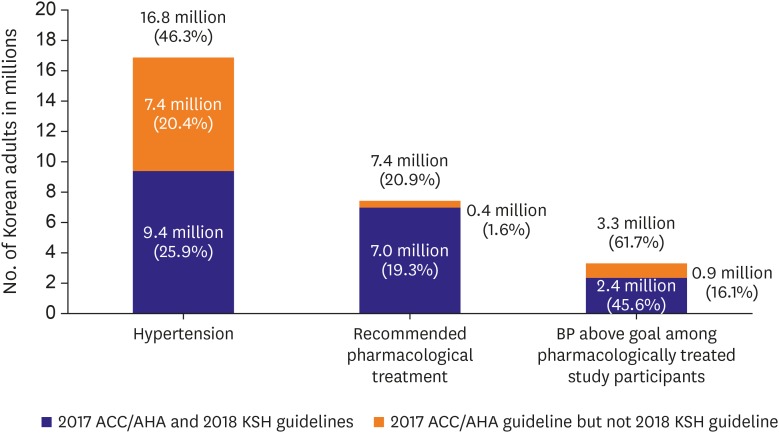
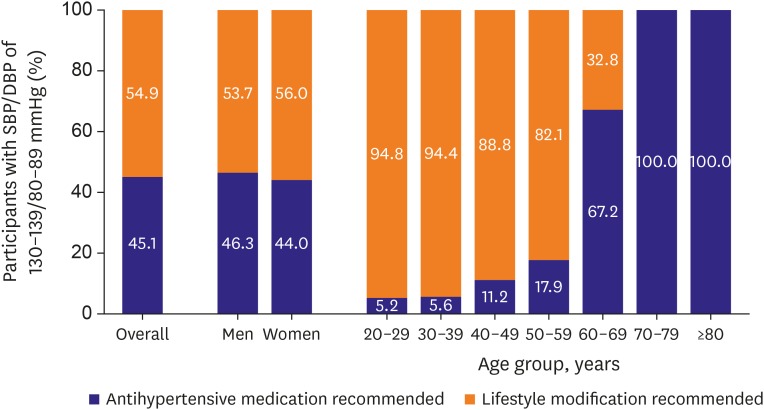
The prevalence of hypertension was markedly higher 46.3% by the ACC/AHA guideline due to the lowered BP cutoff than 25.9% by the KSH guideline; the increase was most pronounced in young adults. Yet, there was only a marginal 1.6% increase in the percentage of adults suggested pharmacological approach by the ACC/AHA guideline, but selectively in the older subgroups. Overall, 45.6% of Korean adults treated for hypertension failed to meet BP goal according to the KSH guideline; the underachievement extended to 61.7% of participants according to the ACC/AHA guideline.
The lowered BP threshold, 130/80 mmHg, by the 2017 ACC/AHA guideline, in conjuncture with 10-year risk calculation largely driven by age, would increase pharmacological treatment preferentially in very old individuals, while increasing prevalence and uncontrolled rate mostly in younger subgroups. Adoption of lower BP cutoff to the KSH guideline would require validated cardiovascular disease risk assessment tools accounting for risk distributions specific to Korean population.
本研究比较了2017年美国心脏病学会/美国心脏协会(ACC/AHA)指南和2018年韩国高血压学会(KSH)指南对韩国人群高血压患病率、推荐的降压治疗以及血压目标达成情况的潜在影响。
我们分析了2007 - 2017年韩国国家健康与营养检查调查数据,以按性别和年龄计算59767名20岁及以上成年人的特定指南高血压患病率及治疗情况。
由于血压临界值降低,ACC/AHA指南的高血压患病率显著高于KSH指南,分别为46.3%和25.9%;这种增加在年轻人中最为明显。然而,ACC/AHA指南建议采用药物治疗方法的成年人比例仅略有增加,为1.6%,但仅限于老年亚组。总体而言,根据KSH指南,45.6%接受高血压治疗的韩国成年人未达到血压目标;根据ACC/AHA指南,这一未达标比例扩大到61.7%的参与者。
2017年ACC/AHA指南降低血压阈值至130/80 mmHg,结合主要由年龄驱动的10年风险计算,将优先增加对高龄个体的药物治疗,同时主要增加年轻亚组的患病率和未控制率。将较低的血压临界值纳入KSH指南需要经过验证的心血管疾病风险评估工具,该工具要考虑韩国人群特有的风险分布。