Kwun Ju-Seung, Kim Sun-Hwa, Kang Si-Hyuck, Yoon Chang-Hwan, Lee Hae-Young, Kim Kwang-Il, Youn Tae-Jin, Chae In-Ho, Kim Cheol-Ho
1Cardiovascular Center, Department of Internal Medicine, Seoul National University Bundang Hospital, 82, Gumi-Ro 173 Beon-Gil, Bundang-Gu, Seongnam-Si, Gyeonggi-Do 13620 South Korea.
2Department of Internal Medicine, Seoul National University, Seoul, South Korea.
Clin Hypertens. 2020 Feb 1;26:3. doi: 10.1186/s40885-020-0137-5. eCollection 2020.
The Korean Society of Hypertension (KSH) revised the local guidelines for hypertension in 2018. The present study sought to evaluate the potential impact of the 2018 KSH guidelines on hypertension management status among the Korean population in terms of prevalence of hypertension, antihypertensive medical treatment recommendations, and control status in Korean adults.
We used data from the Korea National Health and Nutrition Examination Survey to estimate the number and percentage of Korean adults who have hypertension according to blood pressure (BP) classification, are recommended to receive antihypertensive medical treatment, and are receiving medical treatment and have BP in the optimal range according to the new recommendations. Adults aged 30 years or older who participated in the survey between 2013 and 2015 were selected for this study.
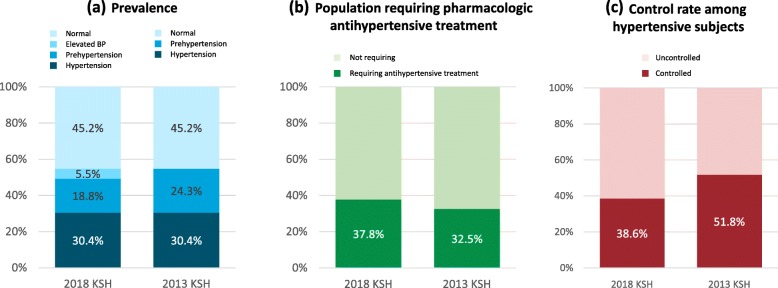
The prevalence of hypertension was 30.5% among Korean adults aged 30 years or older. The percentage of subjects who are recommended to be treated with antihypertensive medications substantially increased from 32.5 to 37.8%, which translates to 1.6 million adults. Among the hypertensive patients who were receiving medical treatment, 38.6% were shown to have adequate BP levels as recommended by the 2018 KSH guidelines compared with 51.8% according to the previous 2013 guidelines.
The present study reports the potential impact of the 2018 KSH guidelines on the prevalence of hypertension, antihypertensive medical treatment recommendations, and control status for Korean adults. The 2018 KSH guidelines recommend more intensive BP control compared with previous guidelines. This study suggests that there is large scope for improvement in hypertension management in the Korean population.
韩国高血压学会(KSH)于2018年修订了当地的高血压指南。本研究旨在从高血压患病率、抗高血压药物治疗建议以及韩国成年人的血压控制状况等方面,评估2018年KSH指南对韩国人群高血压管理状况的潜在影响。
我们使用了韩国国家健康与营养检查调查的数据,以估算根据血压(BP)分类患有高血压、被建议接受抗高血压药物治疗、正在接受治疗且根据新建议血压处于最佳范围的韩国成年人的数量和百分比。本研究选取了2013年至2015年期间参与调查的30岁及以上成年人。
30岁及以上韩国成年人的高血压患病率为30.5%。被建议接受抗高血压药物治疗的受试者百分比从32.5%大幅增至37.8%,这相当于160万成年人。在接受治疗的高血压患者中,根据2018年KSH指南,38.6%的患者血压水平达到推荐标准,而根据2013年的先前指南这一比例为51.8%。
本研究报告了2018年KSH指南对韩国成年人高血压患病率、抗高血压药物治疗建议以及血压控制状况的潜在影响。与先前指南相比,2018年KSH指南建议进行更严格的血压控制。本研究表明,韩国人群的高血压管理仍有很大的改善空间。