University College London, UK.
King's College London, UK.
Dementia (London). 2021 Apr;20(3):1080-1104. doi: 10.1177/1471301220915068. Epub 2020 Mar 25.
Many qualitative studies report the post-diagnostic care experiences of carers and people living with dementia; however, this is not often accompanied by opportunities to hear the corresponding views of their health care professionals and how this triadic relationship functions. The aim of this review was to identify and thematically synthesize the experiences of health care services reported by people living with dementia, their carers and health care professionals.
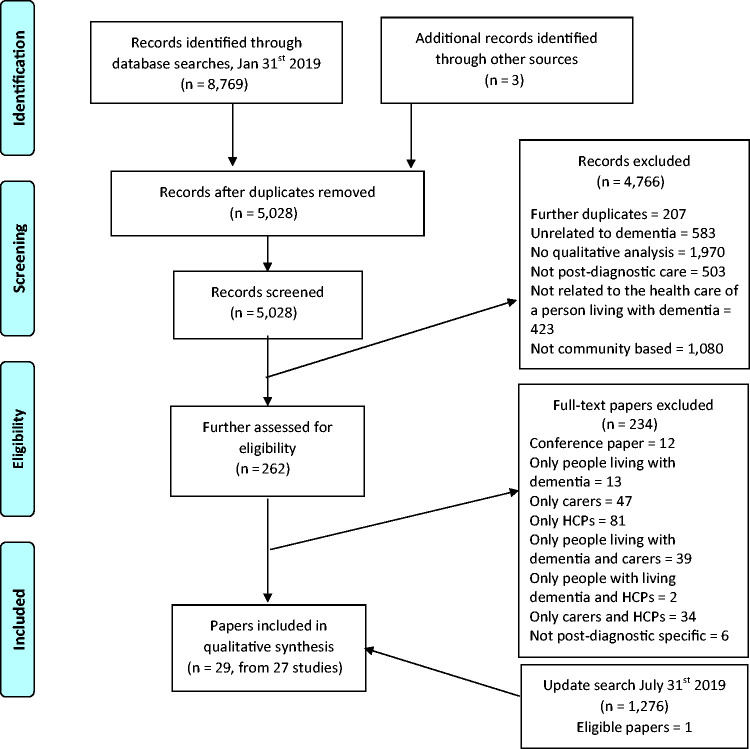
Medline, PsycINFO, Embase and CINAHL were searched from inception to 31 July 2019 for qualitative research including people living with dementia, carers and health care professionals. Data were coded and thematically synthesised using NVivo.
Of 10,045 search results, 29 papers relating to 27 studies were included in the final synthesis, including 261 people living with dementia, 444 carers and 530 health care professionals. Six themes emerged related to the functioning of a dementia care triad: (1) involving the person living with dementia, (2) establishing expectations of care and the roles of the members of the triad, (3) building trust, (4) effective communication, (5) continuity of care and (6) understanding the unique relationship dynamics within each triad.
The interactions and complexity of triadic dementia care relationships further our understanding of how to improve dementia care. Awareness of possible diverging attitudes highlights areas of necessary improvement and further research into facilitating engagement, such as when multiple professionals are involved or where there are mismatched expectations of the roles of triad members. In order to operate efficiently as a triad member, professionals should be aware of how pre-existing relations can influence the composition of a triad, encourage the involvement of the person living with dementia, clarify the expectations of all parties, establish trusting relationships and enable communication within the direct triad and beyond.
许多定性研究报告了照顾者和痴呆症患者的诊断后护理经历;然而,这通常并不伴随着倾听医疗保健专业人员的相应观点以及这种三方关系运作方式的机会。本综述的目的是确定和主题综合痴呆症患者、照顾者和医疗保健专业人员报告的医疗服务经验。
从开始到 2019 年 7 月 31 日,在 Medline、PsycINFO、Embase 和 CINAHL 上搜索定性研究,包括痴呆症患者、照顾者和医疗保健专业人员。使用 NVivo 对数据进行编码和主题综合。
在 10045 条搜索结果中,最终综合分析了 29 篇论文,涉及 27 项研究,包括 261 名痴呆症患者、444 名照顾者和 530 名医疗保健专业人员。出现了六个与痴呆症护理三方关系功能相关的主题:(1)涉及与痴呆症患者,(2)建立对护理的期望以及三方成员的角色,(3)建立信任,(4)有效沟通,(5)护理连续性和(6)了解每个三方关系中的独特关系动态。
三方痴呆症护理关系的相互作用和复杂性进一步加深了我们对如何改善痴呆症护理的理解。对可能存在的态度分歧的认识突出了需要改进的领域,并进一步研究如何促进参与,例如涉及多个专业人员或三方成员的角色期望不匹配时。为了作为三方成员有效地运作,专业人员应该意识到先前存在的关系如何影响三方的组成,鼓励痴呆症患者的参与,澄清各方的期望,建立信任关系,并在直接三方关系内和超越建立沟通。