MMWR Morb Mortal Wkly Rep. 2020 Mar 27;69(12):329-334. doi: 10.15585/mmwr.mm6912a3.
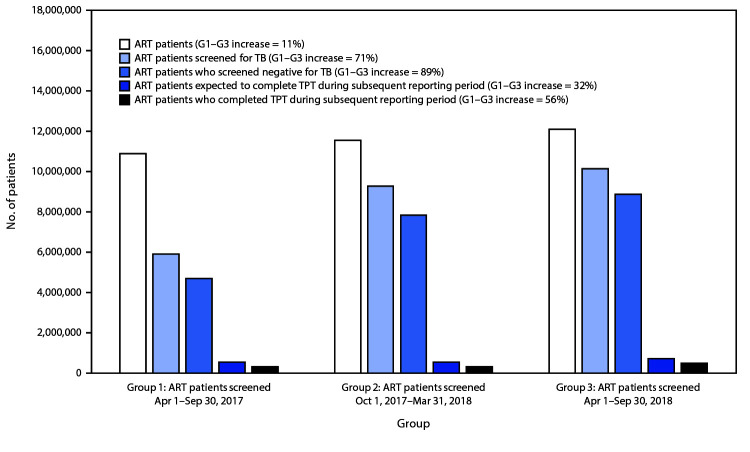
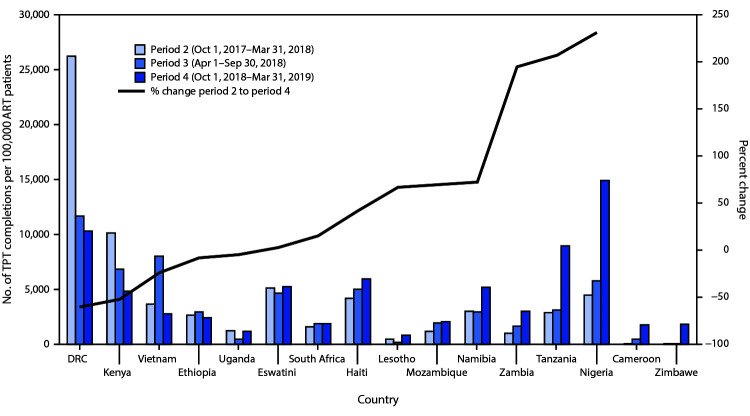
Tuberculosis (TB) is the leading cause of death among persons living with human immunodeficiency virus (HIV) infection. In 2018, an estimated 251,000 persons living with HIV infection died from TB, accounting for one third of all HIV-related deaths and one sixth of all TB deaths (1). TB preventive treatment (TPT) is recommended by the World Health Organization (WHO) for persons living with HIV infection without active TB disease (i.e., adults with a negative clinical symptom screen for cough, fever, night sweats, or weight loss; and children with a negative clinical screen for cough, fever, contact with a person with TB, or poor weight gain) and either without* a tuberculin skin test result or with a known positive result (2). TPT decreases morbidity and mortality among persons living with HIV infection, independent of antiretroviral therapy (ART) (3); however, in 2017, fewer than 1 million of the estimated 21.3 million ART patients started TPT worldwide. Most patients receiving TPT were treated with 6 months of daily isoniazid (1,4). This report summarizes data on TB symptom screening and TPT initiation and completion among ART patients in 16 countries supported by the U.S. President's Emergency Plan for AIDS Relief (PEPFAR) during April 1, 2017-March 31, 2019. During this period, these 16 countries accounted for approximately 90% of PEPFAR-supported ART patients. During April 1, 2017-September 30, 2018, TB symptom screening increased from 54% to 84%. Overall, nearly 2 million ART patients initiated TPT, and 60% completed treatment during October 1, 2017-March 31, 2019. Although TPT initiations increased substantially, completion among those who initiated TPT increased only from 55% to 66%. In addition to continuing gains in initiation, improving retention after initiation and identifying barriers to TPT completion are important to increase TPT scale-up and reduce global TB mortality.
结核病(TB)是导致人类免疫缺陷病毒(HIV)感染者死亡的主要原因。2018 年,估计有 25.1 万名感染 HIV 的人死于结核病,占所有与 HIV 相关死亡人数的三分之一和所有结核病死亡人数的六分之一(1)。世界卫生组织(WHO)建议对没有活动性结核病(即没有咳嗽、发热、盗汗或体重减轻等临床症状筛查阳性的成年人;以及没有咳嗽、发热、与结核病患者接触或体重增长不良等临床筛查阳性的儿童)的 HIV 感染者进行结核病预防性治疗(TPT),且无论是否进行了结核菌素皮肤试验(TST)或 TST 结果已知阳性(2)。TPT 可降低 HIV 感染者的发病率和死亡率,与抗逆转录病毒治疗(ART)无关(3);然而,2017 年,全世界估计有 2130 万接受 ART 治疗的患者中,只有不到 100 万人开始接受 TPT。大多数接受 TPT 的患者接受了 6 个月的每日异烟肼治疗(1,4)。本报告总结了 2017 年 4 月 1 日至 2019 年 3 月 31 日期间,美国艾滋病紧急救援计划(PEPFAR)支持的 16 个国家中接受 ART 治疗的患者中结核病症状筛查和 TPT 启动和完成的数据。在此期间,这 16 个国家占 PEPFAR 支持的接受 ART 治疗患者的约 90%。2017 年 4 月 1 日至 2018 年 9 月 30 日,结核病症状筛查率从 54%增加到 84%。总体而言,近 200 万名接受 ART 治疗的患者开始接受 TPT,2017 年 10 月 1 日至 2019 年 3 月 31 日期间,60%的患者完成了治疗。尽管 TPT 的启动率大幅增加,但启动 TPT 的患者的完成率仅从 55%增加到 66%。除了继续增加启动率外,提高启动后的保留率并确定 TPT 完成的障碍对于扩大 TPT 规模和降低全球结核病死亡率至关重要。