Na'ara Shorook, Mukherjee Abhishek, Billan Salem, Gil Ziv
The Laboratory for Applied Cancer Research, Department of Otolaryngology Head and Neck Surgery, Technion-Israel Institute of Technology, Rambam Healthcare Campus, Haifa, Israel.
The Head and Neck Center, Rambam Healthcare Campus, Clinical Research Institute at Rambam, Rappaport Institute of Medicine and Research, Technion-Israel Institute of Technology, Haifa, Israel.
Onco Targets Ther. 2020 Mar 16;13:2289-2298. doi: 10.2147/OTT.S182580. eCollection 2020.
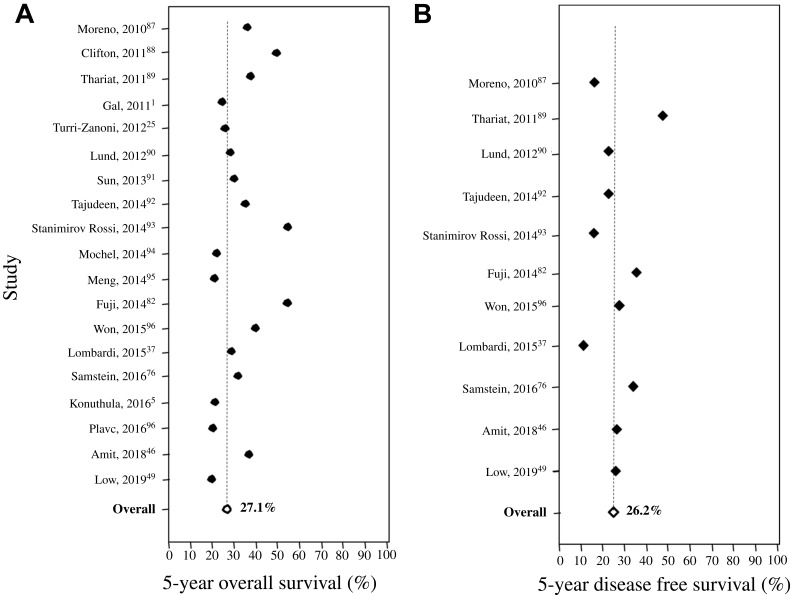
Sinonasal mucosal melanoma (SNMM) is a rare tumor, comprising less than 10% of sinonasal malignancies. SNMM most frequently occurs in the nasal cavity (70%) and maxillary sinus (14%), typically as black patches. Overall, SNMM harbors a very poor prognosis; 5-year survival is less than 30%. Nasal cavity tumors confer a better prognosis than sinus melanoma. The primary management for SNMM is surgery, when feasible, followed by adjuvant radiotherapy. Recent studies suggest that immunotherapy may confer survival benefit to patients with advanced disease. The multidisciplinary team approach has been shown to optimize treatment, reduce costs, and minimize adverse events, while maximizing the chances for cure.
鼻窦黏膜黑色素瘤(SNMM)是一种罕见肿瘤,占鼻窦恶性肿瘤的比例不到10%。SNMM最常发生于鼻腔(70%)和上颌窦(14%),通常表现为黑色斑块。总体而言,SNMM的预后非常差;5年生存率低于30%。鼻腔肿瘤的预后优于鼻窦黑色素瘤。SNMM的主要治疗方法是在可行的情况下进行手术,然后进行辅助放疗。最近的研究表明,免疫疗法可能会给晚期疾病患者带来生存益处。多学科团队方法已被证明可优化治疗、降低成本并将不良事件降至最低,同时最大限度地提高治愈机会。