Department of Genetics, Yale University School of Medicine, New Haven, Connecticut, USA.
Department of Biostatistics, Yale University School of Public Health, New Haven, Connecticut, USA.
J Inherit Metab Dis. 2020 Sep;43(5):934-943. doi: 10.1002/jimd.12236. Epub 2020 Apr 17.
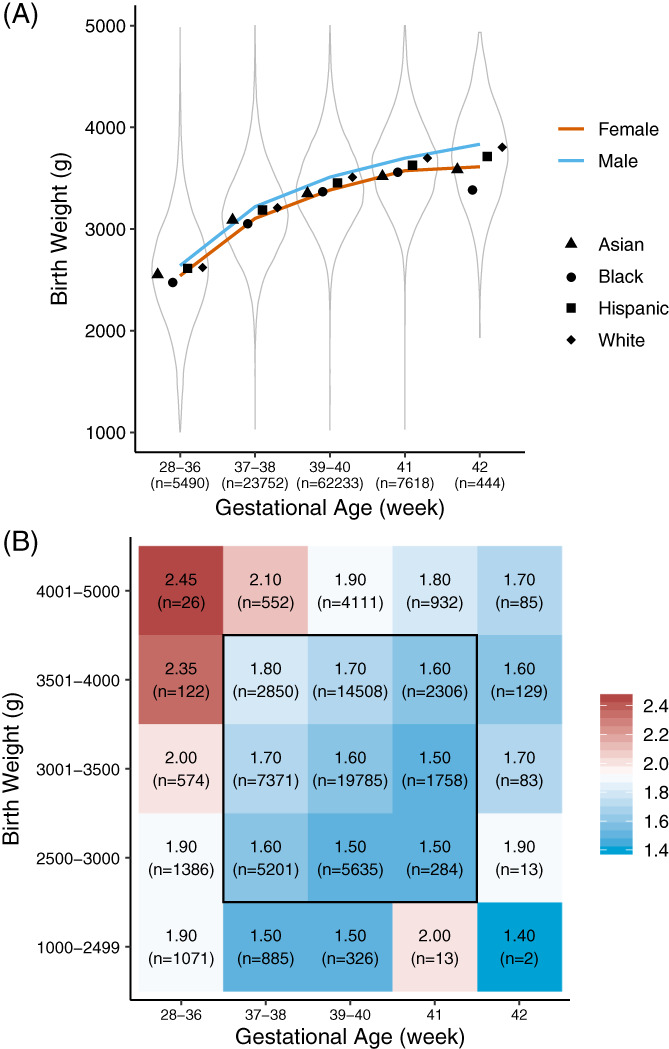
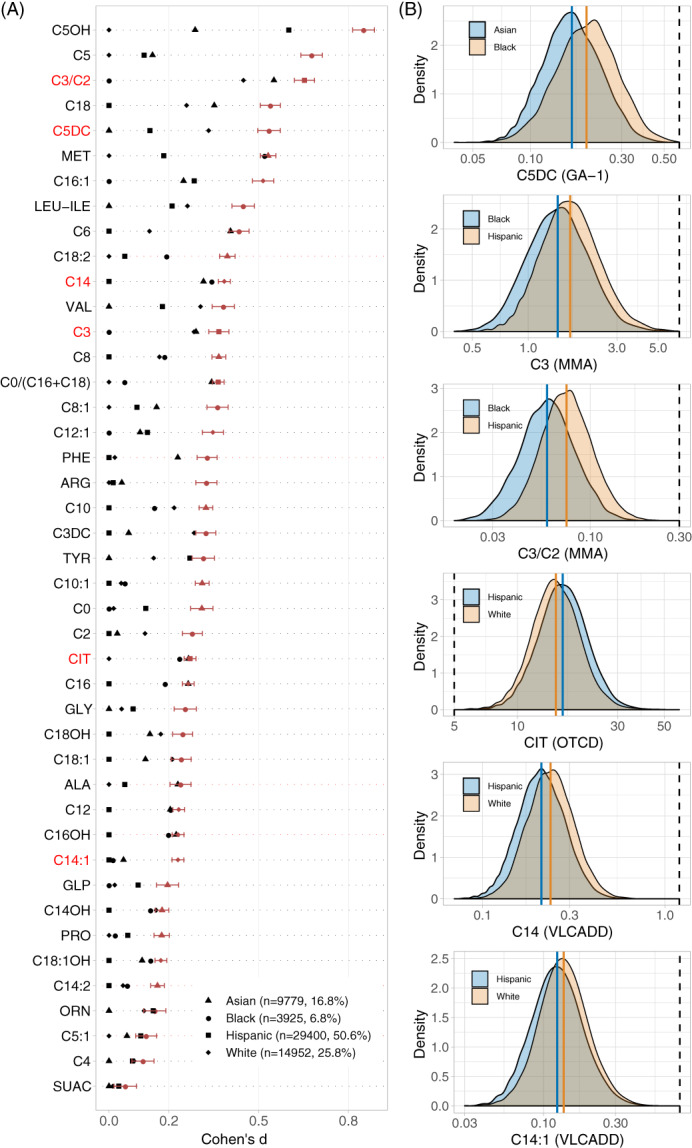
Newborn screening (NBS) programmes utilise information on a variety of clinical variables such as gestational age, sex, and birth weight to reduce false-positive screens for inborn metabolic disorders. Here we study the influence of ethnicity on metabolic marker levels in a diverse newborn population. NBS data from screen-negative singleton babies (n = 100 000) were analysed, which included blood metabolic markers measured by tandem mass spectrometry and ethnicity status reported by the parents. Metabolic marker levels were compared between major ethnic groups (Asian, Black, Hispanic, White) using effect size analysis, which controlled for group size differences and influence from clinical variables. Marker level differences found between ethnic groups were correlated to NBS data from 2532 false-positive cases for four metabolic diseases: glutaric acidemia type 1 (GA-1), methylmalonic acidemia (MMA), ornithine transcarbamylase deficiency (OTCD), and very long-chain acyl-CoA dehydrogenase deficiency (VLCADD). In the result, 79% of the metabolic markers (34 of 43) had ethnicity-related differences. Compared to the other groups, Black infants had elevated GA-1 markers (C5DC, Cohen's d = .37, P < .001), Hispanics had elevated MMA markers (C3, Cohen's d = .13, P < .001, and C3/C2, Cohen's d = .27, P < .001); and Whites had elevated VLCADD markers (C14, Cohen's d = .28, P < .001, and C14:1, Cohen's d = .22, P < .001) and decreased OTCD markers (citrulline, Cohen's d = -.26, P < .001). These findings correlated with the higher false-positive rates in Black infants for GA-1, in Hispanics for MMA, and in Whites for OTCD and for VLCADD. Web-based tools are available to analyse ethnicity-related changes in newborn metabolism and to support developing methods to identify false-positives in metabolic screening.
新生儿筛查(NBS)计划利用各种临床变量(如胎龄、性别和出生体重)的信息,以降低先天性代谢紊乱的假阳性筛查结果。在这里,我们研究了种族对不同新生儿人群代谢标志物水平的影响。分析了来自阴性筛查的单胎婴儿(n=100000)的 NBS 数据,这些数据包括通过串联质谱法测量的血液代谢标志物和父母报告的种族状况。使用效应大小分析比较了主要种族(亚洲人、黑人、西班牙裔、白人)之间的代谢标志物水平,该分析控制了组间大小差异和临床变量的影响。在发现不同种族之间的标志物水平差异后,与四种代谢疾病(1 型戊二酸血症(GA-1)、甲基丙二酸血症(MMA)、鸟氨酸转氨甲酰酶缺乏症(OTCD)和极长链酰基辅酶 A 脱氢酶缺乏症(VLCADD)的 2532 例假阳性病例的 NBS 数据相关联。结果,79%的代谢标志物(43 个中的 34 个)具有种族相关差异。与其他群体相比,黑人婴儿的 GA-1 标志物升高(C5DC,Cohen's d =.37,P <.001),西班牙裔婴儿的 MMA 标志物升高(C3,Cohen's d =.13,P <.001,和 C3/C2,Cohen's d =.27,P <.001);而白人婴儿的 VLCADD 标志物升高(C14,Cohen's d =.28,P <.001,和 C14:1,Cohen's d =.22,P <.001)和 OTCD 标志物降低(瓜氨酸,Cohen's d = -.26,P <.001)。这些发现与 GA-1 在黑人婴儿、MMA 在西班牙裔婴儿、OTCD 在白人婴儿和 VLCADD 在白人婴儿中的假阳性率较高相关。可利用基于网络的工具分析新生儿代谢中的种族相关变化,并支持开发用于识别代谢筛查中假阳性的方法。