School of Dental Sciences, Newcastle University, Framlington Place, Newcastle upon Tyne, NE2 4BW, UK.
School of Medical Education, Faculty of Medical Sciences, Newcastle University, Cookson Building, Newcastle upon Tyne, NE2 4HH, UK.
BMC Health Serv Res. 2020 Mar 26;20(1):255. doi: 10.1186/s12913-020-4980-6.
To help promote a flexible and sustainable workforce in dentistry, it is necessary to access accurate and timely data about the structure and nature of the evolving dental team. This paper considers the results and learning from a region-wide dental workforce survey conducted in one area of Health Education England and how the team has changed since the last survey a decade earlier.
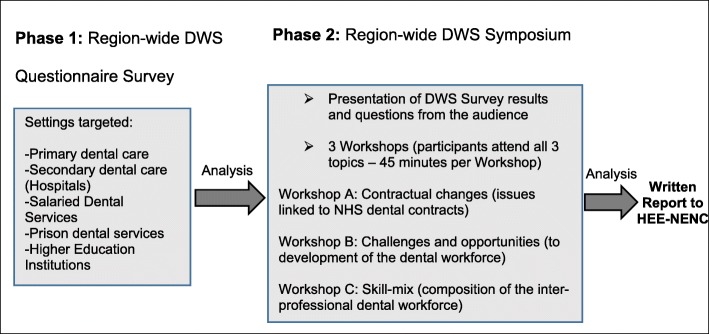
A mixed-methods approach comprised two phases. In Phase 1 a customised workforce questionnaire was sent to all dental practices registered with the Care Quality Commission in the North East of England and North Cumbria in March 2016. Findings then informed Phase 2, a regional symposium held in October 2016, where interactive workshops generated qualitative data that elaborated on factors influencing workforce development.
Of 431 primary dental care practices identified, 228 questionnaires were returned - a 53% response rate. The largest professional groups were dental nurses (n = 1269, 53% by headcount; 50% of fte) and dentists (34% by headcount; 42% by fte), though there had been increases in numbers of all staff groups over the decade, which was most marked for dental therapists (from 1 per 39 dentists to 1 per 8 dentists). The dental team predominantly fell into 'younger' age groups (< 46 years age), with evidence of a significant increase in the number of dentists reporting part-time working in a practice since the last survey. Around one third of dental practices reported employing dental nurses with additional skills (n = 74, 32.5%) or dental therapists (n = 73, 32%), and nearly half employed a dental hygienist (n = 104, 46%). However, there was considerable variability in whether these staff actually carried out the range of skills within their scope of practice. Factors shaping workforce development were identified as, the national context, loss of expertise, patients' health needs and expectations, surgery premises and financial constraints.
The composition and work patterns of the primary care dental workforce have changed markedly over the last decade, though utilisation of skill-mix continues to be constrained. Consideration of factors determining career progression of dentists and dental care professionals is needed to optimise a sustainable future workforce.
为帮助促进牙科领域灵活且可持续的劳动力发展,有必要获取有关不断发展的牙科团队结构和性质的准确且及时的数据。本文考虑了在英格兰教育卫生局的一个区域内进行的一项全地区牙科劳动力调查的结果和经验教训,以及自十年前上次调查以来团队发生的变化。
采用混合方法,包括两个阶段。在第一阶段,于 2016 年 3 月向英格兰东北部和北坎布里亚的所有在英国国家医疗服务体系注册的牙科诊所发送了一份定制的劳动力调查问卷。调查结果为第二阶段提供了信息,即 2016 年 10 月举行的区域研讨会,在研讨会上,互动式研讨会生成了详细阐述影响劳动力发展因素的定性数据。
在确定的 431 家初级牙科护理诊所中,有 228 家返回了调查问卷,回应率为 53%。最大的专业群体是牙科护士(n=1269,按人头计算占 53%;按 FTE 计算占 50%)和牙医(按人头计算占 34%;按 FTE 计算占 42%),尽管过去十年中所有员工群体的数量都有所增加,其中牙科治疗师的增幅最为显著(从每 39 名牙医 1 名增加到每 8 名牙医 1 名)。牙科团队主要属于“较年轻”年龄段(<46 岁),自上次调查以来,报告在实践中兼职工作的牙医数量显著增加。约三分之一的牙科诊所报告雇用了具有额外技能的牙科护士(n=74,32.5%)或牙科治疗师(n=73,32%),近一半的诊所雇用了牙科保健师(n=104,46%)。然而,这些员工实际上在其执业范围内开展的一系列技能的情况存在很大差异。确定劳动力发展因素的因素包括国家背景、专业知识的流失、患者的健康需求和期望、诊所场所和财务限制。
过去十年中,初级保健牙科劳动力的构成和工作模式发生了重大变化,尽管技能组合的利用仍然受到限制。需要考虑决定牙医和牙科保健专业人员职业发展的因素,以优化未来可持续的劳动力。