Zeeman Institute of Systems Biology and Infectious Disease Research (SBIDER), University of Warwick, Warwick, United Kingdom.
School of Life Sciences, University of Warwick, Coventry, United Kingdom.
Elife. 2020 Mar 27;9:e47003. doi: 10.7554/eLife.47003.
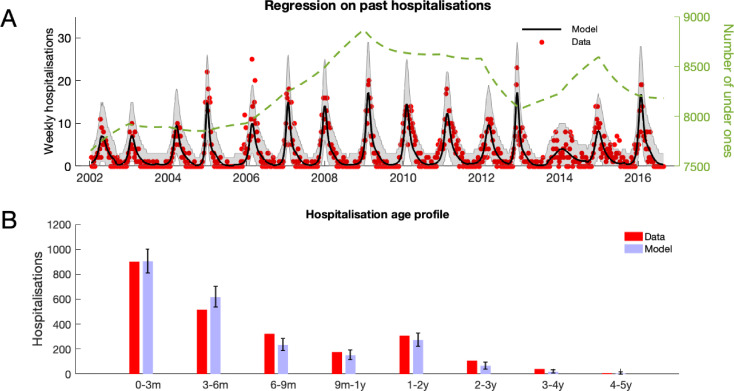
Respiratory syncytial virus is the leading cause of lower respiratory tract infection among infants. RSV is a priority for vaccine development. In this study, we investigate the potential effectiveness of a two-vaccine strategy aimed at mothers-to-be, thereby boosting maternally acquired antibodies of infants, and their household cohabitants, further cocooning infants against infection. We use a dynamic RSV transmission model which captures transmission both within households and communities, adapted to the changing demographics and RSV seasonality of a low-income country. Model parameters were inferred from past RSV hospitalisations, and forecasts made over a 10-year horizon. We find that a 50% reduction in RSV hospitalisations is possible if the maternal vaccine effectiveness can achieve 75 days of additional protection for newborns combined with a 75% coverage of their birth household co-inhabitants (~7.5% population coverage).
呼吸道合胞病毒是婴儿下呼吸道感染的主要原因。RSV 是疫苗开发的重点。在这项研究中,我们研究了一种针对孕妇的两剂疫苗策略的潜在效果,从而提高婴儿及其家庭同住者的母婴获得性抗体,进一步保护婴儿免受感染。我们使用了一种动态 RSV 传播模型,该模型可以捕捉家庭和社区内的传播,适应低收入国家人口结构和 RSV 季节性变化。模型参数是根据过去 RSV 住院情况推断出来的,并在 10 年的时间内进行了预测。我们发现,如果母亲疫苗的有效性能够为新生儿提供 75 天的额外保护,同时为新生儿家庭同住者(约 7.5%的人口)提供 75%的覆盖率,那么 RSV 住院率可能会降低 50%。