Epidemiology, University of Melbourne, at the Peter Doherty Institute for Infection and Immunity, Melbourne, Victoria, Australia.
School of Population and Global Health, The University of Melbourne, Melbourne, Australia.
BMC Med. 2020 Nov 12;18(1):319. doi: 10.1186/s12916-020-01783-8.
Respiratory syncytial virus (RSV) infects almost all children by the age of 2 years, with the risk of hospitalisation highest in the first 6 months of life. Development and licensure of a vaccine to prevent severe RSV illness in infants is a public health priority. A recent phase 3 clinical trial estimated the efficacy of maternal vaccination at 39% over the first 90 days of life. Households play a key role in RSV transmission; however, few estimates of population-level RSV vaccine impact account for household structure.
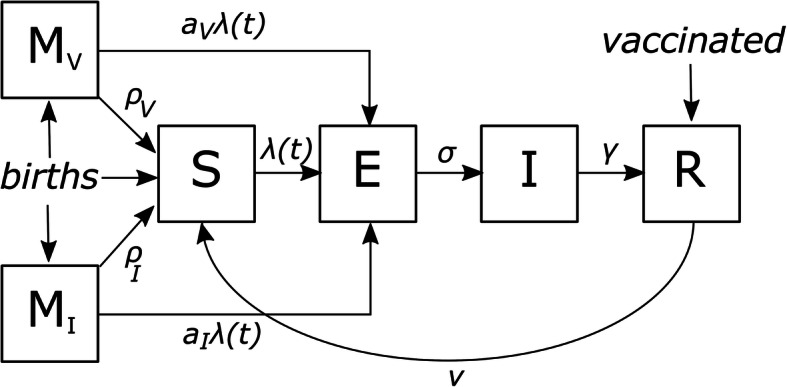
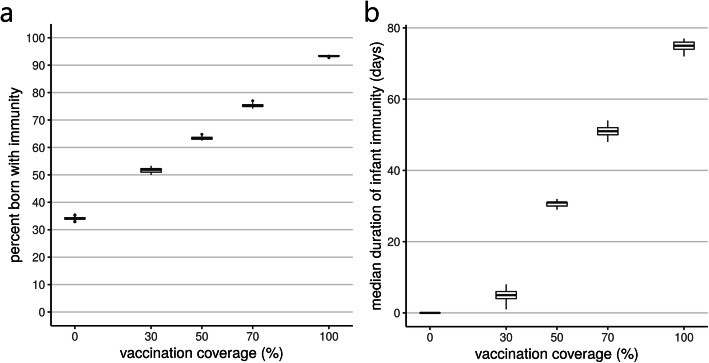
We simulated RSV transmission within a stochastic, individual-based model framework, using an existing demographic model, structured by age and household and parameterised with Australian data, as an exemplar of a high-income country. We modelled vaccination by immunising pregnant women and explicitly linked the immune status of each mother-infant pair. We quantified the impact on children for a range of vaccine properties and uptake levels.
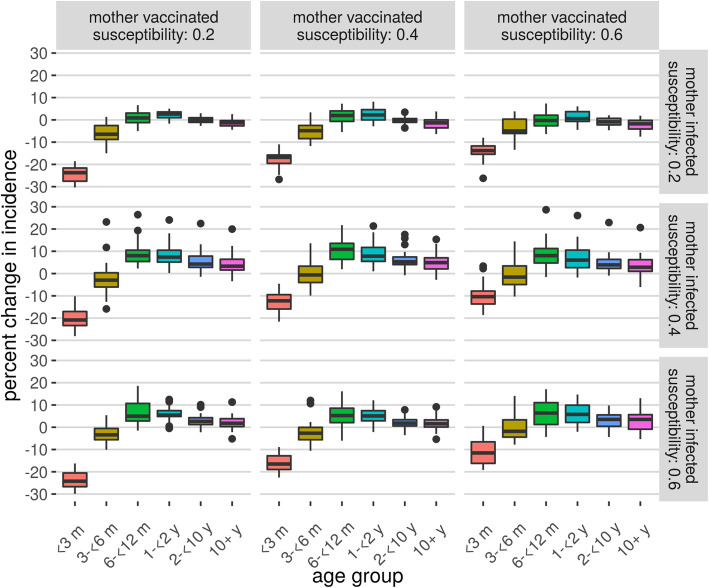
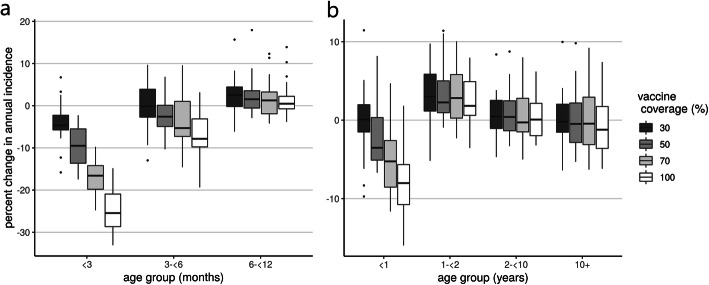
We found that a maternal immunisation strategy would have the most substantial impact in infants younger than 3 months, reducing RSV infection incidence in this age group by 16.6% at 70% vaccination coverage. In children aged 3-6 months, RSV infection was reduced by 5.3%. Over the first 6 months of life, the incidence rate for infants born to unvaccinated mothers was 1.26 times that of infants born to vaccinated mothers. The impact in older age groups was more modest, with evidence of infections being delayed to the second year of life.
Our findings show that while individual benefit from maternal RSV vaccination could be substantial, population-level reductions may be more modest. Vaccination impact was sensitive to the extent that vaccination prevented infection, highlighting the need for more vaccine trial data.
呼吸道合胞病毒(RSV)几乎会感染所有 2 岁以下的儿童,而 6 个月以下婴儿住院的风险最高。开发和许可预防婴儿严重 RSV 疾病的疫苗是公共卫生的重点。最近的一项 3 期临床试验估计,母亲接种疫苗在生命的前 90 天内的有效性为 39%。家庭在 RSV 传播中起着关键作用;然而,很少有针对人群水平 RSV 疫苗影响的估计考虑到家庭结构。
我们使用现有的人口模型,以澳大利亚的数据为参数,在随机的个体基础模型框架内模拟 RSV 传播,该模型按年龄和家庭结构组织。我们通过为孕妇接种疫苗来模拟疫苗接种,并明确关联每个母婴对的免疫状态。我们量化了一系列疫苗特性和接种水平对儿童的影响。
我们发现,母亲免疫接种策略对 3 个月以下的婴儿影响最大,在 70%的疫苗接种覆盖率下,将该年龄段 RSV 感染的发病率降低 16.6%。在 3-6 个月大的儿童中,RSV 感染减少了 5.3%。在生命的前 6 个月,未接种疫苗母亲所生婴儿的 RSV 感染发生率是接种疫苗母亲所生婴儿的 1.26 倍。在年龄较大的儿童中,影响较小,有证据表明感染会延迟到第二年。
我们的研究结果表明,虽然母亲 RSV 疫苗接种的个体获益可能很大,但人群水平的减少可能更为温和。疫苗接种的效果对疫苗预防感染的程度敏感,这突出表明需要更多的疫苗试验数据。