Marto Carlos Miguel, Laranjo Mafalda, Paula Anabela, Coelho Ana Sofia, Abrantes Ana Margarida, Casalta-Lopes João, Gonçalves Ana Cristina, Sarmento-Ribeiro Ana Bela, Ferreira Manuel Marques, Cabrita António, Botelho Maria Filomena, Carrilho Eunice
Institute of Experimental Pathology, Faculty of Medicine, University of Coimbra, 3000-548 Coimbra, Portugal.
Coimbra Institute for Clinical and Biomedical Research (iCBR), Area of Environment, Genetics and Oncobiology (CIMAGO), Faculty of Medicine, University of Coimbra, 3000-548 Coimbra, Portugal.
Materials (Basel). 2020 Mar 25;13(7):1491. doi: 10.3390/ma13071491.
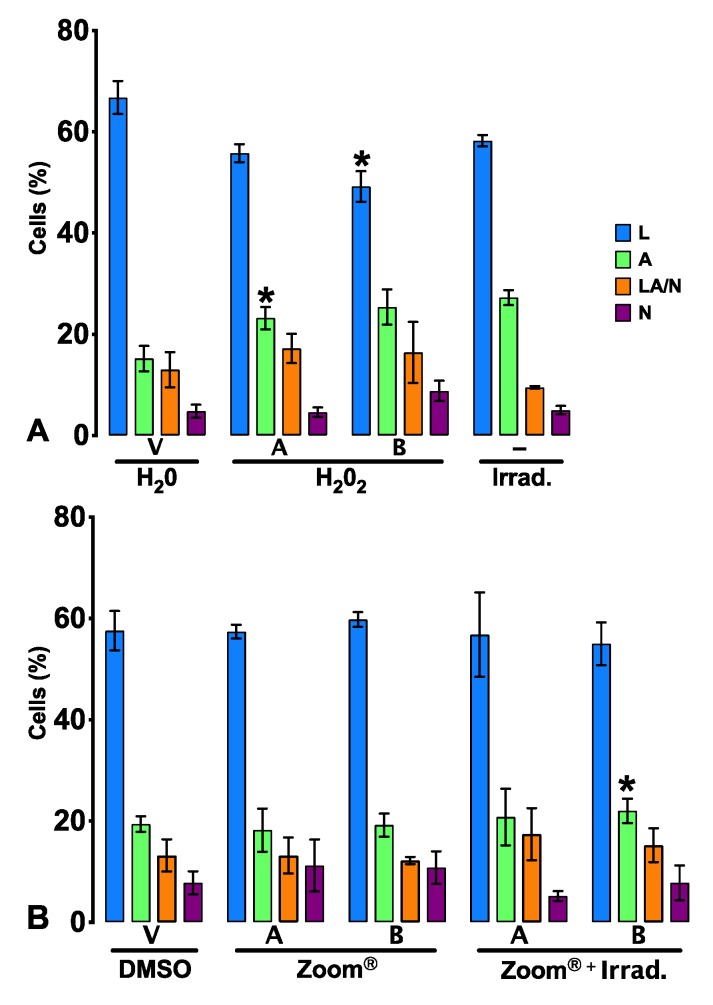
Tooth whitening procedures are increasing; however, side effects can occur, such as damage to pulp cells, by the whitening products. This study aims to assess the cellular effects promoted by a whitening product, namely, the oxidative stress fostered by the active agent hydrogen peroxide, with and without photoactivation. Additionally, if cellular recovery occurred, we intended to determine the time point where cells recover from the tooth whitening induced damage. Human fibroblasts were exposed to hydrogen peroxide, Zoom, Zoom + irradiation, and irradiation alone. The following analysis was performed: metabolic activity evaluation by the MTT assay; cell viability, mitochondrial membrane potential, peroxides production, superoxide radical production, and reduced glutathione expression by flow cytometry. We determined the IC value for all groups, and a dose-dependent cytotoxic effect was verified. At the times analyzed, hydrogen peroxide groups showed no metabolic activity recovery while a cell recovery was observed after 24 h (Zoom) and 48 h (Zoom + irradiation). Cell death was seen in hydrogen peroxide and Zoom + irradiation groups, mainly by apoptosis, and the irradiation had a cytotoxic effect per se. This in vitro study supports that whitening products with moderate hydrogen peroxide (HP) concentration have a temporary effect on cells, allowing a cellular recovery.
牙齿美白程序日益增多;然而,美白产品可能会产生副作用,比如对牙髓细胞造成损伤。本研究旨在评估一种美白产品所引发的细胞效应,即活性剂过氧化氢在有无光活化情况下所产生的氧化应激。此外,如果细胞能够恢复,我们打算确定细胞从牙齿美白诱导损伤中恢复的时间点。将人成纤维细胞暴露于过氧化氢、Zoom、Zoom + 照射以及单独照射的环境中。进行了以下分析:通过MTT法评估代谢活性;通过流式细胞术检测细胞活力、线粒体膜电位、过氧化物生成、超氧自由基生成以及还原型谷胱甘肽表达情况。我们确定了所有组的IC值,并证实了剂量依赖性细胞毒性作用。在所分析的时间点,过氧化氢组未显示出代谢活性恢复,而在24小时(Zoom)和48小时(Zoom + 照射)后观察到细胞恢复。在过氧化氢组和Zoom + 照射组中可见细胞死亡,主要通过凋亡,并且照射本身具有细胞毒性作用。这项体外研究表明,中等过氧化氢(HP)浓度的美白产品对细胞具有暂时效应,能够使细胞恢复。