Noguchi Tomoko, Sakai Kazuko, Iwahashi Naoyuki, Matsuda Kaho, Matsukawa Hitomi, Yahata Tamaki, Toujima Saori, Nishio Kazuto, Ino Kazuhiko
Department of Obstetrics and Gynecology, Wakayama Medical University, Wakayama, Wakayama 641-0012, Japan.
Department of Genome Biology, Kindai University Faculty of Medicine, Osaka-Sayama, Osaka 589-8511, Japan.
Oncol Lett. 2020 Apr;19(4):2713-2720. doi: 10.3892/ol.2020.11356. Epub 2020 Jan 28.
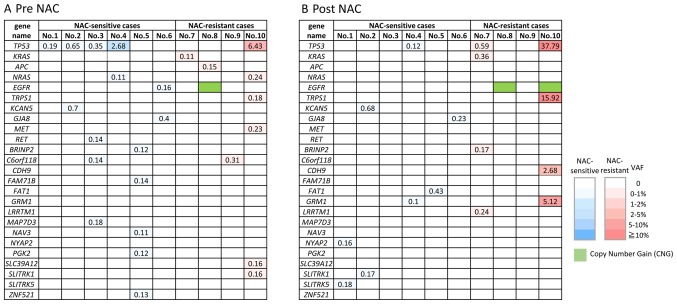
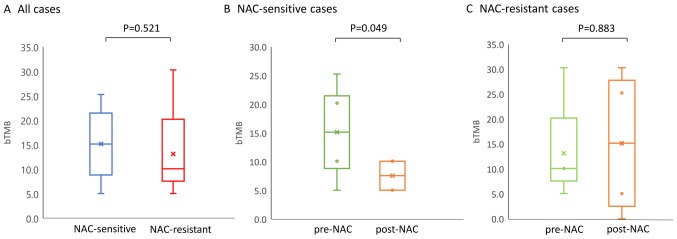
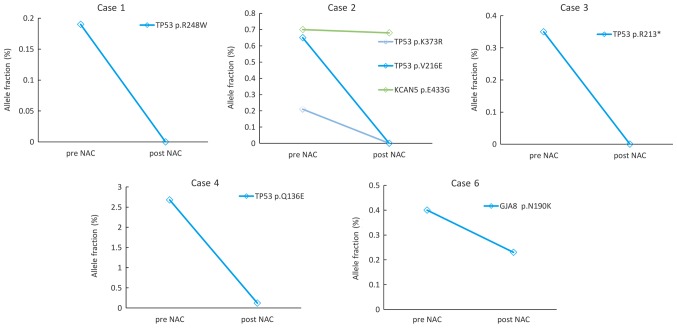
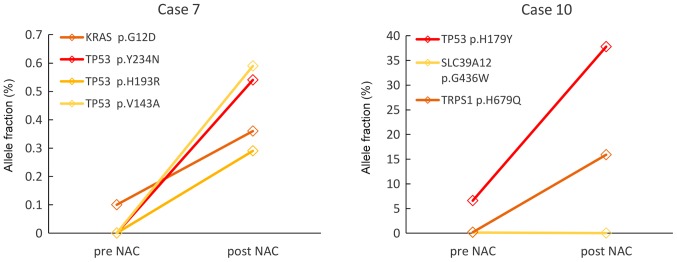
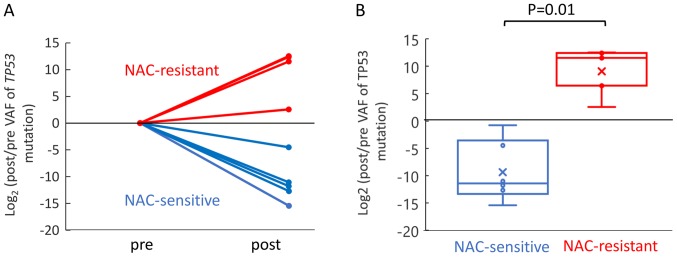
Cancer Personalized Profiling by deep Sequencing (CAPP-Seq) is a novel ultrasensitive next-generation sequencing-based approach that is used to detect circulating tumor DNA (ctDNA). The aim of the present study was to compare the gene mutation profiles and blood tumor mutation burden (bTMB) measured between pre- and post-neoadjuvant chemotherapy (NAC), utilizing CAPP-seq for plasma ctDNA in patients with advanced ovarian cancer. The current study included 10 patients (6 NAC-sensitive and 4 NAC-resistant) clinically diagnosed as having stage III or IV ovarian cancer and were administered NAC between May 2017 and February 2019. The plasma ctDNA samples were collected at pre- and post-NAC, and comprehensive gene mutation analysis was performed using CAPP-seq. In 5 out of 6 NAC-sensitive cases, the variant allele frequency (VAF) of non-synonymous somatic mutations decreased following NAC. In 2 out of the 4 NAC-resistant cases, the VAF of non-synonymous somatic mutations increased, and new somatic mutations emerged following NAC. In regard to mutation, the rate of mutation in the NAC-resistant cases was significantly higher compared with NAC-sensitive cases. Finally, the bTMB decreased significantly after NAC treatment in the NAC-sensitive cases, even though there were no significant differences in the pretreatment bTMB levels between the NAC-sensitive and NAC-resistant cases. These results indicated that gene mutation can be profiled and monitored using liquid biopsy-based CAPP-Seq in patients with advanced ovarian cancer with NAC treatment, and mutation in the ctDNA and bTMB may be novel biomarkers that can be used for patient monitoring during NAC treatment.
深度测序癌症个性化分析(CAPP-Seq)是一种基于新一代测序的新型超灵敏方法,用于检测循环肿瘤DNA(ctDNA)。本研究的目的是比较新辅助化疗(NAC)前后通过CAPP-Seq检测晚期卵巢癌患者血浆ctDNA所测得的基因突变谱和血液肿瘤突变负担(bTMB)。本研究纳入了10例临床诊断为III期或IV期卵巢癌的患者(6例对NAC敏感,4例对NAC耐药),这些患者在2017年5月至2019年2月期间接受了NAC治疗。在NAC前后采集血浆ctDNA样本,并使用CAPP-Seq进行全面的基因突变分析。在6例对NAC敏感的病例中,有5例非同义体细胞突变的变异等位基因频率(VAF)在NAC后下降。在4例对NAC耐药的病例中,有2例非同义体细胞突变的VAF增加,并且在NAC后出现了新的体细胞突变。关于 突变,与对NAC敏感的病例相比,对NAC耐药的病例中的 突变率显著更高。最后,在对NAC敏感的病例中,NAC治疗后bTMB显著下降,尽管对NAC敏感和对NAC耐药的病例在预处理时的bTMB水平没有显著差异。这些结果表明,在接受NAC治疗的晚期卵巢癌患者中,可以使用基于液体活检的CAPP-Seq对基因突变进行分析和监测,并且ctDNA中的 突变和bTMB可能是可用于NAC治疗期间患者监测的新型生物标志物。